
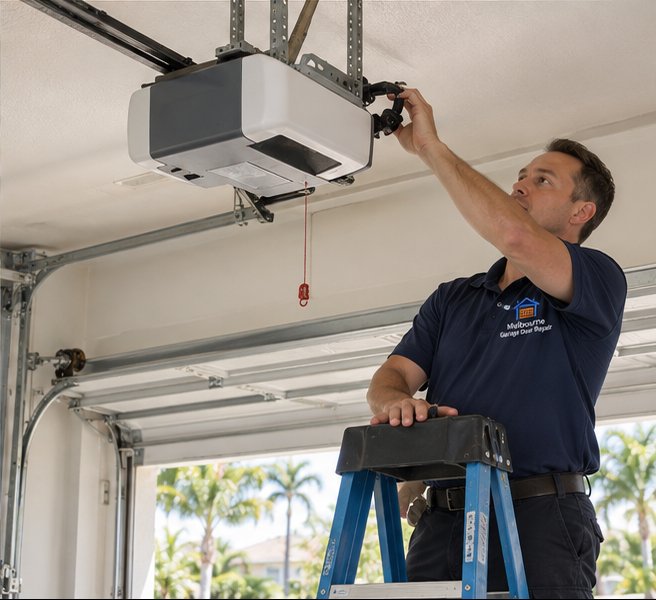
What the emergency release actually is
Every automatic garage door opener has a way to separate the door from the motor so you can lift the door by hand. On most residential openers that is a red rope with a handle, hanging from a small carriage that rides along the rail above the door. Pull it, and a latch inside the carriage lets go of the arm that connects the door to the drive.
It is called an emergency release because it exists for emergencies: a storm knocks out the power, the motor fails, or a safety problem leaves the door stuck while a vehicle is inside. It is not meant to be a daily control, and it is not a way to fix a door that is already misbehaving.
- The red cord and handle you pull
- The release latch inside the trolley carriage
- The arm and pin that link the door to the opener
- The spring-loaded parts that let the carriage re-engage later
Why we treat it as its own service
Homeowners often ask us about the release only after it has failed them, usually in a Florida summer storm when the lights are out and the car is stuck inside. At that moment the release is the most important part of the garage, yet it gets almost no attention during normal maintenance.
Our emergency release service looks at the cord, the handle, the latch and the way the door behaves once it is disconnected. We check that the cord can be reached by an adult, that it pulls cleanly, and that the opener reconnects the way it should afterward. We explain what we find in plain terms and tell you what the options are.
Signs the release needs attention
A release that works is easy to ignore, so these are the signs worth noticing before you actually need it. Some show up during a routine check and others only appear when the cord is pulled.
If any of these sound familiar, treat the release as something to have looked at, not something to test repeatedly until it gives way.
- The red handle is missing, cracked or has pulled loose from the cord
- The cord is frayed, stretched, knotted or tied up out of reach
- The cord is stiff and needs hard force to move
- You pull it and nothing separates
- The door will not reconnect to the opener afterward
- The cord hangs low enough to catch on a roof rack, bike handlebar or mirror
- The carriage looks bent, cracked or heavily rusted
A cord hanging too low
A long loose cord can snag on a ladder, a kayak rack or the top of an SUV as the door travels. If it hooks on something, the release can trip while the door is moving, and the door may drop or stop unexpectedly. If you see this, do not pull on it to release the snag. Stop, and have us look at the cord length and routing.
A cord that has been tied up
Some owners knot the cord up high to keep it away from children or cars. That can leave it out of reach when it is needed. We discuss safer ways to keep it accessible without leaving it dangling.
When the release sticks or will not let go
A sticking release is one of the more common calls we hear. Dust, old grease, corrosion and humidity can stiffen the latch inside the carriage, and Melbourne's salty, damp air is hard on bare metal over the years. The cord may feel tight, bounce back without doing anything, or require several pulls.
The urge is to yank harder. Please do not. A cord that is pulled with force can snap, and a handle that comes off in your hand leaves you with nothing to grip. If the door is closed with a vehicle inside and the release will not work, stop and contact us so a technician can look at the carriage in person.
- Do not hang your weight from the cord
- Do not use pliers or a tool to wrench the latch
- Do not pry at the arm or the carriage while the door is under tension
- Do call someone who works on these every day
Using the release safely during a power outage
Most of the time, the release is used the same way. The door should be fully closed, if possible, when you pull the cord. A door that is partly open can fall or lurch once it is disconnected, especially if a spring is worn or weak, because the opener was the only thing holding it in place.
Our guide to using the manual release during a power outage walks through the sequence in detail. In short: be sure no one is under the door, pull the handle toward the opener (not straight down), lift the door slowly with both hands on a solid part of the panel, and let it settle. Stop if it feels very heavy, grinds, or tries to move on its own.
A very heavy door is a warning
If a disconnected door feels as if it is trying to drop, or you cannot lift it, the springs may be worn or broken. That is not something to push through. Leave the door where it is and read about a door stuck after a power outage or talk to us.
Never reach into the hardware
The springs, cables and brackets on a garage door carry dangerous tension. The release gives you access to the door, not permission to touch those parts. Keep fingers and tools away from them.
Re-engaging the opener afterward
Once power returns or the problem is solved, the door has to be reconnected to the carriage so the motor can drive it again. On many openers this happens by pulling the cord toward the motor or by simply running the door until the carriage latches. Others need the carriage lined up with the arm first.
When it does not reconnect, the cause could be a worn latch, a bent arm, a carriage out of position, or a pin that does not seat. We look at each of these and demonstrate how your particular opener behaves, so you leave knowing the sequence and not guessing.
What we check on a visit
A technician starts by looking at the door in its normal state, before touching anything, and listening to how the opener runs. Then we test the release as you would in an emergency.
The checks below are the ones we typically go through. Every home is different, so we adjust to what the door and opener show us.
- Cord condition, length and height from the floor
- Handle attachment and whether it can be gripped with a wet or gloved hand
- Latch movement inside the carriage
- Arm and pin alignment
- How the door behaves once disconnected, including balance
- Whether the carriage reconnects smoothly
- Whether the opener stops where it should
- Any rust, cracks or wear around the trolley
Replacing the cord, handle or carriage
Sometimes the release can be put right with a new cord or handle. Other times the whole carriage has aged out and is better replaced as one unit, because a worn latch inside will keep causing trouble. We explain which situation you have and what the choices are.
If the opener is old, we may also talk about whether it still makes sense to keep repairing it. Opener repair and opener replacement are separate services, and we try to be honest about which one fits.
| What you notice | What it often means |
|---|---|
| Handle came off the cord | Worn or poorly knotted cord, or a cracked handle |
| Cord pulls but nothing separates | Latch stuck, corroded or the arm is under load |
| Door will not reconnect | Worn latch, bent arm or carriage out of position |
| Cord is too long | Original install left slack that can snag vehicles |
| Release trips by itself | Loose latch or a cord snagged during travel |
Why the springs matter to the release
A garage door is balanced by springs so that it feels light enough to lift by hand. When the springs are doing their job, a disconnected door stays put at about waist height and moves with modest effort. When they are worn or broken, the door can feel like a heavy load, and the opener has been working far harder than it should.
This is why the release should never be judged in isolation. A smooth release on a badly balanced door is still a hazard. If the door is hard to lift, we look at a garage door that is heavy to lift by hand and the spring system together, because one often explains the other.
Florida conditions that affect the release
Brevard County's humidity, heavy rain and salt air all reach the garage. Bare steel parts rust, grease collects dust and sand, and plastic can turn brittle in the sun. Homes closer to the Indian River and the Atlantic often see the effects sooner, but inland garages are not exempt.
Storm season adds another factor. Power outages are the exact situation the release is built for, so it makes sense to test the release when the weather is calm rather than in the dark with a storm outside. Our hurricane preparation guide covers what else to check before a named storm.
Testing the release on a calm day
Many owners have never pulled their cord. Learning the feel of it once, with the door closed and nothing inside to worry about, makes a real emergency much less stressful. Ask another adult to stay nearby.
Close the door, make sure the path is clear, pull the cord gently toward the opener, and lift the door a short way by hand. Then lower it, reconnect it, and run the opener. If any step is stiff, noisy or surprising, stop and have it checked.
What a good test feels like
The cord moves smoothly and returns. The door lifts with steady, moderate effort and stays where you leave it near waist height. The opener reconnects without forcing.
What a bad test feels like
The cord resists, the handle slips, or the door pulls up or falls when released. Any of those means stop and ask for a visit.
Homes with a vehicle or storage trapped inside
The release matters most when something valuable is shut in the garage. A family may have one car inside while the only exit is the overhead door, or a tenant may have stored boats, golf carts or tools there. If the garage has no side door, a failed release can become a real problem on its own.
We often recommend that people with a sealed garage treat the release as part of their storm plan. It also helps to ask whether a battery backup for the opener makes sense. Our page on battery backup for openers explains the idea.
Commercial and larger doors
Business doors may use a chain hoist, a crank or a different type of operator rather than the familiar red cord. The principle is the same: a way to move the door without power. Because these doors are bigger and heavier, they call for more care.
If you manage a shop or warehouse, we are happy to look at how your operators behave when power is lost. See our commercial garage door work for how we approach larger jobs.
Teaching the whole household
A release is only useful if more than one person knows about it. In many homes one adult handles the garage and everyone else assumes it just works. When that person is away and the power fails, nobody knows where to pull or how hard.
We like to show the household the same simple routine: where the cord is, which way it pulls, how the door should feel, and when to stop and call for help. Older children can learn to recognise the cord, though the actual pulling should be left to adults.
It also helps to agree on a few house rules. Nobody stands or walks under a moving door. Nobody hangs from the cord. Nobody uses the release as a shortcut because the remote battery went flat. A new remote battery takes a minute and keeps the release for the days it is truly needed.
After a storm or an outage
Once the power is back, give the opener a careful first run. Watch the door travel from the doorway side, not underneath it, and listen for grinding or hesitation. If the door stops, reverses or sounds strained, shut off use and have us look.
Flooding or driven rain can also reach the carriage and the wiring. Wet parts should be looked at before they are trusted again. If water has been standing in the garage, avoid touching the opener until a professional has checked it.
What to do before you call
Gather a few details, and you will help us help you. Note what the cord does, whether the door is open, closed or in between, whether a vehicle is inside, and when the problem started. A phone photo of the carriage and cord can be useful.
If anyone is hurt, call 911 first. Otherwise leave springs, cables and brackets alone. Our contact page shows how to reach us so we can arrange to look at the door.
Questions and answers
It is safer with the door fully closed. If the door is open or partway up when you pull the cord, nothing is holding it except the springs. A worn spring or poor balance can let it drop. If you must disconnect an open door, keep people clear of the opening and be ready for it to move.
The latch inside the carriage may be dirty, rusty or under load from the door arm. Humid coastal air makes this more common over time. Do not yank harder or use tools on it. Stop and have a technician look at the carriage.
Do not try to reach into the carriage with a tool. The cord may simply need a new handle or a new cord, but the latch could be affected too. Leave it and arrange a visit so we can look at the whole assembly.
It is not a good idea. A disconnected door can be pushed open by anyone, and it will not close with the opener. If you cannot reconnect it, close and secure it as well as you can and ask for a visit as soon as practical.
An outage on its own rarely does harm, but a surge when power returns can affect electronics. Using the release during an outage does not damage the opener when done as intended. If the opener acts strangely afterward, we can check it.
Not if that leaves it out of reach. The cord should hang where an adult can grip it, without dangling low enough to catch on vehicles. We can suggest a better length and routing during a visit.
Most residential trolley-style openers do. Some commercial operators use chain hoists or cranks, and a few older models differ. We can show you how your own system works when we look at it.
Stop lifting. A very heavy or door that drops suggests a spring problem. Keep clear, leave the door as it is and contact us. Do not touch the springs, cables or brackets.