
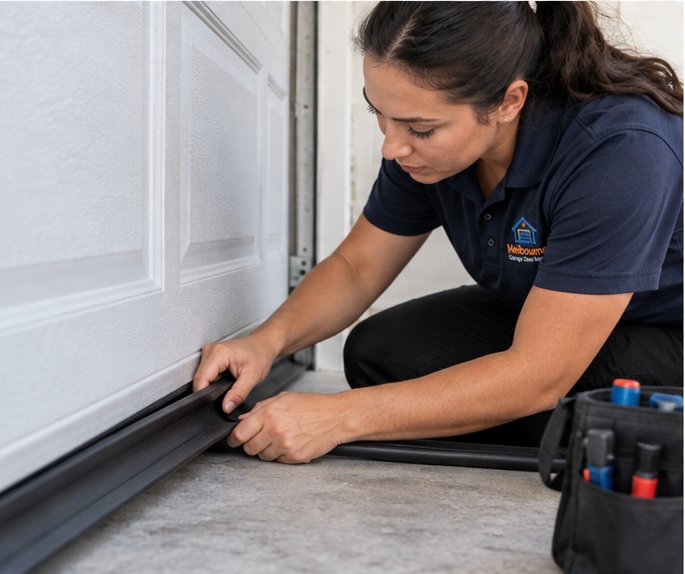
What weather seals do
A garage door never fits its opening perfectly, because it has to move. The panels need clearance at the sides and top, and the bottom edge has to clear an uneven floor. Weather seals fill those clearances. They are made of flexible rubber, vinyl or similar material, and they squeeze against the floor or the frame when the door is closed.
A good seal does several jobs at once. It keeps out wind driven rain, blocks leaves and dust, slows the passage of insects and small animals, reduces drafts and cuts down on the light and noise that pass through the gaps. In a humid climate, it also helps limit the amount of damp air that enters a closed garage.
Because they are soft, exposed to the weather and constantly pressed, seals wear out long before the door does. Replacing them is among the most useful small jobs on a garage door, and often a simple one for a trained technician.
The parts of the seal system
Several separate pieces work together around the door, and each one is replaced differently.
- The bottom seal, a flexible strip fitted along the lower edge of the bottom panel.
- The retainer or channel, a metal or plastic track that holds the bottom seal in place.
- The side stops, usually wood or vinyl strips fixed to the door jambs that the door closes against.
- The top stop or header seal, which closes the gap across the top of the door.
- A threshold seal or floor strip, which some garages have on the ground where the bottom seal meets the slab.
- Seals between the panels, which on some doors keep the joints tight.
Bottom seal shapes
Bottom seals come in several shapes. A bulb seal has a rounded tube at the base that flattens against the floor. A T shaped or double T seal slides into two channels in the retainer. A beaded seal has a small bead that fits into a single slot. The right type depends on the retainer on your door, so we check before replacing.
Signs your seals have worn out
Seals fail gradually, so people often live with the signs for years without connecting them to the door. Once you know what to look for, the problem is easy to spot.
- Daylight visible under or around the door when it is closed.
- A bottom seal that is cracked, flattened, torn, brittle or missing in places.
- Seals pulling away from the retainer or hanging loose.
- Water marks, damp patches or puddles on the floor just inside the door.
- Leaves, dust, sand or pine needles collecting along the door.
- Ants, roaches, spiders or other pests entering along the door line.
- A draft or a sudden change in temperature when the door is shut.
- Wood stops that are soft, split, rotted or discolored.
A simple daylight test
On a bright day, stand inside the dim garage with the door closed and look at the edges of the door. Any line of light shows a gap. Light under the bottom edge is not always a worn seal, because an uneven floor can create gaps too, but it is a good starting point for a conversation.
Why seals wear out in Florida
The Space Coast climate is hard on rubber and vinyl. Sunlight and heat dry out the material and make it brittle. Humidity and rain encourage mildew and breakdown. Salt in coastal air attacks the retainer and fasteners. Cleaning chemicals, car fluids and standing water at the floor line speed up the damage.
The bottom seal also takes mechanical wear. Every time the door closes, it presses against the floor, and over thousands of cycles the edge flattens, splits or tears. A door that closes onto a rough, cracked or gritty slab wears its seal faster.
This is why a seal that lasts for many years in a milder climate may need replacing sooner here. Looking at seals as part of regular checks, rather than waiting for water to appear, saves a lot of trouble. Our guide on garage doors in a coastal climate explains how the environment affects every part of the door.
Rain, flooding and water entry
Water finds its way in through any small gap. Heavy summer downpours, wind driven rain during storms and sprinklers hitting the door all test the seals. A bottom seal in good shape stops most splashing and light water, but it is not a flood barrier.
If water is coming under your door, the seal is only one possible cause. The driveway may slope toward the garage, a drain may be blocked, the slab may have settled or the threshold may be worn. We look at the seal, the floor and the ground outside to work out what is going on.
Our page on water leaking under a garage door describes the usual causes in detail. A new seal can make a real difference to splashing and damp, but it will not turn a garage door into a watertight barrier against standing water, and we say so plainly.
Pests, insects and small animals
Gaps around a garage door are an open invitation. Ants follow scent trails along the edges, roaches and spiders use the dark line at the bottom, and mice and rats can squeeze through surprisingly small openings. Lizards and frogs are common visitors in Florida garages, especially after rain.
A fresh seal that sits firmly against the floor removes many of those entry points. On the sides, tight stops that meet the door without a visible gap make a difference. A seal that has been chewed or torn by rodents should be replaced, and the entry point should be inspected, since the animal that made it will usually return to the same spot unless the cause is dealt with.
No seal can stop every pest, and we will not claim otherwise. A door seal works alongside good housekeeping, sealed food storage and attention to other gaps around the garage. We can point out the openings that we see during a visit.
Light gaps and energy
A gap at the bottom of the door lets in light and heat. In a garage that is attached to the house or used as living or working space, this can add to the heat load, especially on the sunny side of the building. Reducing the gaps helps the garage stay a little cooler and quieter.
Seals work alongside the door's construction. An insulated door with worn seals does not perform as well as it could, because air passes around the panels. On an uninsulated door, seals still reduce drafts and dust, but they will not turn the door into a heat barrier.
Our guide on garage door heat and your garage temperature explains what affects the temperature inside, and our page on insulation and window inserts looks at the door itself.
How a bottom seal is replaced
Bottom seal replacement is usually a straightforward job, though the details matter. The technician first checks the door's condition, the retainer and the floor. The old seal is slid out of its channel, which may involve working it loose from the ends. The channel is cleaned of dirt, debris and any remains of the old rubber.
A new seal of the correct profile and length is cut to match the width of the door and slid into the retainer. The ends are trimmed neatly, and any end caps or fasteners are fitted. The technician then closes the door and checks the contact along the whole width, looking for gaps, bunching or a seal that is too tight.
If the retainer is bent, rusted or cracked, we tell you, because a new seal in a damaged channel will not seat properly. In that case, the retainer is replaced as well. The door's weight is carried by the springs and cables, which we do not touch during a seal replacement.
Getting the right size and profile
Seals are not one size fits all. They differ in width, thickness and cross section. We identify the profile that fits your retainer, and we avoid cutting corners with a generic strip that will not hold. Taking a close look at the old seal and the channel is how we match the replacement.
Side stops and top seals
The vertical strips along the jambs and the horizontal strip across the top are often forgotten. They are usually fixed with nails or screws to the framing and are designed to be pressed against by the door as it closes. Over time they warp, split, rot or pull away.
In a damp climate, wood stops can swell, mildew and rot. Vinyl stops resist moisture better but can crack with age and sun. A replacement stop is cut to length, fitted snugly against the closed door and fastened securely, leaving the door enough room to move without rubbing.
Setting these stops correctly takes care. If they are too tight, the door scrapes and the finish is damaged. If they are too loose, they do not seal. We check by closing the door and looking from inside and outside as we adjust. Our page on bottom seal and threshold service covers the floor end of the same job.
Floors, thresholds and uneven slabs
A bottom seal can only do its job if the floor is reasonably flat. Many garage slabs slope toward the drain or the door, crack, settle or have uneven patches, and the gap under the door varies across its width. A soft bulb seal can compensate for small irregularities, but a large dip lets water and pests through.
In those cases, a threshold seal can help. This is a strip fixed to the floor that raises the point of contact and gives the bottom seal something firm to meet. It also helps stop water running in from the driveway. Not every garage suits one, because it can be a trip hazard or interfere with vehicles or wheeled equipment.
We look at the floor with you and talk through the options. Sometimes the right solution is a better seal, sometimes a threshold, and sometimes simply an adjustment to the door's travel limit. We recommend what suits the situation, not the largest job, and we will say so if the floor is the real source of the trouble and the door is not at fault.
Adjusting the door to the seal
The opener has a down limit that sets where the door stops when it closes. If the limit is set too high, the door does not press the seal firmly against the floor, leaving a gap. If it is set too low, the door pushes too hard and may reverse, because the opener senses an obstruction.
Fitting a new seal can slightly change how the door sits, so the limit should be checked afterwards and the safety reversal tested. A door that reverses unexpectedly after the work is not a seal problem; it is a setting we can adjust.
Please do not adjust the springs, cables or lower brackets of the door yourself. These hold dangerous tension. If you notice the door is uneven, heavy or sticking, tell us instead of trying to fix it. Our page on balance and adjustment explains related work.
Humidity, sticking doors and swollen stops
In wet weather, wood parts can absorb water and swell. Stops that were fitted with a small clearance can start to press harder against the door, and a door that closes smoothly in the dry season may stick or rub in the summer. Panels and trim can swell too.
If your door sticks in humid weather, worn or swollen seals and stops may be part of the cause, though not the only one. Tracks, rollers and hinges also respond to moisture and corrosion. We look at the whole picture before deciding what to do.
Our page on a garage door that sticks in humidity describes what to look for. Keeping the weather stops painted or sealed, and replacing them when rot sets in, helps them last in the Florida climate.
Caring for new seals
Seals last longer with a little attention, and the care involved is gentle, inexpensive in effort and well within what any owner can do. Wipe them occasionally with a damp cloth and mild soap to remove dirt, grit and mildew. Keep chemicals, oil and strong cleaners away from them, since many break down rubber. Make sure that nothing is stored against the bottom of the door and that the floor under it is clear of debris.
Look at the seals when you do other checks. A crack, a flat spot or an area that has pulled away from the retainer is easier to deal with early. Our monthly garage door checklist includes a simple look at the seals and the line of the door.
On a periodic maintenance visit, we include a look at the seals as part of the overall check. Our page on maintenance and tune-ups explains what is covered.
Arranging a seal check
If you can see light around your door, if rain is splashing in, or if insects keep coming through, get in touch and tell us what you are noticing. We serve Melbourne and the wider Space Coast and will come to your property to look at the seals, the door and the floor.
We will explain what we find and what the options are, whether that is a simple seal replacement, new side stops or a conversation about the floor. You decide how to proceed.
Questions and answers
There is no fixed interval. Seals wear with sun, humidity, salt air and use, so replacement depends on condition. Cracks, flat spots, tears, brittleness, light showing at the edges or water coming in are all signs it is time. A short look every few months helps you catch problems early.
Sliding a seal into a channel can look easy, but identifying the right profile and keeping the door safe matters. The door is balanced by springs and cables under dangerous tension, which you should never touch. If you are unsure, have a technician handle it.
A new seal reduces splashing, light water and damp, but it is not a flood barrier. If water pools at the door, the driveway slope, drainage or the floor may be involved. We look at the seal and surroundings and explain what is realistic.
A seal that sits firmly against the floor removes many entry points and helps. It cannot stop every pest, especially small insects or animals that chew through rubber. Good housekeeping and sealing other gaps in the garage work alongside the seal.
The seal may be worn, the wrong profile, or the floor may be uneven. The down limit on the opener can also leave the door slightly above the floor. We check the seal, the retainer, the slab and the opener setting to find the true cause.
Often they do, especially wood stops that have swollen, rotted or split in damp weather. Gaps along the sides and top let in rain, dust and pests. We check each part and replace only what has failed.
A threshold seal is a strip fixed to the garage floor that gives the bottom seal a firm place to meet, which helps where the slab is uneven or water runs in. It is not suited to every garage, and we explain the pros and cons for yours.