
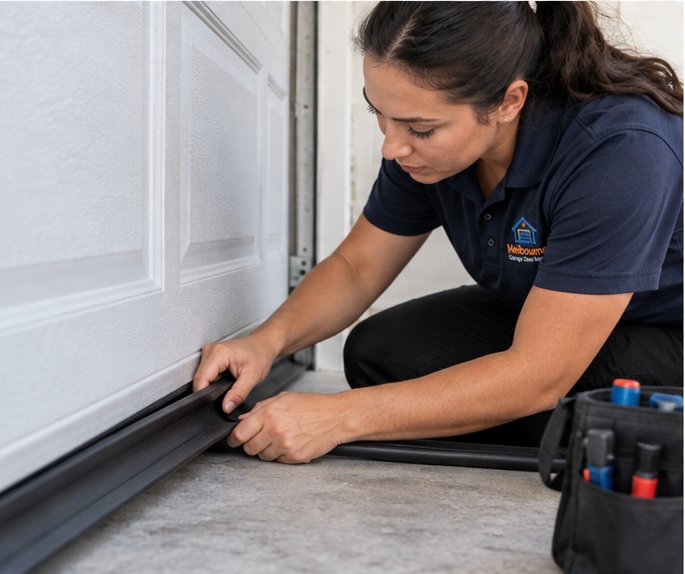
Why water gets under a garage door
A garage door closes against a slab, not against a sealed sill like a front door. The only thing between the outside and your stored belongings is a flexible strip along the bottom edge and whatever the floor does beneath it. That arrangement works well in light rain and badly in a heavy storm.
Water follows the easiest path. If the driveway slopes toward the door, it arrives in volume. If the seal is worn, it finds the gap. If the slab has a low spot at the threshold, it collects there and rises until it spills over. Often two or three of these happen together.
The aim of this page is to help you tell which one you have, so that the repair actually matches the problem. Read through the causes below and note which ones sound familiar.
Reading the evidence inside the garage
The stain pattern tells a story. Look at where the water went after the last heavy rain. A wet stripe along the full width of the door suggests a worn seal or a broad gap. A single wet patch near one corner suggests a local low spot, a torn seal end or a crack in the slab.
A wet floor several feet inside the garage, with a dry strip right at the door, points away from the door altogether. Water may be entering through a wall, a window, a vent or a crack, and travelling across the floor.
Mark the edge of any water line with a pencil or tape after it dries, and take a photograph. The next storm will show whether the pattern repeats, and the photos help a technician understand what happened.
| What you see | Likely contributor | First step |
|---|---|---|
| Wet stripe across the full width at the door | Worn or flattened bottom seal | Look at the seal for cracks and gaps |
| Wet patch at one corner | Torn seal end, local dip or slab crack | Check the end of the seal and the floor edge |
| Puddle begins outside and flows in | Driveway slopes toward the door | Note where water gathers outside |
| Water only on the sides of the door | Worn side weatherstripping or gaps at the jamb | Look at the vertical seals |
| Wet floor with a dry strip at the door | Water entering elsewhere | Check walls, vents and windows |
| Water appears long after rain stops | Drainage from higher ground or saturated soil | Look at gutters and grading |
The bottom seal: what it does well
A healthy seal is soft, springy and unbroken. It presses lightly on the slab, fills small gaps and stops wind-driven spray and light surface water. In many garages that is enough to keep the floor dry through ordinary summer showers.
Seals age in the sun and heat. A strip that has hardened, cracked or shrunk away from the ends will not compress against the floor. A seal that has been pulled out of its retainer, even in one spot, will let a steady trickle through.
Our page on bottom seal and threshold service explains how we replace the strip, match the profile to your retainer, and check how it meets the floor.
- Soft, even compression along the whole width
- No cracks, splits or flattened sections
- Ends that reach the corners of the door
- A snug fit in the retainer with no loose sections
- Contact with the slab right across the width
What a seal cannot fix
It is worth being direct about this. A seal is a flexible edge, not a dam. It does not hold back standing water, and it does not make up for a slab that is significantly lower than the door at one end.
If rainwater gathers in front of the door to a depth of an inch or more, even a perfect seal can be overwhelmed. Water pressure builds against the door, finds the smallest opening, and flows through. A new seal will help, but the pooling needs its own solution.
When we look at a water complaint, we tell you honestly whether a seal alone is likely to be enough or whether the slope, drainage or threshold also needs attention. Some of those steps fall outside a door technician's trade, and we say so when that applies.
Where a seal helps most
Seals work well against blowing rain, light runoff and splash. They also reduce the leaves, dust and insects that ride in with the water.
Where a seal reaches its limit
Deep pooling, a driveway that drains straight at the door, and a sunken threshold all exceed what a flexible strip can handle. In those cases the seal is one part of a larger answer.
Slope and drainage outside the door
Look at the driveway the next time it rains. Does water run toward the garage, along it or away from it? Many driveways in subdivisions are graded to shed water to the street, but settling over the years can change that. Landscaping, added pavers and even a thick layer of mulch can redirect water toward the door.
Gutters and downspouts matter too. A downspout that empties onto the driveway above the garage can send a surprising amount of water straight at the threshold. Clogged gutters overflow in the same place. It also helps to remember that the ground itself changes. Sandy soil near the coast drains well when it is dry, but after days of rain it becomes saturated and stops absorbing anything. Water that would have soaked in during an ordinary shower then runs across the surface toward the lowest point, which is often the garage apron. A driveway that has never given trouble can start to leak into the garage in a wet summer for exactly this reason.
Our guide on garage doors in a coastal climate covers how rain, salt air and soil interact around a coastal garage.
- Check which way the first few feet of driveway slope
- Look for pooling marks or a ring of dried silt in front of the door
- Follow the downspouts and see where they discharge
- Clear leaves and debris from the gutters before the rainy season
- Look at nearby landscape beds for soil or mulch piled against the slab
Thresholds and floor edges
A threshold is a raised strip fastened to the floor at the door line. It gives the bottom seal something to press against and lifts the water barrier a little above the surface. Some garages have one built into the slab, some have an add-on strip, and many have nothing at all.
An add-on threshold can help where water is shallow and the slab is reasonably flat. It must be sized so the door still closes properly and so vehicles and wheeled items can cross it. A badly chosen strip can snag the seal, interfere with the sensors or cause the door to reverse.
Where the slab edge is cracked, chipped or dips, filling or resurfacing the edge is usually a job for a concrete professional. We can tell you what we see and how it affects the door, and we do not claim a threshold alone solves a drainage problem.
Concerns with raised thresholds
A threshold too tall can trip people and catch the wheels of bikes or carts. It can also stop the door from closing evenly. A technician checks height, seal contact and travel before settling on one.
Side and top weatherstripping
Water does not always come in at the bottom. Vertical weatherstripping runs down both sides of the opening, pressing against the door edge, and a top strip seals the header. If these are brittle, torn or missing, wind-driven rain can enter at the sides and run down to the floor.
You will often see this as dark streaks down the jamb or a damp line on the floor near each corner. Replacing the strips is a modest job, but it must be done with care because the strips sit close to the track and rollers.
Our page on garage door weather seal replacement describes the strips we replace and how we check them against the door.
Storm season and wind-driven rain
Tropical systems bring rain that does not simply fall. It moves sideways and builds up against the face of the door. A door facing the prevailing wind takes the brunt, and water can be pushed through gaps that stay dry on an ordinary day.
During storm season, a few precautions are worth taking. Move boxes, tools and anything electrical off the floor. Check that the seal is in place and that the gutters are clear. If a named storm is forecast, our garage door hurricane preparation guide lists what to do with the door itself.
Remember that water inside a garage is not only a nuisance. It can reach the opener power cord, the outlet and any stored batteries, so keep electrical items raised and do not stand in water while handling them.
Safety around water and the door
Standing water and electricity do not mix. If water has reached the opener, an outlet or any wiring, stay out of the puddle and switch the power off at the breaker only if you can do so safely from a dry spot. If you are unsure, leave it and call an electrician.
Wet floors are slippery, and wet hands slip on the manual release cord. Do not pull at the release or try to force a door that has swollen or jammed in the rain. A door that stops partway should be left alone.
If anyone is hurt, call 911. For the door itself, never touch springs, cables or the brackets at the bottom corners, even if water or rust makes them look damaged.
Opener and outlet protection
Openers are plugged into a ceiling outlet, which is usually safe from floor water. Remote receivers, battery backups and extension cords placed low are the risk. Keep them off the floor.
What you can safely check yourself
These checks involve only looking, noting and light cleaning. Do all of them with the door closed.
- Look at the length of the bottom seal for cracks, hard patches and loose sections
- Press the seal lightly with a finger to see whether it springs back
- Check the side strips for gaps or torn ends
- Sweep leaves and silt from the threshold so you can see the floor edge
- Pour a small bucket of water in front of the door on a dry day and watch where it runs
- Photograph the floor and any stain lines before they dry out
Stop points
If the door looks crooked, a cable looks loose, or something scrapes as the door travels, stop using it. Water damage and rust can weaken hardware that holds tension, and that is a job for a technician.
How we approach a water complaint
We start by looking at where the water sits and how the door meets the floor. We check the bottom seal and retainer, the side strips and the header, then compare the door with the slab and the driveway outside.
We also check how the door closes. A door that stops above the floor, or that is out of level, lets water through no matter how good the seal is. Opener travel and balance are part of the visit.
Afterward we explain what we found in plain words and what the options are. For the general flow of a visit, see what happens during a service visit. If your main complaint is a visible gap rather than water, our page on a gap under the garage door covers that angle.
Repair options in plain terms
Which fix makes sense depends on the cause. A worn seal is replaced with a matching profile. Side strips are replaced if they are torn or brittle. A door that stops short is corrected at the opener or the lifting system. A bowed bottom section may be straightened or replaced.
Where the floor is the problem, a threshold strip or a slab repair may be needed. We explain which parts of the job are ours and which are better handled by a concrete or drainage professional.
If the door is old and several parts are worn, it may make sense to look at replacement instead of repeated repairs. Our comparison of repairing versus replacing a garage door sets out the points worth weighing.
- Bottom seal replacement
- Side and top weatherstripping replacement
- Bottom section repair or replacement
- Opener travel and balance correction
- Threshold strip where suitable
- Advice on drainage and slab work that falls outside door repair
Why towels and sealant tubes are not enough
After a wet night, it is natural to jam a towel at the door or squeeze a bead of caulk along the floor. A towel only soaks up water and becomes a damp mat that breeds mildew. A bead of sealant under a moving door can bond to the seal, tear it, or stop the door closing.
Anything that adds bulk under the door can also confuse the safety system. The door may meet the obstruction, reverse, and stay open, leaving the garage exposed during the storm you were trying to prepare for.
It is better to find the cause and fit something designed for the job. If you want to compare what is reasonable for an owner to try and what is not, see do-it-yourself versus professional garage door work.
Planning for a visit
When you get in touch, tell us where the water comes in, how heavy the rain was, and whether it happens every storm or only in the worst ones. Mention anything that changed recently, such as new landscaping, driveway work or a new seal. Photos of the stained area and the bottom edge of the door are very helpful. Keep notes through a full rainy season if you can. Write down the date, how long and hard it rained, which direction the wind blew from, and exactly where the water appeared. After a few entries a pattern usually emerges, such as water arriving only when the wind comes from the east, or only after more than an hour of steady rain. That pattern points toward a seal gap, a drainage path or a side leak, and it saves a good deal of guesswork.
Please clear the area at the door so we can see the seal, the threshold and the slab. Keep children and pets away from the opening while work is under way.
We will explain what we find and what the options are. Our contact page shows how to reach us.
Questions and answers
A worn bottom seal, a driveway that slopes toward the door, or a low spot at the threshold are the usual causes, and sometimes they combine. Heavy wind-driven rain can also push water through a gap that stays dry in light showers. A technician can look at the door and floor together.
It often reduces it, especially when the old seal is cracked or flattened. It cannot hold back deep standing water or overcome a large dip in the slab. We tell you whether a seal alone is likely to be enough or whether drainage or the threshold also needs work.
Neither is a good idea. Towels soak up water and breed mildew, and caulk can bond to the seal or stop the door closing properly. Bulky material under the door may also trigger the safety reversal. A purpose-made seal matched to your door works better.
It can help when water is shallow and the slab is reasonably flat. It has to be sized so the door still closes and vehicles can cross it. A threshold alone will not solve a drainage problem, so we look at the whole picture before suggesting one.
It can be. Water and electricity are a poor mix. Stay out of standing water, keep cords and receivers off the floor, and switch off power only if you can reach the breaker from a dry spot. If you are unsure, call an electrician and leave the garage alone.
Yes. If the floor is wet well inside the garage with a dry strip at the door, check walls, windows, vents and cracks in the slab. A door technician can tell you what the door is contributing, but other sources may need a different trade.