
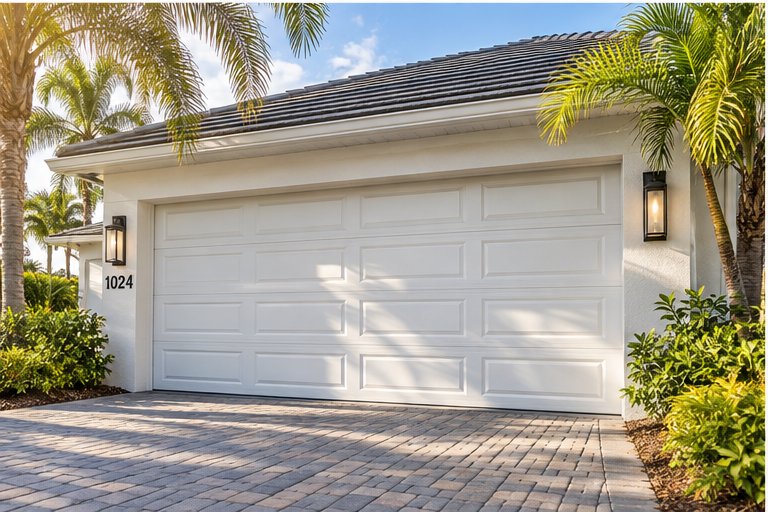
A community built around one-level living
Barefoot Bay sits in the southern part of Brevard County, a short drive from the Indian River County line, and it is known as a large community of manufactured homes. Many of the people who live here are retirees, and many of the homes were set up for easy, single-level living. That shapes the way a garage is used more than any other single fact.
In a family neighborhood the garage door may open six or eight times a day as people leave for school and work. In a retirement community the pattern is different. The door may open two or three times a day, sometimes fewer, and then sit closed for long stretches. Long periods of rest are not harmless for a garage door. Lubricant dries, a spring that is seldom stretched can stiffen in its habits, and a sensor lens collects a film of dust without anyone noticing.
We keep that pattern in mind when we visit. A door that is used lightly can still be worn in the places that matter, and the first sign of trouble is often something small, such as a remote that needs two presses or a door that hesitates at the start of its travel.
Garages, carports and the doors that go with them
Not every home in Barefoot Bay has a garage with a door. Many have a carport, a covered slab open at the sides, and some have a garage built onto the home or a separate storage building. A carport usually has no door at all, although some owners have added roll-down panels or screening to one end of it.
When a home does have an enclosed garage, the opening is often a single-car width, and the door is often chosen to be light. That is a sensible match for the structure it hangs on, because a garage attached to a manufactured home is not framed the way a site-built garage is, and a very heavy door puts more load on the frame and the track brackets.
If you are not sure what you have, describe it to us in plain words: how wide the opening is, whether the door rolls up in sections or swings or tilts, whether there is an opener, and what happens when you push the wall button. We would rather start with your description than with an assumption.
Lighter doors and what that changes
A lighter door is easier on the opener, easier on the springs and easier to lift by hand when the power is out. It is also more likely to dent, bow or loosen at the hinges, because there is less material holding the panel flat. Understanding which of these applies to your door is the first step in a sensible repair.
Here is how the common types behave in this community.
Thin steel sectional doors
A single-layer steel panel has rolled ribs to hold it stiff, and it does that job well until a dent crosses a rib. Once a rib is creased, the panel can flex at that line every time the door moves, and the crease slowly grows. A small impact from a bicycle or a delivery cart is often how it starts.
Aluminum and lightweight panels
Aluminum does not rust the way steel can, which is a real advantage in a humid state. It is also softer. Hinge screws can wallow out the holes they sit in, and a panel can develop a slight wave across its width. Fixes here involve fresh, correctly sized fasteners and sometimes a reinforcing strut across the top of a panel.
Older one-piece and tilt-up doors
A few garages still have a single-piece door that swings up and out on pivot arms. These work on a different principle from a sectional door, and the springs sit at the sides rather than above the opening. If you have one, tell us when you contact us, because it changes how we approach the visit.
How retirement households tend to use the door
People in Barefoot Bay often run a calm routine: errands in the morning, an afternoon at the clubhouse or on the water, home again in the evening. The door gets used in a few predictable windows, and the opener is often left to run on a remote from the car. That pattern makes a few problems more common than others.
These are the things we are asked about most often by owners in situations like this.
- A remote that works from the driveway but not from the street, which usually points to a weak battery or a drifting antenna wire on the opener.
- A door that closes partway and then reverses, which often comes down to dust on a sensor lens or a bracket that has been nudged.
- A wall button that feels loose or only works on the second press.
- A door that is hard to move by hand when the opener is released.
- A light bulb that burns out far more often than it should.
Strength, reach and the weight of a door
A well balanced door should feel almost weightless when you lift it by hand with the opener released. That is the whole point of the springs. If a door feels heavy, it is telling you the springs are no longer carrying their share, and that is a safety signal rather than a nuisance.
For owners who are not as strong as they used to be, this matters a great deal. Please do not lift a door that feels heavy, and do not try to adjust springs or cables to make it lighter. Those parts hold a large amount of stored force and they are the wrong place for a do-it-yourself fix. Our page on garage door weights and balance explains why balance matters and how to tell if yours has drifted.
If a door is hard to lift or falls when you let go, stop using it and contact us. We will check the springs and cables, test the balance and explain what the options are. A properly balanced door also reduces wear on the opener, because the motor is no longer fighting against dead weight.
Remotes, keypads and ease of use
A small remote with tiny buttons is not much help to someone with stiff fingers or reading glasses left in the house. Many people in this community like a larger, simpler remote, or a keypad by the door that works with a code, so the garage can be opened without carrying anything.
A keypad has another advantage: it does not depend on a car battery or a visor clip. If the remote is lost or the car is in the shop, the keypad still works. If you ever need to change the code, for example after a contractor or a helper has used it, the process is short.
We cover the programming steps in our guide to programming garage remotes and keypads, and we can set up new devices during a visit. Whatever device you choose, a door that responds on the first press is a small daily comfort that adds up over a year.
Rules, approvals and the community's own standards
Barefoot Bay has its own governing structure, and homes here are subject to community standards that cover how the exterior of a home and its attachments may look. Those standards can touch a garage door, a carport cover or a new storage structure. We cannot tell you what they require, because the rules are specific to the community and can change over time.
If you are planning anything beyond a repair, such as a new door in a different color or a new opening, the safest sequence is simple. Ask the community office or review the written standards first. Get approval in writing if it is required. Then talk to us about the work. A like-for-like repair that keeps the same door and the same look rarely raises questions, but it is still worth confirming.
Building codes are a separate matter from community rules. Where a permit or a rated product is required, the local building department decides, and we are happy to describe what we plan to do so that you can ask the right questions. Our page on wind and building rules basics explains the general ideas without pretending to replace the local office.
Hurricane season in a manufactured-home community
Anyone living on the Florida coast knows the shape of the calendar: the season begins in early summer and the busiest weeks come late. In a manufactured-home community, wind is taken seriously, and owners often tie down sheds, secure awnings and bring in loose items long before a storm arrives.
A garage door is a large flat surface facing the weather, and a failing door can be a weak point in a building. A door that is bent, worn at the hinges or poorly secured at the track can flex under wind in ways a sound door will not. We cannot promise how any door will perform in a given storm, but we can tell you whether yours is in good shape.
Before the season, it is sensible to check that every roller sits in its track, that the weather seals are intact and that the opener's manual release works. After a storm, look for dents, loose hardware and water at the base of the door. Our page on hurricane season garage door service describes what we look at, and the guide to garage door hurricane preparation is a good checklist to keep on the refrigerator.
When the power goes out
Power outages are common after summer storms, and a stuck garage door can trap a car inside or block the way out. Most openers have a red release cord that disconnects the door from the motor. With the door disconnected you can lift it by hand, but only if the door is balanced and sitting properly in its track.
If the door feels light and moves easily, you can open it carefully, keep it open and wait for power. If it feels heavy, or it drops when you let go, leave it where it is. A heavy door means a spring or cable is not doing its job, and forcing it is how fingers and toes get hurt.
A battery backup unit keeps the opener working through an outage, which is a real comfort for owners who do not want to handle a heavy door at all. Read about it on our page for battery backup for garage door openers.
Humid air, sun and the long rests between uses
Barefoot Bay is close enough to the Indian River Lagoon and the ocean that the air carries moisture most of the year, and the summer sun is strong. A garage door facing west can heat up through the afternoon, and plastic parts become brittle. A door facing a shaded side stays damp longer and shows rust sooner.
Because doors here may sit idle for several days, a film of dust and moisture can build on the track and rollers. Rollers can then flat-spot, which is the small thump you hear each time a worn roller turns on a stuck spot. A rough, noisy door is rarely a sign of imminent failure, but it is a sign that a lubrication and inspection visit is overdue.
A light cleaning of the track and a drop of the right lubricant on the moving parts goes a long way. We explain what to use and what to avoid in our guide to garage door lubrication. Do not lubricate the springs yourself, and do not use grease on the track surface where the rollers run.
Workshops, sheds and the other doors on a lot
Many Barefoot Bay lots carry more than a house. There may be a small storage shed, a workshop, a screened room or a covered spot for a golf cart. Some of these structures have their own roll-up or sectional doors, and the same wear patterns apply.
The small doors on sheds often have little in the way of spring balance, and the owner lifts them by hand. That works until the hinge pins loosen or the panel sags. When a shed door is repaired, the fastenings must suit the thin wall that carries them, because a long screw in thin framing does not hold.
If you have a door that is not on your main garage, mention it when you reach out. We can look at it during the same visit, and we will tell you plainly if it is better replaced than repaired.
Winter residents and homes left closed for months
Some Barefoot Bay owners spend part of the year elsewhere and leave the home closed for months at a time. A garage door can be a source of trouble when it is left alone, mostly because small faults grow quietly. A sensor that was slightly misaligned in spring may refuse to close the door in fall.
If you leave for a long stretch, a short checklist helps. Disconnect nothing, but test the door before you go, wipe the sensor lenses, replace the remote battery and make sure the door is fully closed and locked. Our garage door vacation checklist covers the steps in order.
When you come back, operate the door once while you watch it, listening for scraping or popping. If anything sounds new, let us know before the problem has a chance to grow. A trusted neighbor with a spare remote can also check the door while you are away, which is a good habit in any case.
Signs on your door and what they usually mean
These are the signs owners describe to us, with the usual explanations. They are only starting points, since a technician needs to see the door itself before saying what is actually wrong.
| What you notice | A common cause | What to do |
|---|---|---|
| Door reverses just before it closes | Dirty or misaligned safety sensor | Wipe the lenses and check the indicator lights; contact us if it continues |
| Loud bang, then a door that will not lift | Broken torsion spring | Stop using the door and keep clear; contact us |
| Door heavy to lift with opener released | Springs not carrying the weight | Do not lift it; contact us |
| Remote works only up close | Weak battery or antenna issue | Replace the battery and try again |
| Scraping at one side of the door | Track out of line or worn rollers | Stop using the door and let us look at it |
| Panel creased or bowing | Impact or thin panel flexing | Photograph it and contact us |
What a visit to a Barefoot Bay home looks like
We begin by listening. You tell us what the door has been doing, when it started and what changed beforehand. Then we look at the door, the opener, the track and the hardware without touching anything that carries tension, and we test the sensors and the reversing function.
Next we explain what we find, in plain language and at the door where you can see it. If the cause is something simple, we say so. If a part is worn out, we show you the part and describe the options. You decide what to do, and we do not push work the door does not need.
Our page on what happens during a garage door service visit describes the steps in more detail, and the guide to questions to ask a garage door technician helps you feel ready for the conversation.
Getting in touch from Barefoot Bay
If your door is noisy, heavy, crooked, slow to respond or stuck, tell us what you notice. The more you can say about sounds, lights and timing, the better prepared we are when we arrive. Photographs of the door and the opener are welcome.
Please do not try to adjust springs, cables or the brackets that hold them. If someone is hurt, call 911 first. If the door is simply misbehaving, you can contact us and we will talk through what to do next, step by step and without pressure.
Questions and answers
Yes. We look at the door that is actually on the property, whether it is a thin steel sectional door, an aluminum door or an older one-piece door. Lightweight doors have their own wear patterns, such as creased ribs and loose hinge screws. Tell us what you have when you contact us, and we will explain what the repair involves and whether replacement makes more sense.
The most common cause is a tired battery, since range drops before the remote stops entirely. Another is the antenna wire on the opener, which can hang crooked or be hidden behind a bracket. Replace the battery first and try again from the street. If the range stays short, we can check the opener and the remote and explain whether either one needs attention.
Only if the door is balanced and sitting properly in its track. Release the opener with the red cord and lift gently. A balanced door feels light and stays where you leave it. If it feels heavy or drops, stop at once, because a spring or cable is likely at fault. Do not try to adjust the springs yourself, and contact us so we can look.
It is worth considering if power outages are a concern or if lifting a door by hand is hard for you. A backup unit keeps the opener working for a limited time when the power is out. It does not replace good springs, so the door still has to be balanced. We can explain how it fits your opener and what it can and cannot do.
Usually yes. A keypad mounted by the door works with most openers and lets you enter a code instead of carrying a remote. It is helpful if a remote is lost or the car battery is dead. We set up the code with you and show you how to change it later. Tell us the opener brand if you can read it on the unit.
Look at the door before using it. Check that the track is clear, the sensor lenses are clean, and nothing leans against the door. Then operate it once while watching and listening for scraping or popping. If anything sounds new, or the door feels heavy, stop and contact us. Do not force a door that resists, and do not touch springs or cables.