
What a backup battery does
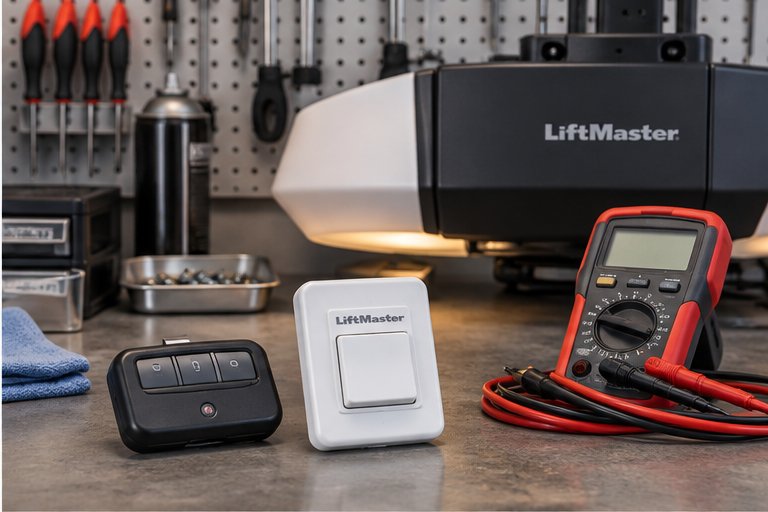
A garage door opener runs on household electricity. When the grid fails, the motor has nothing to run on and the door stops responding to the wall button and remotes. A backup battery stores a small amount of energy so the opener can keep moving the door for a limited number of cycles.
Some openers have the battery built in, usually under a cover on the head unit. Others accept a battery as an add-on module, and certain models are designed to use one while others are not. The system watches the incoming power. When it senses an outage, it switches to the battery without anyone doing anything.
It is worth being realistic about what this means. A backup battery is not a generator, and it is not meant to run the opener for days. It is meant to bridge a short outage, give you a way to get a vehicle in or out and keep the door secure if you need to close it.
Why it matters on the Space Coast
Brevard County and the surrounding communities see thunderstorms through the summer, and the Atlantic hurricane season runs from June through November. Power can drop for minutes or for much longer. A storm that takes down lines may leave a neighborhood dark while the roads are still passable.
In those situations a garage door that cannot open or close becomes a real problem. A closed door may trap a vehicle inside when you need to leave. An open door, if the power fails mid-cycle, leaves the garage exposed. A backup battery lets you deal with either situation using the normal controls.
Our guide to preparing your garage door for storm season explains what else to consider before a storm, and our storm season service page describes the check we offer ahead of it.
How the system works
Inside the opener there is a charger, a battery and a switching circuit. While the power is on, the charger tops off the battery slowly and keeps it ready. When the power fails, the opener draws from the battery for its motor, its logic board and its receiver.
To save energy during an outage, many backup systems limit what the opener does. The lights may stay off, wireless features may pause, and the door may move more slowly than usual. Those limits are a normal part of the design and not a sign of a fault.
When utility power returns, the opener goes back to normal operation and the charger starts to refill the battery. Its battery needs time to recover, so a second outage soon after the first may find it less ready.
What it will not do
Being clear about limits prevents disappointment. A backup battery is helpful, but it is not magic.
- It will not run the opener indefinitely. The battery supplies a limited number of cycles, and that number depends on the door, the battery and its condition.
- It will not fix a door that is out of balance or has a broken spring. A heavy door uses more energy and strains the opener.
- It will not keep your home network or smart features running if the router is down.
- It will not replace knowing how to use the manual release safely.
- It will not last forever. Batteries age, and an old battery may hold very little charge.
We cannot promise a number of cycles
The number of cycles you get varies with the weight of the door, the age of the battery, the temperature and the opener model. We do not quote a figure, because any number would be a guess. What we can do is test your system and tell you what we observe.
Built-in versus add-on batteries
Openers differ in how they handle backup power. Knowing which kind you have helps you plan.
Some modern openers have a battery compartment as part of the original design. The battery plugs into the logic board and is charged automatically. Other openers have no such compartment and may not accept a battery at all. In between are models that take a manufacturer-approved module sold as an accessory.
Compatibility depends on the make, model and age of the opener. We check the label and the unit, then tell you whether a battery is already installed, whether one can be added or whether the opener is a poor candidate. If a battery is not an option, our page on opener replacement and installation explains how a new unit could include one.
| Situation | What it usually means | What we do |
|---|---|---|
| Battery compartment already present | The opener was made for a backup battery | Check the battery, charger and operation |
| No compartment, but an accessory exists | A compatible module may be available | Confirm fit and install as directed |
| No option for this model | The opener cannot use a battery | Explain the alternatives |
| Battery installed but door will not move on it | Weak battery, heavy door or another fault | Test the battery and the door |
| Warning light or beep | Battery needs attention | Inspect and replace if needed |
How we test a backup battery
A battery that looks fine can still fail when it is needed. A real test tells you more than a visual check. During a visit we follow a careful sequence.
Check the door first
Before we test the battery, we make sure the door is balanced and moves freely. A door that is hard to move wastes battery power and gives a misleading result. If we find a problem with the springs or tracks, we explain it before going further.
Inspect the battery and connections
We look at the battery for swelling, leaks, corrosion or heat damage. We check the wiring and connectors, and we look for the charging indicator on openers that provide one.
Run the opener on battery power
With the door in view and the area clear, we disconnect the opener from mains power in the way the manufacturer allows and cycle the door on the battery. We watch how it moves, how the opener sounds and whether the battery holds up for a cycle or two.
Restore power and confirm charging
Once power is back, we confirm that the opener returns to normal operation and that the charger is working. If the battery is weak, we tell you what the options are.
When to replace the battery
Backup batteries are consumable parts. They lose capacity over time, and heat shortens their life. A garage in Florida can get very warm in summer, which is hard on any battery.
Many openers signal a problem with a chirp, a blinking light or a message on the wall control. A battery that no longer holds a charge often shows up as an opener that fails the moment the power drops, even though the battery was installed. Replacing it on a schedule, rather than waiting for a failure during a storm, is the safer approach.
We follow the guidance for each opener, because battery types and replacement intervals vary. If you do not know how old your battery is, we can check the date or identify the type and tell you what is sensible.
- The opener beeps or flashes on a regular pattern.
- The door does not move at all during an outage test.
- The battery case looks swollen, cracked or damaged.
- There is corrosion around the terminals.
- You cannot remember when the battery was last replaced.
Safe handling and disposal
Batteries store energy, and a damaged one can leak, get hot or fail. If you see swelling, a strong smell, fluid or heat coming from the opener, unplug the unit if you can do so safely and keep people and pets away. Do not touch a leaking battery with bare hands.
Used batteries should not go in household trash. Many contain materials that need proper recycling. When we replace a battery we take care of the old one so you do not have to deal with it.
If anyone is hurt or if there is smoke or fire, call 911.
The manual release is still your safety net
No battery should replace your knowledge of the manual release. The red cord hanging from the trolley lets you disconnect the door from the opener so it can be moved by hand. It is meant for emergencies, and it must be used with care.
A door that is out of balance or that has a broken spring can be very heavy and can drop suddenly once disconnected. Only use the release with the door fully closed, and never if you suspect a broken spring or a damaged cable. Our guide on using the manual release during a power outage explains the steps and stop points in detail.
If the cord is stuck or snapped, read our page about the emergency release cord that is stuck or snapped.
Before a storm: a short checklist
If a storm is on the way, a few calm steps help your garage door and opener. They fit alongside, and do not replace, the wider steps you take for your home.
- Make sure the opener is plugged in and the battery indicator, if there is one, looks normal.
- Know where the manual release is and who in the household understands how to use it.
- Park vehicles in a way that lets you leave if you need to.
- Look for loose hardware, damaged panels or worn seals on the door.
- Remember that a backup battery is for short outages, not for a long loss of power.
After the storm
When power returns, watch the first few cycles. If the door moves unevenly, makes new noises or stops partway, stop using it and contact us. Our page about a door stuck after a power outage explains what may be going on.
Solar, generators and other power sources
Some households run a generator or a home battery system during storms. If your garage opener is on a circuit that stays powered, the opener's own backup battery matters less. If it is on a circuit that does not, the built-in battery may be the only thing that keeps it going.
Connecting an opener to a generator needs thought. A generator that is plugged in the wrong way, or one that produces rough power, can damage electronics. Any wiring change should be handled by a qualified electrician, and we do not do electrical work on your home circuits. What we can do is look at the opener and tell you how it behaves when power comes and goes.
Heat, humidity and battery life in a Florida garage
A closed garage on a summer afternoon can be much hotter than the air outside. Heat is the main enemy of a small stored-energy battery, since it speeds up the chemical aging inside the case. A battery that would last for years in a mild climate may age sooner above a car in a Melbourne garage.
Humidity adds a second concern. Moist air can lead to corrosion on terminals and connectors, and a poor connection can make a healthy battery look weak. If your garage is damp, or if water ever reaches the ceiling area, mention it to the technician so the connections get a close look.
A few habits help the battery last. Keep the opener plugged in so the charger can do its work, avoid stacking stored items around the head unit and make sure the garage has some ventilation. None of these will stop aging, but they give the battery a better chance.
Choosing a battery or an opener that supports one
If your opener cannot take a battery, you have two broad paths: live with the manual release, or move to an opener that includes backup power. Neither is wrong, and the right answer depends on how much an outage would disrupt your household.
When we look at replacement openers with you, we talk about the garage use, the weight of the door and whether backup power is a priority. Our guide to choosing a garage door opener covers the other points worth weighing.
We stay with products and settings that suit your door. Where a battery is offered as an accessory, we confirm that it is meant for your opener before installing it, and we do not mix parts that were not designed to work together.
Questions worth asking before you buy
Ask whether the opener includes a battery or only supports one. Ask what the battery runs during an outage, such as the motor only or the lights as well. Ask how the battery is replaced and whether the part is easy to obtain later.
Common questions we hear about backup power
The same worries tend to come up each season, so here are the ones that matter most.
Should I rely on the battery to get out during a hurricane?
No. Follow official guidance and plan your departure early. A backup battery is a convenience for short outages and not a substitute for a plan. Always know how to operate the door by hand.
Does a battery make the opener safer?
It helps in one way, because you can close and secure the garage when the grid is down. It does not change the safety reverse or the photo eyes, which must be working in any case.
Does the battery charge when the door is not used?
Most systems keep the battery topped off while plugged into mains power, whether or not the door moves. If the opener is unplugged, the battery will slowly run down.
Questions and answers
No. Some openers are designed for one, with a compartment and a charger built in. Others accept a manufacturer module, and some cannot use a battery at all. The answer depends on the make, model and age of the opener. We check the label and the unit, then tell you what is possible for your garage.
It depends on the opener, the weight and balance of the door, the age of the battery and the temperature. We do not quote a number because it would be a guess. The battery is meant to bridge short outages. We can test yours and tell you what we observe in your own garage.
Many backup systems reduce speed or turn off lights and wireless features to save energy, so slower movement can be normal. If the door struggles, stops partway or makes new noises, the cause may be a weak battery or a door that is out of balance. We can check both.
Common signs include regular beeping or flashing from the opener, a door that does not move during an outage, a swollen or leaking case and corrosion at the terminals. Batteries also lose capacity with age and heat. If you cannot remember when yours was installed, it is worth having it checked.
The manual release is always your fallback, and everyone in the household should know how to use it carefully. It only works safely when the door is balanced and the springs and cables are sound. A battery adds convenience, but it does not replace the release.
Usually not. Smart features depend on your router and internet service, which are often down when the power is out. The battery may keep the opener's motor and receiver working so the wall button and remotes still function, but the app side typically needs home network power.
Some openers have an easy access cover and a plug-in battery, and the manual explains the steps. Only attempt it if the opener is unplugged, you can reach it from a stable surface and you are comfortable. Never touch the door springs, cables or brackets. We are happy to replace it for you.