
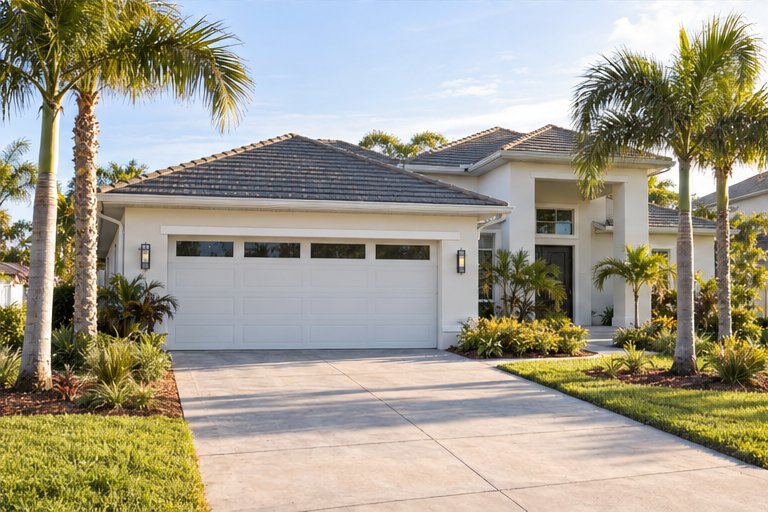
Why wind and garage doors are linked
In a strong windstorm the garage door is often the weakest part of the house envelope. It is wide, relatively thin, and made of sections that bend more easily than a masonry wall. Once wind pressure pushes a garage door inward or pulls it outward, the building loses its seal, and pressure inside the house can rise sharply. That is why building officials and engineers pay close attention to garage doors in storm-prone regions.
Florida's coast sees tropical weather, summer thunderstorms and the occasional strong gust in any season. The Space Coast, with its long shoreline and open exposure to the Atlantic, is no exception. Local building rules in this part of the state reflect that history, and they influence what kind of door can be installed and how it must be attached.
This page keeps to the general picture. We are technicians, not building officials, so we do not quote code sections, and we never claim that a particular door meets a particular standard. What we can do is explain the concepts so your questions to the local building office and your HOA are better informed.
How wind acts on a garage door
Wind pushes on the face of a door that faces into it, and it pulls on a door that faces away. In a storm both can happen one after another as the wind shifts. The door is therefore asked to resist forces in both directions, and the track, brackets and framing have to carry that load into the building structure.
A sectional door has horizontal joints between its panels, and those are natural places to flex. Without stiffening, a wide panel can bow inward under pressure. That is why wind-resistant doors often include additional reinforcement, such as horizontal struts or heavier gauge track, and why the attachment points matter as much as the panels.
Gusts also create pressure on the opener and the springs. A door that is already out of balance or has worn hardware is a poorer candidate for a storm. For a deeper look at preparation, see our guide to garage door hurricane preparation.
What wind-rated or impact-rated generally means
In this part of Florida you will hear doors described as wind-rated or impact-rated. Put simply, these are doors that have been designed and tested to resist wind pressure, and in some cases the impact of flying debris, as part of a defined system. The test applies to a complete assembly, including panels, track, fasteners and sometimes the way it is installed.
The key idea is that the rating belongs to the whole system, not just to a panel. Swapping a part, such as using different track or a different fastener, can change how the system performs. This is one reason we encourage owners to keep installed components together and to ask a technician before mixing parts.
We do not publish numbers here, because ratings differ between products and between local requirements. Ask the manufacturer or the seller to show you the documentation for the specific door you are considering, and compare it with what your local office requires.
Product approval and labeling
Many jurisdictions in Florida use a product approval process for exterior openings. The idea is that a product is reviewed, tested and listed, and the listing is referenced when a permit is issued. The door often carries a label or a marking on the panel or on the hardware that identifies it as an approved assembly.
That label matters in a practical way. A building inspector may look for it during an inspection, and an insurance company may ask about it after a claim. If the label is missing or painted over, a record of the purchase and the installation can help. Our page on reading your garage door label shows where labels tend to appear and how to photograph them.
Do not remove or paint over labels, and do not assume that an older door, installed before current requirements, carries the same marking. Ask the seller to confirm in writing which documents come with the door.
Permits and when they may be required
Replacing a garage door often requires a permit, especially when the door is part of the exterior envelope. Repairs of parts, such as rollers or sensors, usually do not, while replacing the entire door or changing the opening frequently does. The line differs from place to place, so the right move is to ask the building department that covers your address.
Cities and counties along the Space Coast may handle permits differently, and unincorporated areas follow county procedures. Do not assume that the rule in one city applies in the next, even when the streets seem to run together. A short call or visit to the correct office is the reliable way to find out.
Permits typically involve a form, a description of the work, and documentation for the product. Some offices want drawings or measurements. Our page on measuring for a new garage door helps you gather the figures that those forms often ask for.
- Ask whether a replacement door requires a permit at your address
- Ask whether the product needs to appear on an approved list
- Ask what documents must be on site for an inspection
- Ask whether an inspection is required after installation
- Ask how long the permit stays valid once issued
Who is responsible for permits
Responsibility for a permit depends on who performs the work. When a contractor installs the door, the contractor commonly arranges the permit and the paperwork, while the owner remains responsible for the property. When an owner installs a door personally, the owner is usually responsible for the entire process.
Whichever route you choose, ask who will pull the permit before the work begins, and get the answer in writing. We encourage owners to keep copies of everything. A permit file that gets lost can cause trouble when you sell the house or file an insurance claim.
We do not make promises about approvals or timing, because those depend on the office, not on us. What we can promise is that we will explain what we find and what the options are, including the practical steps to take when a door is replaced.
Inspections and what an inspector looks at
If an inspection is required after installation, the inspector generally checks that the door installed matches the one on the permit and that it is attached as described by its documentation. They may look at the track fasteners, the way the track is anchored to the framing, the label on the door and the state of the framing around the opening.
Inspectors also tend to notice general quality issues, such as loose hardware, missing fasteners or framing that has deteriorated. Keeping the area around the opening clear and accessible makes an inspection simpler. Have the permit card and the product documentation ready.
An inspection is not a performance test of your springs or opener. Those still need ordinary care, and our guide to garage door safety tests describes the checks that owners can do themselves between visits.
HOA rules and appearance requirements
Homeowners associations deal with a different kind of rule. Instead of structure and safety, they typically care about appearance: door style, color, window pattern and sometimes hardware. A door that meets every wind requirement can still be rejected by an association if it does not match the community's standards.
Approvals from the HOA and from the building office are separate. You may need both, and one does not replace the other. Check your community documents, ask for written guidelines, and submit your request with a clear description of the door.
Our guide on HOA rules and garage doors explains how the process often works and how to prepare a clean submission. Starting the HOA process early prevents delays caused by waiting on meetings.
Flood zones, coastal exposure and the garage
Parts of the Space Coast sit near water, whether it is the Atlantic, the Indian River Lagoon or a tidal creek, and some properties fall into designated flood zones. Garages in those zones can have extra rules regarding what may be stored there and how the openings are built.
Exposure also affects materials. Salt air accelerates corrosion on exposed hardware, and sustained humidity affects wood, trim and fasteners. A door that meets wind requirements still needs attention to finishes and hardware if it stands close to the water. We discuss this in our guide on garage doors in a coastal climate.
If you are not sure which flood zone applies to your property, ask the local building or floodplain office. They can tell you what applies to your address without guesswork.
How older homes differ
Many houses in the area were built before today's wind requirements took shape. Their garage doors may be lighter, their tracks lighter gauge and their framing different. A replacement on an older house often raises questions about the surrounding structure, not just the door.
A technician may find that the framing around the opening needs attention, that old fasteners are corroded, or that the header is not what current requirements expect. We point out what we see and leave structural decisions to people qualified to make them.
Replacing a door in an older house is not impossible or even unusual. It simply benefits from asking the building office about the specific situation, and from having a clear photographic record of the existing opening.
Newer homes and builder installations
Newer houses typically came with a door that was selected to meet requirements in force at the time of construction. The builder's packet often includes product information, and that packet is worth keeping. If your house is relatively new, look for it before you start planning.
Our guide to garage doors for new construction covers the builder side of the story, including how selections are typically made during building. Note that some builder doors use particular hardware that is not interchangeable with common retail parts.
When repairing a newer door, we pay attention to preserving the original configuration. Replacing the wrong part with a look-alike can quietly undo the work that went into the original system.
Storm preparation is not the same as a rating
Even a properly rated door benefits from care. Springs and cables wear, rollers loosen, tracks shift, and a door that was balanced years ago may no longer be. Preparing for storm season is about maintaining the system you have and understanding its limits.
That includes thinking about the opener. In a power outage the door must be operated by hand, and a rated door can be heavy. Know how to use the manual release safely before you need it. Our guide on using the manual release during a power outage covers the sensible steps and the stop points.
Remember that a rating is not a promise of how a door will behave in any particular storm. Conditions vary, and no door is certain to survive every event.
Insurance and documentation
Insurers often ask about the garage door after a storm, because it has a direct bearing on how the house performed. Documentation is your friend: the purchase record, the permit, the final inspection, product information and dated photographs all help tell the story.
Keep these papers together, preferably in both paper and digital form. If a door is replaced, store the new paperwork with the old. A tidy file simplifies conversations with an insurance company, a buyer or a building office.
We do not give insurance advice, and nothing here replaces a conversation with your agent. What we can say is that a dated photograph of the door and its label, taken before a storm, takes a minute to make and is valuable to have.
Common misunderstandings about wind and garage doors
One frequent belief is that a heavier door is automatically a stronger one. Weight helps in some ways, but strength in wind comes from the design of the whole assembly, including reinforcement, track and attachment. A heavy door on tired hardware is still a tired system, and it puts extra load on springs and the opener.
Another is that bracing a door with a board or a prop at the last minute is a harmless precaution. It is not always harmless. Anything that interferes with the track, the rollers or the opener can damage the door or make it unsafe to operate afterward, so talk to a technician before improvising.
A third is that a door which looks fine from the driveway is ready for a storm. Looks say little about balance, fasteners or the framing behind the trim. A short inspection by someone who knows what to look for tells you much more than a glance from the street.
Questions to ask the local building office
Because rules differ from one municipality to the next, the most useful thing you can do is ask. A short list of well-chosen questions saves time and avoids surprises. Write the answers down, with the name of the person and the date.
Ask what the office requires for a replacement door, what documents they accept, and how inspection is handled. Ask whether any extra requirements apply to your location, such as a particular flood zone or a historic district.
Take these questions to your HOA too, where relevant, and compare the answers. If anything conflicts, ask for the requirement in writing.
- Is a permit needed to replace my garage door, and who can apply for it?
- What product documents does the office need to see?
- Is an inspection required, and what should be ready on the day?
- Do any special requirements apply to my flood zone or exposure?
- Does my HOA need to approve the style before I order?
How we fit into the process
We repair, maintain and install garage doors, and we are happy to talk through the practical side of a replacement. We cannot promise approvals or speak for any building office, but we can look at your door, explain what is there and what the options are, and help you gather the facts you need.
If you are weighing a repair against a replacement, our guide on repairing or replacing your garage door sets out the reasoning. If you are leaning toward new, our page on new garage door installation describes how that process generally goes.
Whatever you choose, keep records, ask questions, and avoid shortcuts around springs, cables and brackets. Those parts hold tension that can cause serious injury, and they are for trained hands only.
Questions and answers
Replacing a whole door often requires one, while small repairs usually do not, but the rule depends on the city or county where your home sits. Contact the building department for your address and ask in writing who will pull the permit and what documents they require.
It generally means the complete door system, including panels, track and fasteners, was designed and tested to resist wind pressure. The rating applies to the assembly as installed, so swapping parts can change how it performs. Ask the seller for the documents that apply to your specific door.
We can explain the general picture, but we are not building officials and do not quote code. The building office for your address is the right source for permit and product requirements. We will happily look at your door and help you gather facts for those conversations.
No. They are separate. An HOA usually reviews appearance such as style, color and windows, while the building office reviews structure, safety and product approval. You may need both, so ask each for written requirements before you order a door.
Yes. Labels and markings can identify the product, and they may be useful for inspections, insurance questions or a future sale. Do not remove them or paint over them, and take clear photographs so there is a record even if the sticker fades.
Older doors can be lighter or lack current reinforcement, but each situation differs. A technician can look at the door, the track and the framing and explain what stands out. For structural or rule questions, the local building office is the right place to ask.
Have the door checked for balance, loose hardware and worn rollers, learn how to use the manual release safely, and photograph the door and its label. Do not adjust springs or cables yourself, because those parts hold dangerous tension and need trained hands.