
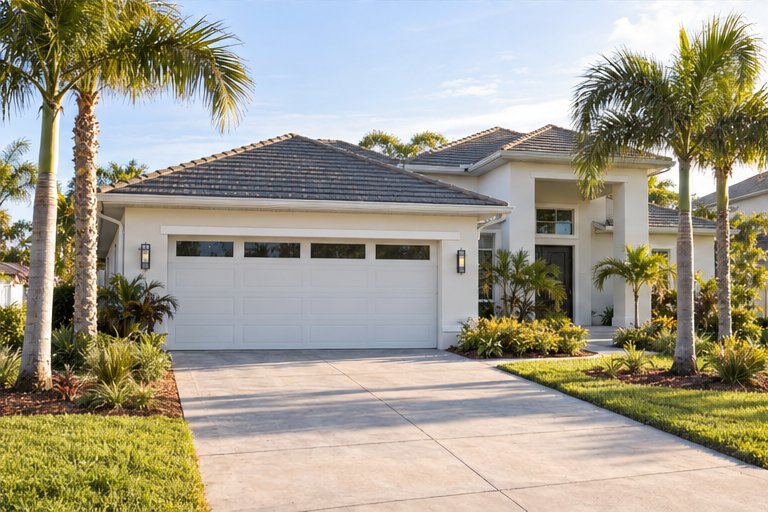
Why the garage door shapes the whole front of the house
Stand across the street from a typical Florida home and look at what draws your eye. Very often it is the garage door. On a two-car house the door can cover a third or more of the front wall, and on homes where the garage faces the street it is the largest flat surface you see.
That means a door can lift a plain facade, and it is also why a poor match is so hard to ignore. The goal is not to make the door the star of the house. It is to make it look as though it belongs. or make a handsome one look tired. A style that echoes the roofline, the window shapes and the entry door makes the house feel pulled together. A style that fights those things draws attention for the wrong reasons.
Start with the house, not the catalog
Catalogs show doors on idealized houses. A better method is to study your own. Look at the shapes already present: arches over windows, straight horizontal rooflines, square columns, rounded stucco corners or crisp modern edges. The garage door should join that conversation, not start a new one.
The most reliable shortcut is to look at three or four houses you like and ask what they have in common. Walk around the neighborhood and note which homes look settled and which look off. Often the difference is a door whose scale, pattern or details have nothing in common with the rest of the house.
- Note the dominant line on your house: horizontal, vertical or arched.
- Count the materials in sight, such as stucco, brick, siding and stone.
- Look at the entry door and window frames for a style cue.
- Take a straight-on photo of the front and use it later for mock-ups.
Flat, raised and recessed panel designs
The panel pattern is the most visible choice after color. Each design reads differently from the street, and each has its own habits when it comes to cleaning and wear.
Flat panels
A smooth face with thin horizontal grooves between sections. It suits contemporary and minimalist homes and shows dirt and dents plainly. Cleaning is easy because there are no recesses to hold grime.
Raised panels
Rectangular shapes that stand proud of the surface, a classic look for traditional homes. The edges of the raised areas give depth in sunlight. Dust and pollen collect in the shadow lines, so an occasional rinse helps. In spring, when oak and pine pollen settles on everything, those lines can look yellow within a day or two, which is normal and washes off with plain water.
Recessed or short panels
A pattern set into the face rather than standing out from it. The effect is softer than raised panels and casts fewer harsh shadows in strong midday sun, and it can look smart on ranch-style and coastal cottages.
Long panels
Wide horizontal bands, often with a shallow ribbed texture. They give a calm, modern rhythm and pair well with simple rooflines. Because the lines are long and uninterrupted, any section that has shifted out of true shows up right away, so installation accuracy counts for more on this style than on a busy pattern.
Carriage-house looks without the carriage-house mechanics
True carriage doors swing open like barn doors. Most homeowners want that look with the convenience of an opener, and modern sectional doors deliver it. The sections are shaped and detailed to resemble paired swing doors, and from the street the illusion is often convincing, complete with the appearance of cross braces and strap hinges.
The style is popular in Florida because it works with Mediterranean, Spanish-inspired and cottage homes. The details are usually decorative. The door still moves up and back on a track, and it still relies on springs and cables. That distinction matters because the weight may differ from a plain door, and the counterbalance has to match.
- Decorative hinges and handles are for looks and should never be used to lift the door.
- Heavier faux-wood faces need a spring system chosen for that weight.
- Check that the style does not hide the manual release handle.
- Make sure decorative parts are rated for outdoor use and for salt air.
Windows: how many, where and what kind
Windows change the personality of a garage door more than almost anything else. They also affect light, privacy, heat and security. A door with no windows looks solid and quiet. A door with a row across the top section looks lighter and friendlier.
Placement is the central question. Many owners find the answer by walking up and down the street and noticing which doors feel comfortable. Putting windows in the top section only keeps them above eye level, which preserves privacy and reduces the view into the garage. Spreading them across several sections gives a more open look, but it also gives more view inside. For more on the heat side of this choice, see our insulation guide.
Common window patterns
Rectangular panes in a straight row are the most familiar. Arched or curved tops add a Mediterranean flavor. Long, narrow panes read as modern. Stepped or staggered windows give a more custom look.
Glass types
Clear glass gives the most light. Frosted, textured and tinted glass offer privacy. Insulated glass resists heat better. All of them need a frame that stays tight as the door moves.
Full-view and modern glass doors
At the contemporary end of the range sit full-view doors, with large glass panels in slim aluminum frames. They look striking, especially on a home with clean lines, and they bring daylight deep into the garage. The look suits owners who treat the garage as part of the living space, and some use them for a studio, a workshop or a showcase for a classic car.
The same qualities create limits. Glass lets a garage heat up in direct sun, so orientation matters. Privacy and security need thought, as does the way a glass panel might fail if hit by a ball or a bumper. Frosted glass is a common compromise.
Proportion, symmetry and the rule of the eye
Good design is often about proportion, and proportion is mostly a matter of looking honestly. A double-wide door has a lot of surface, and a pattern that looks fine on a narrow single door can feel heavy when repeated across sixteen feet. Larger doors usually do better with simple patterns and calm color.
Symmetry also matters, because the eye reads imbalance faster than it reads detail. On a house with a centered entry and balanced windows, a door with a centered pattern and evenly spaced windows echoes that order. On an asymmetrical house, a playful pattern can work, but it needs to be deliberate. If you have two single doors side by side, matching style and spacing keeps the wall from looking uneven.
- Let window rows line up with other horizontal lines on the house when you can.
- Avoid busy patterns on a wide door facing a large expanse of plain wall.
- Keep the number of different motifs on the front facade small.
- Stand back at a distance when judging a sample, since details shrink with distance.
Decorative hardware and trim
Handles, hinges, straps and brackets give a door character. They can also look fussy if overdone. Hardware is a place where small choices add up, so decide on a single finish and stay with it. Choose hardware that matches other metal on the house, such as light fixtures, door handles and house numbers, and pay attention to the finish. Black, bronze and brushed finishes each give a different mood.
Trim around the opening matters as much as the door itself. Fresh paint on the casing, a clean header and neat caulking give a finished look. The area above the door also hides parts you should not touch. Springs, cables and brackets hold tension, and decorative changes never require handling them.
Practical limits that shape what you can choose
Not every style fits every opening. Headroom, side room, the weight of the door and the type of opener all affect what can be installed. A technician checks these details during a visit, and they are better learned early than after an order has been placed.
Headroom and track
Sectional doors need clearance above the opening for the track and springs. Low headroom may limit the door types available.
Weight and balance
Heavier faces need a matched spring system. See weights and balance for the principle.
Wind and building rules
In Florida, doors on many homes must meet wind-load requirements. Some decorative styles and glass options are available in rated versions and some are not. Our overview of wind and building rule basics explains the idea.
Matching the door to common Florida home styles
These are starting points, not rules. Use them as ideas to test against your own house.
| House style | Door ideas to consider | What to watch |
|---|---|---|
| Mediterranean or Spanish-inspired stucco | Carriage look, arched window row, iron-look hardware | Keep hardware finish consistent with outdoor lights |
| Single-story ranch | Short recessed panels or long panels, simple window row | Avoid heavy ornament that overpowers a low roofline |
| Coastal or Key West cottage | Raised panels, light color, divided windows | Choose finishes made for salt air |
| Contemporary or modern | Flat or long panels, frosted or full-view glass | Plan for heat from large glass |
| Traditional two-story | Raised panels, upper window row | Balance the door with the entry and shutters |
Lighting, landscaping and the setting around the door
A door is seen in context. Wall lights on either side frame it. Plants soften the edges but should be kept away from tracks, the sensors near the floor and the path of the door. A driveway in good order draws the eye toward a clean door. If the apron in front of the door is cracked or stained, a pressure wash or repair there can do as much for the view as any change to the door itself.
At night, warm lights beside the door make the front feel welcoming. The garage door itself does not need to be lit up. Overgrown shrubs, stacked bins or an old oil stain can undo the effect of even a beautiful door, so a short tidy-up often gives the biggest improvement for the least effort.
Rules from neighborhoods and associations
Many Space Coast neighborhoods have design rules covering color, window style and sometimes even panel pattern. Check before you order, and keep a copy of the approval, because it can save an argument later. Some associations specify color families, others specify the pattern of the panels, and a few regulate the shape of the windows. Approval requests often need a photo, a sample and a description of the door.
Our guide to HOA rules and garage doors explains what such rules usually cover and how to prepare. If your home is in a historic or deed-restricted area, check that too, because the review process may take time.
Replacing the whole door or refreshing what you have
A new door is not the only route to better curb appeal. A thorough wash, fresh paint where the finish allows it, new hardware, replaced weather seals and a tidy trim can lift an older door dramatically. If a door is structurally sound, this is often the sensible first step.
If sections are bent, the door is out of balance or the track is damaged, appearance is not the only issue. Our guide to repairing or replacing your garage door describes how to think about that decision, and you can contact us to have the door looked at before you choose.
Mistakes people make when choosing a style
After years of looking at doors on the Space Coast, certain mistakes show up again and again. None are disasters, but each is easy to avoid once you know about it.
Choosing from a tiny picture
A thumbnail on a screen hides the scale of the pattern, the depth of the shadow lines and the true color. Ask to see a large sample and stand well back from it, since the door will normally be seen from the street.
Ignoring orientation
A door that faces west takes hard afternoon sun, which strains dark finishes and large glass panels. A door in shade can carry a darker color or more glass with fewer heat concerns.
Forgetting the people who use it
If the door is opened a dozen times a day by a busy household, smooth, easy-to-clean surfaces and sturdy hardware matter more than a delicate pattern.
Treating it as separate from the rest of the work
A new style on tired tracks or an old opener is a missed chance. Think about the opener, remotes, keypad and seals at the same time, so the whole system works as nicely as it looks.
How style choices change upkeep and repairs
Every design decision carries a small cost in time later. A raised panel collects dust and pollen in its shadow lines. A flat panel shows scratches and smears more plainly. Windows add seals and frames to inspect. Decorative hardware adds screws and fasteners that can corrode in salt air.
None of this is a reason to avoid a style you love. It simply helps to know what you are signing up for. If you like a clean, quiet routine, simple panels and fewer decorative pieces make life easier. If you enjoy the details, plan a seasonal wash and a look at each bolt and bracket on the visible face of the door.
- Rinse the door with fresh water after salt spray or heavy storms.
- Wipe window panes and frames, and look for cracked seals.
- Check decorative hardware for loose screws or rust streaks.
- Watch for sections that look out of line, which can mean wear or damage in the track.
- Replace worn weather seals so the door looks neat along the bottom edge.
A simple process for deciding on a style
Choosing a style is easier when the steps are small. This sequence works for most people and keeps the decision from turning into a long argument over catalog pages.
- Take a clear, straight-on photo of the front of your house.
- List three words you want the house to say, such as warm, crisp or relaxed.
- Pick two or three panel designs that fit those words.
- Decide on window placement and glass type.
- Choose a finish and hardware that match other metal on the house.
- Check association rules, wind requirements and the physical limits of your opening.
- Look at a real sample outdoors before you commit.
Questions and answers
Yes. On many homes the garage door is the largest feature facing the street. A style that matches the roofline, windows and entry door makes the house look unified, while a mismatched one stands out. Updating or even refreshing the door is often among the more visible changes you can make. A short mock-up with your own photo can make the decision easier.
Maintenance is similar to other sectional doors. The decorative hardware needs occasional cleaning and should be made for outdoor, salt-air use. The faux-wood faces can be heavier, so the springs must match. Keep an eye on the finish and ask a technician to check balance after installation. If you are unsure, we can look at the door and explain which designs suit it.
Top-section windows keep the view into the garage limited and add daylight. Windows across several sections look more open but give less privacy. Consider heat and security too, and choose frosted, textured or tinted glass if you want light without a clear view inside. Ask for a large sample so you can judge pattern and shadow lines in daylight.
Not always. Headroom, side room, door weight and the opener all limit the choices. Wind requirements and association rules can also apply. A technician can measure the opening and tell you what fits, which saves disappointment after an order is placed. We will measure and explain what suits your opening before you order. It also helps to bring photos of the house.
If the door is straight, balanced and structurally sound, a wash, repaint where the finish allows, new hardware and fresh seals can change its look a lot. If sections are bent, the track is damaged or the door will not stay balanced, replacement may make more sense. Either way, a thorough wash and tidy hardware improve the look straight away.
Usually not. They are for appearance and should not be used to lift or pull the door. The door moves on its track with springs, cables and rollers. Never use decorative parts as grips, and never touch the springs or brackets above the opening. If anything feels loose or wobbly, stop and contact us rather than pulling on it.