
Why this choice matters more than it seems
Most people choose between a wide door and two narrow doors once, usually when a house is designed or when an old door is finally replaced. After that, the decision quietly shapes every repair call. A wide door puts a lot of weight and width on one set of springs, one opener and one pair of tracks. Two single doors split that work into two smaller systems that run independently.
Neither layout is wrong. Builders across Melbourne, Palm Bay, Viera and the rest of the Space Coast use both, and the right answer depends on the opening, the framing, the budget, and how the garage is used. What we want to do here is explain the practical differences, so that you can decide with the full picture instead of only the curb appeal.
We will keep this comparison grounded in what technicians actually see: how each layout ages, which parts carry the load, what a failure looks like, and what it means for the people living in the house. If you already have a door and are simply curious whether a change is worth it, the later sections on conversion will help.
The two layouts in plain terms
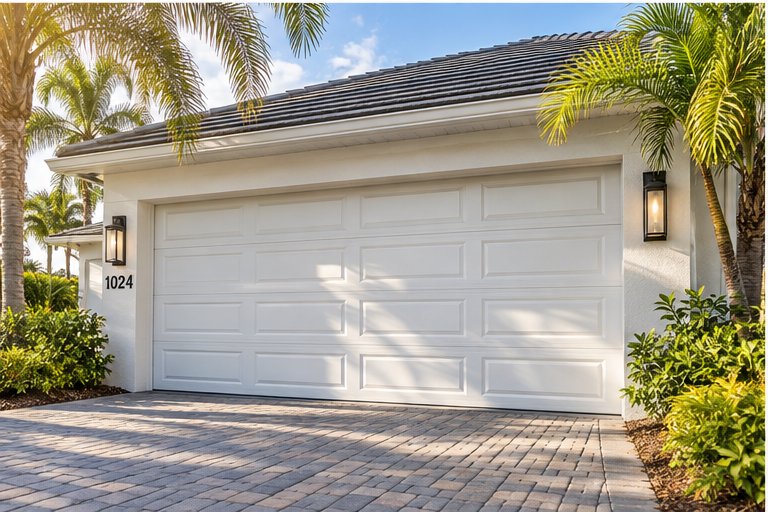
A wide door, often called a double door, is one large panel set that covers the full opening of a two car garage. It rides on one pair of tracks, hangs from one spring system, and is usually driven by one opener. When it opens, both bays are open at once.
Two single doors are exactly what they sound like. A center post or pier sits between two narrower openings, and each opening has its own door, its own tracks, its own springs and its own opener. You can open one bay while the other stays closed.
What the wide door is built from
Because the span is long, a wide door needs stiffer sections and often reinforcing struts so the panels do not bow in the middle. The springs are sized for a heavier door, and the opener has more mass to move. The hardware is the same family of parts as a single door, just scaled up.
What the paired single doors are built from
Each narrow door is lighter and shorter in width, so the panels stay straighter without as much reinforcement. The two systems share nothing mechanical. They share only the wall, the ceiling joists and the electrical supply.
Side by side comparison
The table below summarizes how the two layouts differ in the ways that matter once the door is in daily use. The notes after it expand on the rows that people ask about most.
| Factor | One wide door | Two single doors |
|---|---|---|
| Appearance from the street | One large, uninterrupted face that shows the style and color clearly | Two separate faces divided by a center post, which gives a more traditional look |
| Opening width for vehicles | Full width opens at once, easier for wide trucks, trailers and boats | Each opening is narrower, so large vehicles need the right bay |
| Number of springs systems | One system carrying a heavier door | Two smaller systems, each carrying a lighter door |
| Number of openers | Usually one, with a stronger motor | Two openers, one per bay |
| If one part fails | The whole garage is closed off until it is repaired | One bay can still be used while the other is repaired |
| Panel flexing | More likely to bow or sag in the middle over time without reinforcement | Panels stay straighter because the span is shorter |
| Wind and storm behavior | One large surface takes the full load of wind pressure | Smaller surfaces, with a center post helping to share the load |
| Replacement cost of one door | One larger door, one set of parts | Two doors to replace if you update both, though one can be replaced alone |
| Framing requirement | Needs a strong header across the full width | Needs a solid center post, which also supports the header |
| Security | One set of locks and one opener to secure | Two sets of hardware, which is more to maintain but each is simpler |
Space, vehicles and how the garage is really used
Think first about what goes through the opening. A wide door gives one generous gap, which is helpful when you back in a long trailer, pull in a boat, or move a large workbench or piece of furniture. On the Space Coast, where many households keep a boat, a golf cart or a kayak rack in the garage, that clear width can be a real convenience.
Two single doors give you narrower gaps, and the center post is always there. It can make parking two wide vehicles side by side feel tighter, because each driver has less room to swing in and out. On the other hand, a post can be a handy place to mount a keypad, a light or a hook for a hose and cord.
If one bay is a workshop, a storage area or a place where a project car sits for weeks, two doors let you leave that bay shut and secured while the other bay is used every day. That separation also helps with heat, because you are not opening a full wall to the afternoon sun every time someone takes the car out.
- Boats, trailers and long cargo: a wide door is usually easier to enter.
- Daily parking for two cars: both layouts work, and the choice is mostly about habit.
- A workshop or hobby bay: two doors keep one bay closed and quieter.
- Narrow lots with tight driveways: narrower doors can be easier to line up with.
Springs and the weight they carry
Every sectional garage door is counterbalanced by springs, and the springs are chosen to match the weight of the door. A wide door is heavy, so it needs strong springs, and often two of them working together on one shaft. If you want to understand how those springs behave, our guide to how a garage door works walks through the balance system.
Two single doors each carry about half the load, so each set of springs is smaller and typically under less strain. That does not make them immune to wear. Springs are rated for a certain number of open and close cycles, and a family that uses both bays equally will wear both sets at a similar pace.
A point worth knowing is that when a spring on a wide door breaks, the entire garage is out of service, and the broken spring is large and under serious tension. This is professional work. If you hear a loud bang from the garage, read about a spring that snapped with a loud bang and leave the door alone until it has been looked at.
Torsion or extension on each layout
Wide doors almost always use torsion springs, because they are better suited to heavy doors and give smoother control. Some narrow single doors, especially on older homes, still use extension springs along the sides. The difference is explained in our comparison of torsion and extension springs.
What happens when the springs wear
The signs are the same on either layout: the door feels heavy, the opener strains, the door drifts rather than staying put halfway, or the door will not lift at all. A wide door simply makes those symptoms more dramatic because there is more weight behind them.
Openers: one strong motor or two modest ones
A wide door needs an opener with enough pulling power for the extra weight and the extra friction. Many wide doors also benefit from a reinforcement bar across the top panel, so the opener can lift the door evenly instead of flexing it. The opener is a single point of pull, so if it fails the whole opening stays shut.
With two single doors, each opener is a modest unit that handles a lighter door. If one opener stops working, the other bay carries on. You also get two remotes, or two buttons on the same remote, and two sets of sensors. That means a little more equipment to look after, but also a nice amount of redundancy.
When you compare running costs, the difference is small. Openers use little electricity in normal use, and the real expense of any opener is its eventual repair or replacement. Our overview of choosing a garage door opener covers how to match a motor to a door, and the same thinking applies whichever layout you have.
- A wide door asks more of one motor, so a weak opener tends to show strain sooner.
- Two doors mean two sensor pairs, and both must be aligned for the door to close.
- Programming is slightly more involved with two openers, because each remote button must be matched to the correct bay.
Repair patterns we see with each layout
Wide doors tend to show their age through the middle. Panels can bow, the top section can crack where the opener pulls, and the long track can drift out of alignment over time. Because the door is wide and heavy, an off track event can be dramatic, and it is not a job to attempt yourself. If a door has come out of its track, see a door that is off track for what to do while you wait for a technician.
Two single doors are more forgiving. A lighter panel is less likely to buckle, and a mishap in one bay does not take down the other. The most common repairs on paired doors are rollers, hinges and sensor alignment, simply because each bay is used many times a day.
Both layouts can suffer from the same coastal problems. Salt air attacks hinges, rollers and track fasteners. Humidity swells wood and rusts steel. The monthly habits in our monthly garage door checklist help either layout last longer, and they cost nothing but a few minutes of looking and listening.
Typical trouble spots on a wide door
The top section near the opener bracket, the center hinges where the panels meet, and the bottom corners where cables attach are the places we check first. These are also the places where a safety minded owner should look but never touch the cable or bracket.
Typical trouble spots on single doors
Rollers wear out faster on the bay that is used most. Photo eye sensors collect dust, spider webs and sun glare. A bent track near the center post can happen when a vehicle clips the post.
Wind, storms and Florida building concerns
On the Space Coast, wind is part of the conversation. A wide door is a large flat surface, and in strong wind it takes the full pressure across the whole width. That is why wide doors in coastal zones are often built with extra struts, heavier tracks and stronger fasteners, and why the rules around wind rated doors matter so much for them.
Two single doors present smaller surfaces, and the post and framing between them add rigidity. That does not make them storm proof, but the load is divided. Whichever you choose, the door must be installed to the wind and building requirements that apply to your address. Our guide on wind and building rules basics explains what to ask about.
Before storm season, both layouts need the same attention: sound tracks, tight hardware, a working manual release, and a plan for the power. The steps in our hurricane preparation guide apply to a wide door and to paired doors alike.
Cost thinking without the guesswork
We will not quote figures here, because the cost of a door depends on size, material, insulation, hardware, wind rating and the condition of the opening. What we can say is how the costs tend to be shaped.
A wide door is one larger purchase with one set of hardware. Two single doors are two smaller purchases, so the hardware and labor repeat. The benefit of two doors is flexibility. You can replace one that is damaged or worn while keeping the other, which spreads the expense over time and lets you match a new door to an old one only if you want to.
Repairs follow the same logic. A repair on a wide door often involves larger and heavier parts, and the technician may need more time to balance and test it. A repair on a single door is generally simpler, but you may have two doors that need attention at once. For a deeper look at how bills are put together, read about how service pricing is built.
- Think about total life cost, including future repairs and replacements.
- Ask whether reinforcement and heavier springs are included in the plan for a wide door.
- Ask how a mismatched door would look if only one bay is replaced later.
Converting from one layout to the other
Homeowners sometimes ask if they can swap a pair of single doors for one wide door, or the reverse. It can be done, but it is a construction job, not just a door swap. Removing a center post means a new header must carry the load across the full width, and that is a framing matter that may need professional engineering and permits.
Going the other way, adding a post to split a wide opening into two, also touches the framing and the garage floor slab and wall finishes. The opening sizes, the headroom and the side room for tracks must all fit. Many homes simply do not have the layout to allow it.
If you are thinking about a change like this, start with a conversation and an inspection of the opening. A technician can tell you what the existing framing looks like and whether a straightforward change is possible. For help with the first steps, see our guide to measuring for a new garage door, and the overview of new garage door installation.
What stays the same in a swap
The opening is still measured for width, height, headroom and side room. The finish choices, such as steel, composite or wood, are not affected by layout.
What changes in a swap
The header, the track layout, the spring size, the opener and the electrical may all change. These are not parts to improvise.
Homeowner associations, appearance and resale
Many communities in Viera, Suntree, Heritage Isle and similar neighborhoods have rules about how a garage door looks. Those rules may cover color, window style and panel design, and sometimes how many doors face the street. Before you change a layout, check what your association allows, and ask whether a change needs approval.
From a resale point of view, buyers care most about the door working well, looking tidy and opening quietly. A wide door can look sleek and modern. Paired doors can look classic and balanced. Either one can lose value if it is dented, faded or noisy. Our notes on HOA rules and garage doors cover what usually needs approval.
If you are preparing a house for sale, consider the working order of the door more than its layout. A smooth, balanced door with fresh weather seals makes a better impression than a new style that has not been set up carefully.
Safety points that apply to both layouts
The two layouts share the same dangers. Springs and cables hold stored energy and are not parts for owners to touch. The door itself can weigh a great deal, and a wide door weighs more. Keep hands and fingers away from the hinges and the gaps between panels while the door moves.
Test the safety reversal on each opener regularly, and keep photo eye lenses clean. The steps for simple, safe checks are in our garage door safety tests guide. Teach children that the wall button and the remote are not toys.
If someone is hurt, call 911 first. Then leave the door as it is until a technician has looked at it. A door that has partly fallen or come off its track can move without warning.
- Never stand under a moving door or a door that is partly open.
- Never try to loosen, tighten or remove springs, cables or brackets.
- Keep remotes out of reach of small children.
- Use the manual release only with the door fully closed and when you are sure of what you are doing.
A short guide to choosing for your own garage
If you need to decide, start with the use. Do you need one wide clear opening for a boat, trailer or large equipment? A wide door is the natural choice. Do you want one bay to stay closed while the other is used, or do you value having a working bay when one part fails? Two doors are the more flexible answer.
Then think about the building. An existing opening with a center post should usually stay that way unless you have a strong reason to rebuild it. A new build can go either way, and the choice can shape the front elevation of the house, so it is worth considering with the designer.
Finally, think about maintenance. A wide door rewards regular checking of the center hinges, the reinforcement and the opener bracket. Two doors reward regular checking of both sensor pairs and both sets of rollers. You will do about the same amount of looking in total. If you are weighing a new door against repairing the one you have, our page on repairing or replacing a garage door gives a clear way to think about it.
Choose a wide door if
You need the full width often, you like a clean look, and you are comfortable with one heavier system that must be built and balanced properly.
Choose two single doors if
You value independence between bays, you prefer lighter parts, or your opening already has a center post that you do not want to disturb.
When to have the door looked at
If your current door is heavy, noisy, uneven or slow to respond, the layout is not the cause, but it can influence how the problem shows up. A wide door that sags in the middle may need reinforcement and rebalancing. A pair of doors that behave differently from each other may point to a wear difference between the two bays.
A technician who comes to the property will look at the springs, cables, tracks, rollers, hinges, panels and opener, and then explain what they find in plain language. That visit is the right time to ask about layout questions too, such as whether your opening could support a different arrangement.
Our team serves Melbourne and the Space Coast, and we are glad to talk through your garage, your vehicles and your goals before anything is changed. You can read about what a visit involves in what happens during a garage door service visit, or reach us directly through the contact page.
Questions and answers
A wide door has larger and heavier parts, so the work is usually more involved, and springs on a wide door carry more tension. Two single doors use smaller systems, but you may have twice as many parts to look after. In both cases, spring and cable work belongs to a trained technician, who will explain what they find and what the options are.
Yes, if you have two single doors, because each runs on its own springs, tracks and opener. A fault in one bay does not stop the other. With a wide door, one failure usually closes off the whole garage until the repair is done, which is one reason some owners prefer two doors. Each bay keeps its own remote button too.
Yes. Each door needs its own opener, its own remote programming and its own pair of safety sensors. That means more equipment to maintain, but each opener handles a lighter load. A wide door usually needs one stronger opener, and often a reinforcement bar across the top panel. Ask the installer to confirm both are matched to the weight of each door.
Neither is automatically better. What matters is that the door is built and installed to the wind and building requirements for your address. A wide door is a large surface and needs proper reinforcement and heavier hardware, while paired doors share the load with the center post. Ask about wind ratings when choosing. Your installer should be able to tell you the rating of any door you are considering.
It can be done, but it is a construction project, not a simple door swap. The center post must be removed and a header sized to carry the load over the full width. That may involve permits and a framing professional. A technician can look at your opening and tell you whether the change is realistic. Expect the work to be planned before it starts, not improvised on the day.
Not necessarily, but a heavy wide door can show wear in rollers, hinges and the opener more clearly, so noise from those parts can seem louder. Regular lubrication, tight hardware and good balance keep either layout quiet. Persistent grinding or banging should be looked at by a technician rather than ignored. If a particular noise bothers you, tell the technician when it happens so the cause is easier to find.
No. With two single doors you can replace only the one that is damaged or worn. If you want both to match, you can choose to update them together, but it is a choice, not a requirement. Ask about matching color and panel style if you replace one at a time. A mismatch in age is the only real drawback.