
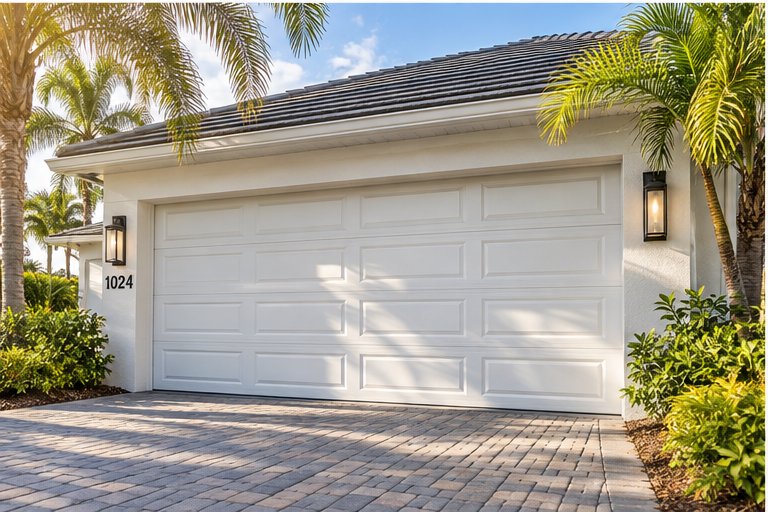
A small town with garages of every age
Palm Shores is one of the smaller municipalities in Brevard County, and it sits near Melbourne, within easy reach of the lagoon side of the county. A town of this size does not have one single housing style. Older homes stand beside newer ones, and the garages attached to them reflect the decade in which they were built.
That variety is the main reason we do not treat a Palm Shores call as a routine job. One owner may have a door that has hung in the same opening for decades, with parts that are no longer made. Another may have a newer door with a modern opener and a smart-home app. The repair approach, the part sourcing and the advice are all different.
So we ask a few plain questions up front. How old is the home? Has the door been repaired before? Is the opener original? The answers tell us what we are likely to find, and they help us arrive ready to explain, not just to fix.
Reading your door like a technician would
You do not need any tools to learn a great deal about your door. Stand inside the garage with the door closed and look at it. Then watch it once as it travels, from closed to open and back, and pay attention to what you see and hear.
Most useful clues fall into four groups, and each points to a different part of the system.
Sounds
Squealing usually means dry hinges or rollers. Popping from above often comes from the springs or the bearing plates. A rhythmic thump points to a flat roller. A grinding sound from the opener head can mean worn gears. Describe the sound as precisely as you can, and if you can record a short clip on your phone, that helps.
Movement
A door that rises crookedly, stops partway or drifts down after you let go is telling you about balance, track alignment or limit settings. Notice whether one side moves ahead of the other.
Lights
The opener's motor head and the sensors both use small lights to report status. A steady light on each sensor is normal. A blinking or dark one points to alignment or wiring. Our guide to understanding opener indicator lights explains the common patterns.
Feel
With the opener released, a balanced door feels light. Heaviness, drag or sudden drops tell you the springs, cables or track need professional attention. Do not test this if the door looks off its track.
Spring: warm mornings and the first openings of the day
Spring in Brevard is mild, dry and pleasant, and it is a natural moment to look at the garage. After a winter of cooler nights, the metal in a door contracts a little and the lubricant thickens. As days warm up, you may hear the door settle into its normal sounds again.
This is a good time to wipe down the track, clean the sensor lenses and replace the batteries in the remotes. It is also the time to look at the bottom seal, which is the rubber strip along the base of the door. A seal that has hardened or torn lets in dust, pollen and insects, and it can start to curl at the ends.
If you notice daylight under a closed door, or the seal looks cracked, our page on weather seal replacement explains how we approach it. A fresh seal is a small job that makes a visible difference to how the garage feels.
Summer: heat, humidity and the afternoon storm
Summers here are hot and humid, with thunderstorms that arrive on many afternoons. Heat softens lubricants, expands metal and bakes the plastic parts of the opener. Humidity encourages rust at screws, track fasteners and the cut edges of steel panels.
Storms bring two separate problems. The first is wind and rain, which can find gaps at the base of the door and along the sides. The second is electrical. A strike on a nearby line or a power flicker can leave an opener unresponsive or can erase its memory of your remotes.
If the opener stops working after a storm, check the outlet, check the circuit breaker and try the wall button before assuming the unit has failed. If it still will not respond, our page on a door stuck after a power outage explains the safe way to open the door by hand and what to look for. Keep in mind that a door that feels heavy when released should not be forced.
Fall: the quiet weeks before the cooler months
In late summer and early fall, attention turns to the tropics. Even in a small town set back from the open ocean, strong wind and heavy rain are real possibilities, and a garage door is a large surface facing the weather. A door that is already bent, rusted at the track or loose at the hinges is less able to handle stress.
Fall is also when many owners plan larger work, because the heat has eased a little and projects can be done in comfort. If you have been thinking about a new door, now is a sensible time to measure the opening, think about insulation and decide what style suits the house.
Our guide on measuring for a new garage door explains what to record and how to avoid mistakes before you order anything. If you only want to repair what you have, a maintenance visit in this season sets the door up for the months ahead.
Winter: short days and cooler nights
Brevard winters are mild by most standards, but a cold front still brings noticeably cooler mornings. Cooler air makes grease stiffer, and an older opener can sound strained for the first few cycles of the day. That is usually normal. A door that fights you every morning is a different matter.
Shorter days mean more people arrive home in the dark, and the opener's light matters more. A bulb that fails every few months may indicate vibration or a socket problem, and our page on a garage door light bulb that keeps burning out explains the usual causes.
Winter is also the time when seasonal visitors arrive in this part of Florida. If you have guests who will use the garage, make sure they know how to operate the manual release and where the wall button is. A short walk through the garage before they arrive avoids awkward calls later.
Three kinds of lot, three kinds of garage
Looking across Palm Shores, you see that lots fall into a few rough patterns, and each shapes a garage in a different way. We find it useful to think about these when we plan a repair.
- Established homes on older lots, where the garage may be a single bay with a door that has been repaired more than once and an opener of unknown age.
- Newer homes with two-car garages, where doors are usually heavier, openers are more capable and the issue is often a sensor, a remote or a spring that has reached its rated cycles.
- Homes with extra structures, such as a workshop, a detached garage or a boat shed, where doors vary widely and sometimes have no opener at all.
Fixing an older door or replacing it
Owners of older garages often wonder whether a repair is worth the money or whether it is time to start over. We understand the question, and we do not think there is one right answer. Much depends on the condition of the panels, the track and the opening, and on how the owner uses the garage.
A door in sound condition with a worn part is usually worth repairing. A door with rust through the panels, cracked sections or a track bent past correcting is a poor candidate, because each repair only holds until the next weak point gives out.
Our comparison of repairing or replacing a garage door lays out the questions we ask. We will tell you what we see and why, and the decision stays with you.
Openers: old, new and everything between
A garage opener is a small machine with a motor, a drive and a circuit board, and it ages in the same way as any appliance. Older units use chain drives and simple radio codes. Newer units use belts, quieter motors, rolling codes that change with each press and connections to a phone.
We can repair many openers, but not every repair makes sense. If a unit is old enough that a worn part is hard to find, or if its safety features no longer meet current expectations, replacement is a reasonable option. A new opener should always be installed on a balanced door, and the sensors and reversing system should be tested before we leave.
Our comparison of chain, belt and screw drive openers helps you decide what suits your garage, particularly if the room is attached to a bedroom or an office and noise matters.
Remotes, codes and the neighbor problem
In a small town, houses sit close enough that a signal can occasionally cross to a neighbor, especially from an older opener that uses a fixed code. If your door opens and closes on its own, or a neighbor tells you their remote works on your garage, take it seriously.
The usual remedy is to clear the opener's memory and program fresh remotes, or to replace an old unit that has no rolling code. We explain the issue on the page about a neighbor's remote that opens your door.
A fresh start also makes sense after you lose a remote, sell a car or change tenants. Anyone who has a working remote has your garage door open, and the garage is often a way into the house.
Safety around springs and cables
Every sectional garage door is balanced by springs or cables under strong tension. The springs are wound to hold much of the door's weight, and the cables carry that force to the bottom of the door. These parts can injure someone badly if they let go or if a bracket fails.
For that reason, we do not suggest that anyone adjust, loosen or replace springs, cables or their brackets without proper training and tools. Simple checks are fine: looking, listening, wiping a sensor lens, replacing a remote battery and using the red release cord with care.
If you hear a loud bang from the garage, or the door suddenly becomes impossible to lift, keep clear and contact us. Our page about a spring that snapped with a loud bang describes what that means and what to do next.
A short list of useful things to have ready
When you call us about a door, a few facts save time on the visit and help us bring suitable parts. None of them need technical knowledge. You are describing, not diagnosing.
- How old the home is, and the door if you know it.
- The brand name on the opener, which is usually printed on the motor head.
- The width and height of the opening, roughly, if you have measured it.
- A short description of what the door does and when it started.
- Any photos of the door, the track or the label on the springs or panels.
- Whether anything happened beforehand, such as a storm, a bump or a power loss.
What happens when we arrive
We begin by listening to what you have noticed. Then we look at the door and the opener, watch the door travel and test the safety features. We stay away from anything that carries tension until we know what we are dealing with.
Once we understand the cause, we explain it in plain words. We show you the worn part, describe what a repair involves, and tell you what the options are, including leaving things as they are if that is sensible. You choose, and we do the work you ask for.
If you want a fuller picture, read our page on what happens during a garage door service visit. It sets out the steps from the first look to the final test.
Garages used as workrooms and storage
In a small town where lots are varied, the garage often does more than shelter a car. It becomes a workbench, a tool room, a place for fishing gear, a storage zone for hurricane shutters and holiday boxes, or an extra refrigerator room. Every one of those uses changes what the door has to put up with.
Shelving built close to the tracks can interfere with the rollers. Boxes stacked beside the door hide the sensors from view. A ladder hung on a wall bracket within reach of the springs invites someone to touch them. A clear lane along both sides of the opening makes the door safer and makes every inspection simpler.
If you use the garage as a workroom, sawdust and fine grit settle on the track and the opener, and they wear moving parts faster than clean air does. A wipe-down of the track and a clean sensor lens each season are small habits with a noticeable effect.
Questions people ask before booking a visit
Owners in a small town tend to prefer a direct conversation to a long form, and the questions are usually practical. Is the door worth fixing? Is the noise normal? Can the opener stay if the door changes? Is this a safety issue or can it wait?
Our answer to the last one is simple. Anything involving a door that is heavy, crooked, off its track or stuck partway should be treated as a safety issue, and the door should not be used until it has been looked at. Annoyances such as a slow remote, a dim light or a squeaky hinge can wait for a convenient time, though they rarely get better on their own.
If you are unsure which group your problem falls in, describe it to us and we will say honestly which it is. The comparison on whether to repair now or wait explains how we think about timing.
Getting in touch from Palm Shores
If your door is acting up, tell us how. A few sentences about sounds, lights and timing, plus a photo or two, is plenty to get started. We will tell you what we think is going on and what we would look at first.
Please keep away from springs and cables, and call 911 if anyone is hurt. For everything else, contact us and we will explain what we find and what the options are.
Questions and answers
We do both. Repairs include springs, cables, rollers, tracks, panels, openers, sensors and remotes. We also install new doors and new openers, and we can help you think through style, insulation and opening size before you order. Tell us what you have now and what you would like to change, and we will explain the options at the property.
It can be a security concern, so take it seriously. Causes include a stuck wall button, a remote pressed inside a bag, signal interference or an old opener with a fixed code. Clear the opener's memory if you know how, replace remote batteries and watch for patterns. If it continues, we can inspect the opener and wall control and explain what needs to change.
Many owners find a yearly visit is a sensible rhythm, and a seasonal self-check in between. A visit includes looking at springs, cables, rollers, hinges, tracks and the opener, then testing safety features and lubricating moving parts. Heavily used doors benefit from more attention. We can describe what makes sense for your door after seeing how it is used.
A little extra noise on the first cycle is common, because lubricant thickens in cooler air and metal contracts slightly. If the sound fades after a cycle or two, it is usually harmless. If the door is loud every time, or the noise includes grinding, popping or a thud, something is worn. Tell us what you hear and we will help narrow it down.
Change the battery first, since that solves most cases. Then try the wall button to see whether the opener itself responds. If the wall button works but the remote does not, the remote may need to be reprogrammed or replaced. If neither works, check the outlet and the breaker. If the problem remains, we can test the opener and explain the next step.
Often yes, using the red release cord. Pull it with the door closed, then lift gently. A balanced door feels light and stays where you leave it. If it feels heavy, resists or drops, leave it alone, since a spring or cable may have failed. Never force the door, and contact us so we can look at it before anyone uses it again.