
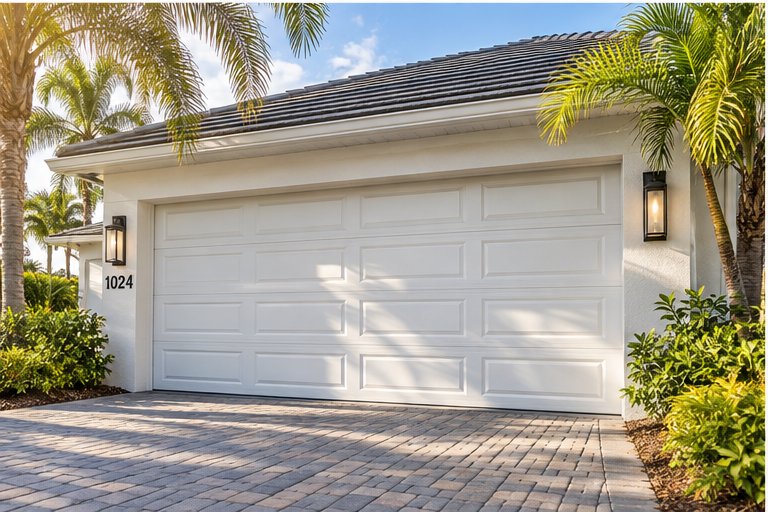
Established streets, seasoned doors
In an established neighborhood the garage door is often one of the oldest working machines on the property. It may be the original door or a replacement from some earlier owner, and the opener may have been changed once, twice or never.
That history is not a problem. Many older doors are well built and can keep going with proper care. But age does mean parts have been cycled thousands of times, finishes have thinned, and decisions made years ago about springs, tracks and openers may no longer suit how the garage is used today.
Reading the clues on an older door
Before anyone repairs an older door, it helps to read it. The labels on springs and openers, the style of hinges, the thickness of the panels and the shape of the track each say something about when the door was made and what parts will fit it.
Sometimes a label has faded or been painted over, and we work from the measurements instead. Our guide on reading your garage door label explains what the numbers mean and why they help.
Taking a clear photograph of the labels, the springs and the opener before we arrive is useful. It lets us come prepared and often shortens the visit.
Single garages and tight spaces
Many older homes in the area have one-car garages or narrow double openings. The space inside may be tight, with little headroom, shallow depth and shelves close to the door. Narrow garages restrict how tracks and springs can be arranged, and they limit which openers fit.
When headroom is short, a low-headroom track kit or a compact opener can solve the problem. Where the ceiling is cluttered with storage, an opener must be positioned carefully so that the rail does not strike anything as the door travels.
A tidy garage is a safer one. Boxes stacked against the side of the door, a bicycle leaning on the track or a freezer parked too close to the opening all interfere with movement, and they are among the most common reasons a door scrapes or jams.
When the garage is also a hallway
In some older houses the garage connects to the kitchen or laundry through a door that people use all day. A garage door that is slow, noisy or unreliable turns into a daily irritation in that setup, and a good seal at the bottom matters for comfort.
Converted and partially converted garages
Some owners have closed in part of a garage to make a room or workshop. A door that is still used should be in good shape, with a working seal and a dependable release. If the room beyond is lived in, even more so.
Original openers and what they lack
An opener installed many years ago may still run, but it was built to an earlier set of standards. Older units may have no reversing sensors at all, and some use a fixed code that can be copied. Their motors may be noisy, and replacement parts may be hard to find.
None of this means you must rush to replace it. It does mean you should test the safety features you do have, and consider an upgrade as part of ordinary home maintenance, not as an emergency. Look at opener replacement for what a changeover involves.
| Older feature | Modern equivalent |
|---|---|
| Fixed remote code | Rolling code that changes each use |
| No photo-eye sensors | Reversing sensors near the floor |
| Loud chain drive only | Belt, chain or screw options |
| Single wall button | Wall control with lock and light features |
| No battery backup | Optional backup for outages |
| Manual-only monitoring | Optional app connection |
Carports, add-ons and doors that were retrofitted
Not every garage in an older neighborhood began life as a garage. Some were carports closed in with a door, and some were extended or reworked by earlier owners. The framing around those openings can be uneven, and the door may have been fitted to whatever was there.
A retrofitted door tends to show its history in small ways: a gap along one side, a header that bows slightly, tracks that were shimmed to line up. These details do not make a door unsafe, but they do change how we adjust it and what we recommend if it needs replacing.
If you are unsure how your garage came to be, tell us what you know. Even a rough history helps us understand why the door behaves as it does.
Tree litter, roots and shade
Mature trees are one of the pleasures of an established neighborhood, and one of the reasons garage doors there pick up extra dirt. Leaves, seed pods, pine needles and Spanish moss collect on driveways and blow into the garage when the door is open.
Debris in the lower track and on the sensors causes odd behavior: a door that stops and reverses, a sensor light that blinks, a roller that jumps. Shade keeps surfaces damp longer, which encourages mildew on seals and trim.
Roots occasionally lift a slab or driveway apron near the door. If the floor at the threshold has risen or dropped, the door can seal unevenly. Adjusting the door does not fix that, and we will tell you so.
Pine needles and moss are especially good at finding their way into the lower track and the rollers. A soft brush and a vacuum, used with the door closed and the opener unplugged if you are working near the moving parts, will keep most of it under control.
Humidity, rain and rust in an inland-coastal setting
Gifford is not on the beach, but it is near enough to the coast that the air is humid for much of the year and the salt-laden breezes drift inland during some weather. Metal fittings show rust more readily than they would in a dry climate.
Roller stems, hinge pins, cable ends and the lower brackets are the parts to watch. Surface rust is common and can be slowed. Deep pitting on a bracket that carries the door's weight is a job for a technician, and you should not try to remove or adjust it yourself.
Our guide to garage door lubrication describes which parts to oil, which to leave alone and what products suit them.
Keeping a door going or replacing it
At some point most older doors raise the question: keep repairing, or replace? The answer depends on the condition of the panels, the cost and availability of parts, the condition of the opener and what you want from the garage.
A panel with a small dent, a stuck roller or a broken hinge is a repair. A door with cracked panels across the face, rot at the bottom edge and a track bent from past impacts may be reaching the end of its useful life. Our repair versus replace comparison gives a plain framework.
We tell you what we see, and we are comfortable if the answer is to repair and wait.
Parts availability is a practical factor in this decision. Some older hinge and roller patterns are no longer made, though many have close modern equivalents. We can often match what is needed, and we tell you plainly when we cannot.
New doors for older homes
Fitting a new door to an older house takes some thought. Openings may not be perfectly square, framing may have settled and the door header may be narrower than modern kits assume. A careful measurement, taken in more than one place, avoids surprises.
Style matters too. A new door should suit the house. Raised panels, flush panels, windows and carriage looks each give a different impression, and an older home often looks right with a design that echoes its original character. Insulated doors reduce heat and noise, and they are especially welcome where the garage is attached and used often.
See garage door insulation explained for what the ratings and layers actually mean.
If the existing door is wooden, think about whether the decorative character is something you want to keep. Modern doors can echo the look of wood with steel or composite panels, which need less upkeep in a humid climate.
Homeowners who are planning for the long term
Many people in established communities stay for years, and they think about the home in the long run. A garage door that is dependable, easy to operate and safe is part of that.
Features that help include a wall control mounted at a reachable height, a remote with large buttons, a light that stays on long enough to walk to the door and a clearly marked release. A door that is properly balanced lifts easily by hand in an outage, which makes it kinder to anyone with limited strength.
If you or a family member has trouble with a heavy door, tell us. Small changes can make a real difference.
Lighting matters here as well. A dim garage makes it hard to see the sensors and the release handle. A brighter bulb, or a separate fixture, makes the space friendlier and the door easier to inspect.
Selling, buying and inspections
In an established community, homes change hands regularly, and the garage door often appears on an inspector's list. A door that does not reverse, a rusted spring or a missing safety cable can slow a sale or lead to a negotiation.
If you are selling, a service visit before listing can address small problems and give you a clear picture of the door. If you are buying, a close look at the door is a sensible part of your due diligence. See buying a home: the garage door inspection for what to ask.
Rentals and small business use
Some properties in the area are rented out, and some host small businesses, workshops or storage. Doors there are used by many hands. People who do not own a door tend to treat it more roughly and report problems later.
A tenant should know where the release is, what the sensors do and who to contact when something changes. An owner should schedule maintenance rather than wait for a failure. A simple check once or twice a year prevents most of the avoidable calls.
Storm preparation for an older door
Older doors were often built before current wind-load thinking, and they may not be braced or anchored for strong gusts. That does not mean replacing them, but it does mean checking what you have.
Look for loose track fasteners, bent or rusted brackets, sagging panels and gaps at the sides and top. A door that rattles in a breeze may rattle louder in a storm. Strengthening or replacing weak parts before the season is more sensible than doing it afterward.
After severe weather, treat a door that moved or bowed as unsafe to operate until it has been checked.
Keep an emergency plan for the door itself. Know whether the release is reachable, whether the door will stay up when lifted by hand, and who to call if it does not. These small preparations count when the power is out and everyone is tired.
What a visit to a Gifford home involves
We arrive, look at the door and ask what has been happening. We test balance, inspect springs, cables, rollers, hinges and tracks, and run the opener through a few cycles, including a reversing test.
Then we explain what we found in plain terms. Where parts are worn, we say which ones and why they matter. Where an older door still has life in it, we say that too. You make the decision, and we make sure you understand the choices first.
Habits that keep an older door healthy
A little care goes a long way with an older door. The aim is not to make it new but to keep it safe and smooth.
A few safe checks, done every month or two, reveal most developing problems. Springs, cables and brackets are for a technician only, so these checks stay at the level of looking, listening and gently testing.
- Watch the door travel and note any jerking, drifting or uneven rise.
- Listen for new sounds such as grinding, squealing or popping.
- Clean the sensor lenses and the lower track area.
- Test the auto-reverse with a rolled towel in the door's path.
- Practice the manual release once, with the door closed, so you know how it feels.
Questions and answers
Many older doors can be repaired, especially if the panels and track are sound. A broken spring, worn rollers or a failed sensor are common, fixable problems. Replacement makes more sense when panels are cracked or rotted, the track is bent or parts are hard to find. We explain what we see and let you decide. We are happy to answer follow-up questions before any visit is arranged.
Not necessarily. If it runs reliably and reverses when it meets an obstacle, it can continue. But older units may lack reversing sensors, use fixed codes and be noisy. An upgrade is a sensible project to plan for, rather than a rush, and we can compare options and explain the differences. If you are unsure, describe what you see and hear, and we will help you sort it out.
The most common cause is dirt or a spider web on a sensor lens, or a sensor that has been bumped out of alignment. Wipe both lenses gently and check that each light is steady. If the problem continues, a worn wire or a limit setting may be involved and the door should be examined. Nothing is decided until you understand what we found and what the options are.
A heavy door usually means the springs are weak or the balance is off. Do not adjust the springs yourself, as they carry dangerous tension. Avoid using the door repeatedly in that state because it strains the opener. Contact us and we will test the balance and explain what is needed. Photographs of the door and any labels can help us prepare before we arrive.
Yes. Narrow garages and limited headroom call for careful planning, and there are low-headroom track kits and compact openers made for these spaces. We measure the opening and the room above it, explain what fits and make sure the door and opener work together without hitting anything. Whatever the situation, we explain things in plain language and leave the choice with you.
Leaves and pods collect in the lower track and on the sensors, which can cause jumping, stopping or reversing. Damp shade also encourages mildew on seals. Sweep the area regularly, wipe the sensor lenses and check the seal. If debris keeps returning, mention it so we can look for the entry point. We are happy to answer follow-up questions before any visit is arranged.
It is a sensible step. Inspectors often test the reversing function and look at springs, cables and rollers. A service visit lets you fix small problems in advance and avoid surprises. We can explain what we find in plain language, which also helps if a buyer asks questions. If you are unsure, describe what you see and hear, and we will help you sort it out.
Check the simple things first: whether the opener has power, whether the remote battery is fresh and whether the sensors are clean and lit. Make sure nothing blocks the door. If the door still will not move, or you heard a loud bang, stop and call us rather than forcing it. Nothing is decided until you understand what we found and what the options are.