
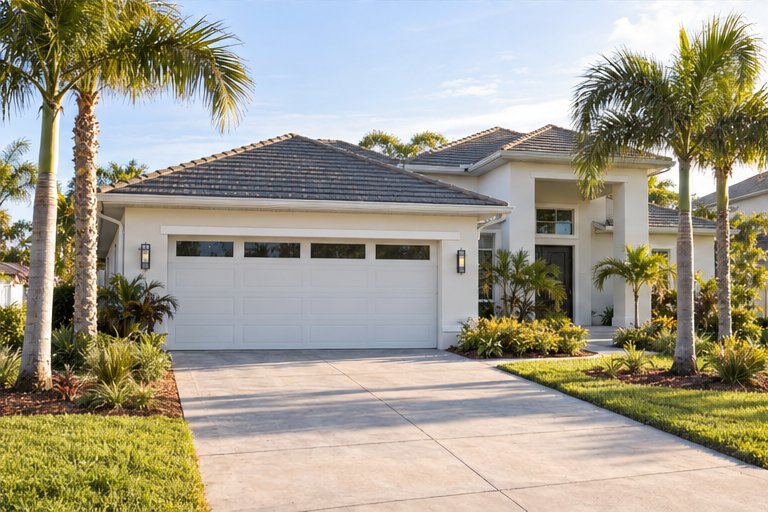
One city, several generations of garage doors
Drive through Rockledge and you will see the whole story of Florida home building. There are older houses with modest garages, mid age neighborhoods with two car doors and more recent streets with wide, tall openings and decorative panels. Each period used different hardware, different openers and different ideas about how much a garage should do.
That matters when something goes wrong, because the right repair depends on what is actually on the wall and ceiling. A part that fits a door from one generation may not fit another, and a safety feature that is standard on a recent opener may be missing on an older one.
This page is organized by the age of the garage rather than by the street, because that is how the problems actually divide. Find the description that sounds like your home, and you will know what to expect from a visit.
The older garage: smaller openings and original hardware
Older Rockledge homes often have a one car garage or a narrow two car opening, and many were built when a garage was mainly a place for a single car and a workbench. The door may be wood or an early steel type, and it may still use extension springs that run along the sides of the tracks, with cables looped over pulleys.
Extension spring systems have their own quirks. The springs stretch and lengthen over time, and when one breaks it can whip, which is why safety cables inside the springs matter. Our guide on the difference between torsion and extension springs explains how each one works and why the choice matters for an older door.
If your older garage has an original door, we will look at the panels for rot or sag, the hinges for wear, the tracks for rust and bending, and the springs and cables for age. Some of these doors can be kept running with careful repair. Others reach a point where replacement is the sensible, safer path, and we will say so plainly.
- Wood panels that have swollen, split or rotted at the bottom edge.
- Extension springs that look stretched, rusty or uneven side to side.
- Cables that are frayed, kinked or sitting loose on the pulley.
- Tracks that have loosened from the wall jamb or bent over the years.
- A manual door lift that has become heavy or uneven.
Retrofits: when the house changes but the door stays
Many Rockledge houses have been renovated. New roofs, new windows and new paint often come with a plan to update the garage door too, and sometimes the old door gets a modern opener without any other change. That is where retrofit problems begin.
An opener attaches to a header, a ceiling and a door. If the header is old, the ceiling is low or the door is heavy, the new opener may be installed at an awkward angle or without proper bracing. A door that was never meant to be motorized may also lack the reinforcement an opener needs at the top panel.
We look at how the opener is mounted, how the door is reinforced and whether the door is balanced before judging the opener. If you are considering a new opener on an older door, read about opener replacement first, and let us check the door before you buy.
The mid age neighborhoods: workhorse doors reaching their limits
The largest group of Rockledge garages are probably from the middle of the range: two car steel doors on torsion springs with chain or belt openers. They have been in service for years, they work most days, and they quietly approach the age at which parts fail.
Torsion springs are rated for a certain number of cycles, and on a busy household that number is reached sooner than owners expect. Rollers wear, hinges loosen, the weather seal hardens and the opener starts to complain. Often, several parts reach the end of their life in the same couple of years.
This is a good time for a thorough look instead of a single repair. If one spring has broken, its partner is usually close behind. If a roller has failed, the others are likely worn. Our page on torsion spring repair explains why springs are often replaced in pairs and why this is not an upsell.
Signs a mid age door needs attention
Look for a door that is louder than it used to be, that jerks or shudders as it moves, that hangs slightly crooked, or that sits lower on one side. An opener that is working harder, taking longer to start or reversing for no reason also points to wear in the door, not only the motor.
Newer streets: wide doors, windows and decorative panels
Recent construction in Rockledge brings taller and wider doors, often with window sections, carriage style looks and insulated steel. Heavier doors need stronger springs and a more capable opener, and any damage to a panel can matter more because the panels are structural.
Window sections can crack, and decorative hardware can loosen. Insulated panels hold up well, but a dent can crack the skin or break the foam bond. With a newer door, the question is often whether a single panel can be replaced to match, and the answer depends on the model and how long ago it was made.
Our page on garage door panel repair explains what can be repaired and what needs a new section. Take photos, record the model label if you can find one, and we will advise what is realistic.
Living near the river: humidity, trees and rain
The Indian River sits along the eastern edge of Rockledge, and the air in most neighborhoods stays humid for much of the year. Mature trees are another feature of the city. They give shade, but they also drop leaves, seed pods and branches onto driveways and bottom seals.
Humidity works slowly on steel parts. Springs, cables and hinges rust, and the bottom edge of the door gathers moisture. Wooden doors swell and stick in the wet season and shrink in the dry. In a garage with a shaded driveway, algae and moss can grow along the threshold, and the door can stick to a damp floor.
None of this is unusual for the Space Coast, but it does mean that a visit every year or so for inspection and lubrication of the correct parts is a good idea. Our service for maintenance and tune ups explains what is checked, and what is deliberately left alone for safety.
The generations at a glance
It helps to see the differences side by side. The table below is a general guide, not a rule, because every home has been repaired and altered over the years. Use it to describe your garage when you contact us, and we will confirm the details when we see the door.
If your garage does not fit neatly into one row, that is normal. Many houses have a door from one period and an opener from another, and both may have had parts replaced. What we care about is the condition of each part today.
| Garage generation | Common door and springs | Common opener | What usually needs attention |
|---|---|---|---|
| Older, modest garage | Wood or early steel door, often extension springs with cables and pulleys | Older chain drive or none at all | Panel rot, stretched springs, worn cables and bent tracks |
| Middle age, two car garage | Steel sectional door on torsion springs | Chain or belt drive, sometimes screw drive | Spring fatigue, worn rollers, hardened seals and tired sensors |
| Newer street, wide door | Insulated steel, windows or decorative panels, strong torsion springs | Belt drive with smart features | Cracked window sections, loose hardware, dented panels and wifi setup |
Matching what is already there
Homeowners often ask whether a repair will match the rest of the door. For mechanical parts such as rollers, springs, cables and hinges, the answer is yes: those parts are chosen by size, strength and fit, not looks. For panels, paint and trim, a match can be harder.
Colors fade in the Florida sun, and a new panel next to a faded one stands out. Manufacturers change designs and stop making old ones. If a section of your door is damaged and the model is no longer made, a new door may be a better route than a patchwork repair.
We explain the choice honestly. Our guide on whether to repair or replace your garage door sets out the questions to ask, including age, condition, safety and cost over time, so you can decide without pressure.
- Mechanical parts are chosen for strength and size, so they can be matched reliably.
- Panels and paint depend on the model, the age and the sun exposure of the door.
- A full replacement may look better than several mismatched repairs.
- An older opener does not need to be replaced just because the door is.
Reading the sounds in an older neighborhood
Neighbors who have lived on the same street for years often know the sound of every garage in the block. That is a useful skill, because a change in sound is usually the first sign that something is wearing. A door that was once quiet and is now loud has told you something.
Some sounds are harmless, and some are warnings. The trick is to notice what changed and when, and to stop using the door if the sound is sharp, violent or paired with a door that moves unevenly.
- A steady rumble from the rollers usually means worn or dry rollers, or grit in the tracks.
- A squeal or screech from the hinges or springs suggests they need attention from a technician, not a spray can on the springs.
- A loud bang followed by a door that will not lift is often a broken spring. Do not try to force the door.
- A grinding or slipping noise from the opener points to a worn drive part or gear.
- A pop or crack as the door starts to move may be a stressed panel, bracket or cable.
What to do with a loud bang
If you hear a bang from the garage and the door will not rise, leave it alone. Do not pull on the emergency release, do not try to lift the door by hand and keep people away from the spring area. Our page on a spring that snapped with a loud bang explains the next steps.
Sensors, remotes and the small things that stop a door
A great many calls start with something small. The door will not close, the light on the sensor blinks, the remote does nothing, or the keypad has stopped working. These issues are often not mechanical at all.
Start with the simple checks. Wipe the sensor lenses with a soft dry cloth, make sure nothing is in the beam and the two units face each other. Replace the battery in the remote, and make sure the opener has power. Do not go further than that if anything looks damaged.
Our page on blinking sensor lights explains what the signals mean, and when it is time to stop. If the sensors are aligned and clean and the door still refuses to close, there may be a wiring or board problem, and we should look.
Rental homes and absent owners
Rockledge has its share of rental properties and homes owned by people who live elsewhere for part of the year. A garage door at a rental sees many users, some of whom treat it roughly, and problems may go unreported until the door fails.
If you manage a rental, build a simple routine. Ask tenants to report noises, sticking or sensor trouble early. Keep a record of the opener model and the remote type. Replace lost remotes promptly, and consider changing keypad codes between tenants.
Tell us if you are an owner who cannot be on site. We can arrange the visit with a tenant or a property manager, and we will explain what we find so you have the information you need to decide. Our guide for garage doors in rental properties has a longer checklist.
Storm season and what happens to doors
Rockledge is inland of the open ocean but still feels hurricane season. Wind and rain from a storm test a garage door, because the door is a large, flexible panel facing the weather. Older doors, doors with weak panels and doors with loose tracks are most at risk.
Before a storm, look at the door for dents, loose hardware and tracks that are not firmly attached. Do not try to reinforce the door yourself with anything that blocks the springs or the tracks. After a storm, check for water in the opener, bent sections and damaged seals.
If you are uncertain whether a door is safe, leave it closed and call. Our page on hurricane season garage door service describes what we look at before and after the season.
How small faults chain together over a year
Most garage door failures are not sudden. They are the end of a chain. A hardened seal lets in humidity, which rusts a hinge, which loosens a roller, which makes the door sag a little, which strains the opener, which wears out its gear, which finally gives up on a hot afternoon.
Breaking the chain early is the real value of inspection. A technician who looks at the whole door can spot the stiff hinge or the frayed cable strand long before it becomes a stuck door. That is why we describe what we see at each visit, including the things that do not need fixing yet.
Keep a short note on your phone of dates and symptoms. When the door gets louder, slower or less even, write it down. A history like that helps us trace a problem to its start, and it helps you decide when a repair has reached the point where replacement makes more sense.
Planning a visit and what to have ready
A good visit begins with a clear description. Tell us what the door does, when it started and whether anything happened just before, such as a storm, a bump from a car or a power cut. Note the age of the home if you know it, because that helps us anticipate the hardware.
Clear the space around the door and the vehicles out of the way. If you can, find the labels on the door and the opener, usually on the end panel or the motor unit, and take a photo. Keep children and pets away from the area.
Our technician will look at the door, test the safety systems, explain what is wrong and describe the options in plain words. You decide what goes ahead. If you want to know more about how the visit runs, contact us and ask.
Questions and answers
Look at the door from inside. Torsion springs are coiled and mounted on a bar above the opening. Extension springs are long and run alongside the horizontal tracks. Do not touch either, because both hold dangerous tension. Tell us what you see, or send a photo, and we will confirm the type and its condition. The type matters because the safety steps and the parts differ.
Sometimes. If the frame of the panel is sound, hinges and rollers can be replaced and the door rebalanced. If the wood is rotting, sagging or split in several places, repair may not hold. We look at the door, explain the condition honestly and describe the options so you can decide. Photos of the panels and hinges make it easier for us to judge before the visit.
Usually yes, if the door is in good condition and properly balanced. The top panel may need reinforcement, and the mounting area must be solid. A heavy or unbalanced door will strain any opener, so we check the door first and explain whether the opener or the door is the real problem. Tell us the make of the opener if you can read it from the label on the motor unit.
Springs on the same door are the same age and have done the same work. When one breaks, the other is close to the end of its life. Replacing both keeps the door balanced and avoids a second visit. It is not mandatory, but we explain the reasons so you can choose. We will show you the old springs and explain how they wore.
It is common in humid places. Wood swells, tracks collect damp debris and the bottom seal can stick to a wet floor. Wipe the tracks and the seal with a dry cloth. If the door still binds or moves unevenly, stop using it and let us look at the tracks and rollers. Never force a door that binds, because that can bend a track or damage the opener.
Yes. We can arrange the visit through a tenant or manager and explain what we find, so an absent owner has the facts. Tell us the address, the issue and who will be there. We will describe what needs attention now and what can be watched. We will also explain what the owner should keep an eye on between visits.
Clear the space around the door and the vehicles, and keep children and pets back. If you can, photograph the door label and the opener label. Write down what the door has been doing and when it started. That information helps us bring suitable parts and explain what we find. It also helps to know where the opener remote and keypad codes are kept.