
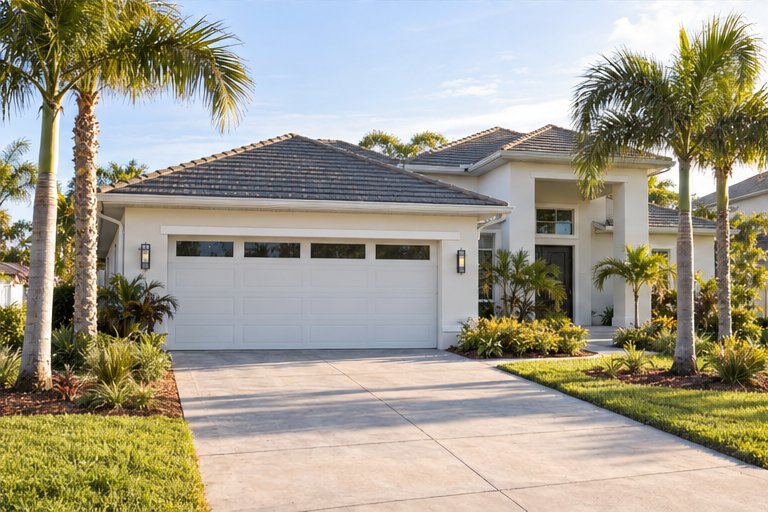
One island, many kinds of garages
People often talk about Merritt Island as if it were a single place, but a drive from one end to the other shows how much it varies. Some streets run along the water, with docks behind the houses and a boat lift in the yard. Others wind through quiet inland neighborhoods where the closest water is a retention pond.
Because the housing is so varied, so are the garages. You will find standard two-car attached garages, oversized bays built for trucks, detached buildings that serve as workshops, and carports that were enclosed years ago. Each calls for a slightly different approach.
This page is organized by type of property rather than by problem, since that is how most island owners think about their own garage. Find the one that sounds like yours and start there.
Waterfront and canal-side homes
If your house backs onto a canal or the river, your garage door works in a more demanding environment than most. Moist, salty air moves across the water and reaches the front of the house too, especially when the wind comes from the east or west.
On these lots, corrosion shows up first on lower hinges, roller stems, and the screws that hold track brackets in place. A door that looks fine from the driveway may have rust creeping behind the hardware, where you rarely look. Docks, boat lifts and outdoor showers all add splash and spray near the garage, so rinse and inspect more often if your door faces the yard or the water.
A habit that pays off here is a fresh-water rinse of the door and visible hardware every so often, followed by a dry wipe. Our guide to garage doors in a coastal climate lists the parts that wear first and what to watch for.
Inland subdivisions and newer builds
Away from the shoreline, much of the island is made up of subdivisions with attached two-car garages and standard sectional doors. Corrosion is less dramatic here, but the daily workload is higher. Families come and go, kids wheel bikes through, and the door may cycle many times a day.
In these homes, the wear tends to appear in rollers, hinges, weather seals and the opener. Rollers wear flat, the opener chain stretches, and sensors drift out of alignment when something bumps them.
If your home is relatively new, you may still have the builder's original door and opener. That is often a perfectly good setup, and regular tune-ups keep it that way. Our maintenance and tune-up service checks balance, hardware and safety features in one visit.
Homes from the space-program boom
Much of Merritt Island grew rapidly when the space program drew workers and their families to Brevard County, and many houses from that era still stand. Some have been renovated, some are lovingly original, and some have garages that were converted or extended along the way.
Older garages can have quirks that newer ones do not. The opening may be an odd width, the framing may have settled, and the slab may slope slightly toward the door. A door that was fitted decades ago may have been replaced once and adjusted by several different hands.
We take these garages as they are. If the opening is not square or the header has moved, we explain how that affects the door and what can be done. Replacement is not automatic, and we discuss repair first when it makes sense.
Boat garages and tall doors
Boating is part of island life, and plenty of owners keep a boat, trailer or personal watercraft under cover. Garages built for this purpose often have taller or wider doors, and the extra size means more weight, more spring tension and more strain on the opener.
A large door magnifies small problems. A slightly weak spring that a normal door could tolerate may leave a tall door heavy and hard to control. An opener that is just adequate may struggle on hot afternoons.
If you own a tall or double-wide door, have it checked as a whole system. Balance, springs, cables and opener power all need to match the door, not just the garage. Our balance and adjustment service explains how we test for this, and why it matters for safety.
Workshops and detached outbuildings
Detached garages and backyard workshops are common on larger island lots. They are often wired differently from the main house, with a single outlet or a long run of wire, and their doors may be older or custom built.
A detached building may lack a reliable connection to your home Wi-Fi, which matters if you want a smart opener. It may also have tools, paint and equipment that give off dust and fumes, which can wear on opener parts.
Because these buildings are used less often than a main garage, problems tend to go unnoticed. A door that has not been opened for weeks may have swollen, rusted or gathered debris in the track. Test it gently, and if it resists, stop and call rather than forcing it.
Springs, cables and the heavy parts
No matter which type of property you have, the springs and cables do the same job, and they are the parts we most want owners to leave alone. A torsion spring over the door stores a great deal of energy. If it breaks, the door becomes extremely heavy and the opener cannot lift it.
The usual sign is a loud bang from the garage and a door that will not rise. Sometimes the cable slips or snaps too, and one side of the door sits lower. Our page on a spring that snapped with a loud bang explains what to do and what to avoid.
Stay clear of the door, do not stand under it and do not attempt to lift it by hand beyond a careful release. We replace springs as a matched pair when appropriate and explain why.
Openers, remotes and everyday controls
On a larger island lot, the driveway can be long and the signal from a remote has some distance to cover. A remote that works near the house but not from the street may need a new battery, a repositioned antenna or an opener that is better suited to the property.
Keypads at the front door or beside the garage are popular because they let family members, cleaners and dog walkers in without sharing a key. They need fresh batteries and occasional code changes.
If a remote or keypad misbehaves, see remote and keypad programming for how we set up and troubleshoot these controls. Ask about options if your property has several doors, since each needs its own remote setting.
Storms, wind and rain on the island
Merritt Island is not as exposed as the beachside barrier islands, but it takes its share of tropical weather. Wind can bow a weak door, and heavy rain can blow sideways under a worn bottom seal and onto the floor.
Before hurricane season, look over your door and hardware. Check that panels sit straight, the track is firmly fastened, and the opener works normally on both the remote and the manual release. If you plan to install a storm-rated door, check local requirements and ask your insurance agent how it affects coverage.
For a wider look at what to do and when, see our hurricane season garage door service. After a storm, we can inspect for hidden damage that is not obvious from the driveway.
Drainage, flooding and the slab
Water in the garage is a common complaint on low lots. A bottom seal that does not meet the slab evenly lets water creep in, and a slab that slopes toward the door pools it against the threshold.
Standing water is bad news for a garage door. It rusts the bottom panel and hardware, swells wood trim, and sends moisture to the opener. If water collects near your door, a proper threshold seal and some attention to drainage can help.
We can fit a seal to match the shape of your slab, and we will tell you honestly when the problem is the ground, not the door. Moving a downspout or clearing a swale is often a better first step than replacing hardware.
Replacing a worn or damaged door
Sometimes a repair no longer makes sense. A door with many dented panels, a bent frame, or a long history of fixes may be better replaced. A new door can also improve appearance, insulation and noise.
On the island, material matters. Steel, aluminum, composite and wood all behave differently in salt and humidity. Our comparison of steel, aluminum, wood and composite doors sets out the trade-offs in plain terms.
We measure the opening, explain the choices and the installation steps, and check any local or association rules before ordering. Replacing a door is a decision, not a sales pitch, and we are happy to talk it through.
Curb appeal and neighborhood rules
On a street with matching houses, the garage door is often the largest visible feature of the home. A tired or mismatched door affects the look of the whole facade, which is why many owners think about style when they replace one.
Neighborhood associations on the island vary. Some have strict color and style requirements, and others leave decisions to the owner. If you are in a community with a board, check before you choose a door or change its color.
A well matched door, with panels, windows and hardware that fit the architecture, can lift the appearance of an older house without a bigger renovation. We can share the options and let you decide what suits your property.
Keeping a door healthy with simple habits
Most homeowners can do a few things to extend a door's life without touching anything dangerous. Wipe the tracks, clean the sensor lenses, and keep the area around the door clear. Listen for changes in sound and note when they began.
Test the safety reverse once a month with a roll of paper towels on the floor under the door. If the door does not stop and reverse on contact, stop using the opener until it has been inspected.
If you use the manual release cord, close the door first and pull the cord gently. Never release the door when it is partway open. A short monthly routine like this takes only a few minutes, needs no special tools, and often catches a problem while it is still small. Write the date of each check on a card near the door so you can see how things change over time, and mention any change to us at your next visit.
- Wipe tracks and rollers with a dry cloth
- Clean sensor lenses and check their alignment
- Look for rust, frayed cable strands and loose brackets without touching them
- Test the safety reverse once a month
- Keep the manual release cord clear and know how it works
Buying, selling and moving in
Island real estate changes hands often, and the garage door is easy to overlook during a sale. A home inspector may open and close it once, but a thorough look at springs, cables, balance and the safety reverse is a different matter. Buyers who learn about a tired door before closing can plan for it, and sellers who deal with it first remove a question mark.
If you have just moved into a house, take an afternoon to learn how the door works. Find the manual release, test the reverse feature, count the remotes you received and ask the previous owner about any keypad codes. Codes and remotes left with former residents are a security gap that is simple to close.
We can check a door before a sale or after a move, explain its condition in plain terms and reprogram the controls so only the right people have access.
Children, pets and the family routine
Island households use the garage as a back door. Kids drop bikes in the opening, dogs wait by the door for a walk and groceries come in and out all afternoon. All of that makes the safety features more important than they seem.
The photo-eye sensors near the floor stop the door when something crosses their beam, and they are the main protection for a child or a pet. Keep their lenses clean and aimed at each other, and never disable them to get around a nuisance problem.
Teach everyone in the home that the door is not a toy and that nobody runs under it as it closes. If a sensor light blinks or the door reverses for no clear reason, have it looked at. Our page on blinking sensor lights describes the usual causes.
What to expect when we visit
We come to the property, look at the door at rest, and run it through a few cycles. We check balance, springs, cables, track, rollers, hinges, seals, the opener and the safety sensors.
Then we tell you what we found in plain language, show you any worn or damaged parts, and go over the choices. You decide what to do. We do not rush anyone into a purchase.
If you have a particular problem, such as a door that will not close, describe it when you contact us. Our page on a door that will not close lists the common causes so you can see what we will look at.
Questions and answers
Usually yes. Moist, salty air speeds up rust on hinges, springs, cables and fasteners, even on a door that looks fine from the driveway. A fresh-water rinse now and then followed by a dry wipe, regular lubrication of moving parts and a yearly inspection help. If you see orange streaks near hardware, have a technician check it.
Yes. Tall and wide doors carry more weight and need springs, cables and an opener that match the door. We check balance and hardware as a complete system and explain what we find. Tell us the approximate size of the opening when you contact us so we can prepare for the visit, and mention anything stored near the door that might get in the way.
Do not force it, since a stuck door can hide a broken part. Stop, check that nothing is blocking the track and that the lock is released, then try gently once. If it still resists, a swollen panel, rusty roller or damaged spring may be the cause. Contact us and we will look at it, explain what we find and discuss the options.
Often it is, as long as the panels and frame are sound and the door still lines up well in its opening. Springs, rollers, cables and openers can be replaced without changing the door. If the panels are badly dented, rotted or rusted through, replacement may make more sense. We look at the whole door and explain both paths so you can decide.
Look first at the bottom seal. A hardened or cracked seal lets water in, and so does a slab that slopes toward the door. We can replace the seal and fit it to the floor shape. If the cause is drainage outside, we will tell you honestly and suggest you look at the ground as well, such as a low spot or a downspout that empties near the slab.
It depends on your Wi-Fi signal where the building sits. Many smart openers need a steady connection to your router, which can be weak in an outbuilding, and a weak link makes the app unreliable. A signal booster or a different setup may help. We can explain the options and check the signal strength during a visit.
Look at the panels and frame together. Minor dents, worn rollers, weak springs and tired openers are usually repairable. Several buckled panels, deep rust, rot or a door that keeps going out of alignment may point to replacement. We inspect, tell you what we see and go over the costs of each option with you in person.