
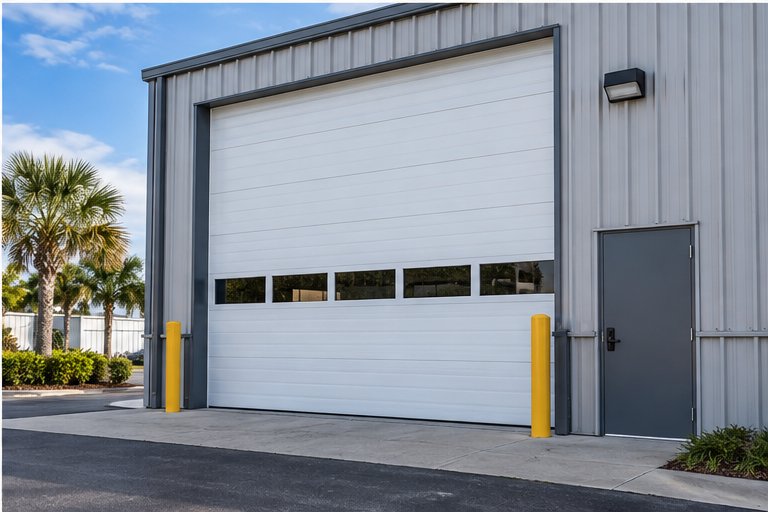
Why a business door is a different kind of problem
A home garage door might open twice a day. A door at a delivery bay, a repair shop or a self-service business can cycle many times in a single shift. Every cycle loads the springs, wears the rollers and hinges, and works the opener. The parts are the same family as those on a house, but the wear arrives faster.
There is also a difference in consequences. When a home door fails, the family parks in the driveway. When a commercial door fails, a truck may be stuck outside, a bay may be unusable, or a building may be impossible to secure overnight. The cost of an unplanned stop is often larger than the cost of the part.
Planning is the answer. Not elaborate planning, just a short routine, a clear owner for it, and a relationship with a service company that knows your doors before there is an emergency.
Know what kind of door you actually have
Maintenance starts with identification. Commercial properties on the Space Coast tend to use a handful of door types, and each has different needs. A sectional door looks like a larger version of a residential one and travels up a track onto the ceiling. A rolling steel door coils into a barrel above the opening. Some sites have both, plus a service door beside the bay.
Write down for each door its location, its approximate size, how it is operated and how it is used. Is it opened by an opener, a chain hoist, a wall switch, or by hand? Is it a daily loading door or a door that opens once a week? Is it exposed to the weather, or inside a building?
That list becomes the backbone of your plan. Our guide to residential versus commercial garage doors explains how the two families differ, and our page on commercial garage door service describes the work we do on business properties.
Daily and shift level habits
The strongest early warning system is a person who uses the door every day and knows what normal looks and sounds like. Employees who open and close a bay are the first to notice a new noise, a door that drifts, or an opener that hesitates. The trick is to give them a simple way to say so.
A short walk around and a few seconds of attention at the start of a shift is enough. No tools are needed, and nobody should be touching springs or cables. The point is to notice and report, not to repair.
- Watch and listen as the door travels. Note any new scraping, popping, grinding or jerking.
- Check that the door moves smoothly and stops where it should, without drifting.
- Look at the floor and the track area for debris, pallets, or anything leaning on the door.
- Make sure the photo-eye lenses are clean and the sensors are not blocked.
- Confirm the door can be closed and secured at the end of the day.
- Tell a named person right away if anything seems different, and do not keep using a door that behaves unsafely.
A monthly look that anyone can do
Once a month, someone responsible should spend a little longer on each door. This is a visual and listening check, with the door closed and then operated through a full cycle. It is similar to a home checklist, scaled to a business setting, and our monthly garage door checklist is a good starting point.
Look at the hinges and the rollers for wear or cracks. Check the panels for dents, especially around the lower sections where forklifts, carts and trucks tend to make contact. Look at the weather seal along the bottom and the sides for tears or gaps that let in rain, pests and dust.
Operate the door and compare what you see to last month's notes. If you do not keep notes, start now. A short line in a log with a date and initials turns a vague feeling into something a technician can use.
What not to touch
This is the most important section of the guide. Garage door springs, lift cables, drums and the brackets that hold them are under heavy tension, even when the door is closed. A slipped tool or a loosened bolt can cause serious injury, and commercial doors are larger and heavier than residential ones, so the forces are larger too.
Staff and maintenance workers should never adjust, loosen, tighten or replace springs, cables, drums or bottom brackets. That applies to experienced handymen as much as to new employees. Simple tasks such as wiping photo-eye lenses, sweeping debris, and reporting problems are appropriate. Spring and cable work is for trained technicians.
If a door has a broken spring or a frayed cable, tag it out of service. Stop using it and keep people clear. If someone is hurt, call 911 first. Our page on garage door cable safety explains why these parts deserve respect.
Setting a service schedule that fits your use
How often a professional should look at a door depends on how hard it works, and we do not want to hand you a number that does not fit. A door that cycles heavily through the day deserves attention more often than one used occasionally. A coastal location, with salt in the air and a lot of humidity, adds to the wear on metal parts.
A sensible approach is to match the schedule to the use. Heavy use doors get a regular planned visit, with the interval agreed after the first inspection. Moderate use doors get a periodic inspection and a tune up. Rarely used doors still need an occasional look, because they can seize or drift when they sit idle.
Ask the service company to put the schedule in writing, along with what each visit includes. A planned visit is usually calmer, easier to fit around your operations, and less disruptive than a failure in the middle of a busy week. See our maintenance and tune-up page for what a visit covers.
What a professional inspection looks at
A trained technician looks at the whole system, not only the part that is complaining. That means the spring or springs, the cables and the drums, the track alignment, the rollers, the hinges, the opener and its safety devices, the panels and the seals. Each of these affects the others.
The inspection includes a balance test. A properly balanced door stays where you leave it when it is partway up. A door that drifts up or slams down is telling you the springs no longer match the load. Balance matters on commercial doors because an unbalanced door puts extra strain on the opener and the track.
The safety devices are tested too. Photo-eyes, edge sensors where fitted, and reversing behavior should all respond as designed. Our guide to garage door safety tests explains the checks in plain terms. After the visit, we explain what we found and what the options are, so you can decide what to do and when.
Lubrication and cleaning on a busy site
Moving parts need the right lubricant in the right places, and just as importantly, they need to be kept clear of the wrong ones. Dust and grit stick to oil and form a paste that wears rollers and hinges. A lightly applied, suitable lubricant on the right points does more good than a heavy spray everywhere.
Do not put grease or oil on the track surface where the rollers ride, and do not use heavy products that attract dirt. Wipe excess off. The door should be lubricated according to the manufacturer's guidance and by someone who knows which points to treat and which to avoid.
Cleaning matters as well. Wash the panels periodically to remove salt and road film, which can eat into finishes. Clear leaves, sand and trash from the track area and from the bottom seal. A clean door is also easier to inspect, because damage stands out.
Keeping a simple service record
Most businesses already keep records for vehicles and equipment. Doors deserve the same treatment. A single sheet per door, kept in a binder or a shared folder, makes it easy to see patterns and to hand useful information to a technician.
Record the date, who inspected or serviced the door, what was found, what was done, and anything recommended for later. Note any incidents, such as a truck strike or a power outage. Over time you will see which doors fail first, which ones are drifting out of adjustment, and which repairs keep returning.
A record also helps with insurance and with property managers. If a landlord is responsible for some doors and the tenant for others, a clear history avoids arguments about who knew what and when.
Planning around downtime
Every business has busy and quiet periods. Schedule inspections and non-urgent work for the quiet ones, and let the service company know about your operating hours. We cannot promise a particular arrival time or a set completion time, but we can plan work with you, and we will explain the scope of any repair before it starts.
For businesses with several bays, consider working on one door at a time so the rest stay available. For a single critical door, think about what you would do if it were out of service: is there an alternate entrance, a temporary closure, or a way to secure the opening?
Having a plan for a failed door is part of maintenance. It does not have to be elaborate. A short note stating who to call, where the manual release is, and how to secure the building is enough to prevent confusion on a stressful day.
Common causes of avoidable failures
Many commercial door problems have familiar origins. Looking at them in advance helps you target the habits that matter. None of these is exotic, and most can be reduced with awareness and a little discipline.
Impact damage
Forklifts, pallet jacks, trucks and carts strike the lower panels and the track more than anything else. A bent track or a damaged section may still seem to work, but it adds friction and stress. Marking the bay edges and training drivers reduces strikes. After any impact, stop and have the door checked.
Running a door in the wrong condition
Using a door with a broken spring, a frayed cable or an off-track panel turns a modest repair into a larger one. The opener is not designed to lift the door on its own, and forcing it can strip gears and damage the track.
Deferred small repairs
A worn roller, a loose hinge or a torn seal is a small item today. Left alone, it changes how the door runs and passes strain to neighboring parts. Dealing with minor wear early is usually kinder to the door.
Neglected openers and sensors
Dust, misalignment and loose wiring cause nuisance reversals and stops. These are irritating, but they also tempt people to bypass safety devices. Do not allow sensors to be disabled or covered.
Florida conditions that matter to a business door
The Space Coast climate affects doors in several ways. Salt from the Atlantic and the Indian River Lagoon accelerates corrosion on exposed hardware, particularly on properties near the water. Heat and humidity age seals and lubricants. Afternoon thunderstorms drive rain at the bottom of the door, and hurricane season brings wind loads that doors must be built to resist.
Before storm season, take stock of each door's condition. Look at the seals, the hardware, the track mounting and the general state of the panels. A door in poor repair is more likely to be damaged in high wind. Our hurricane preparation guide describes sensible steps, and it applies to commercial properties too.
After a storm, do not operate a door that looks damaged. Check for debris and bent parts first, and keep people clear until a technician has had a look.
Security and after-hours closing
A business door is also a security boundary. At closing time, someone should confirm that each door has actually come all the way down and is locked or otherwise secured. A door that reverses on a sensor or stops short can leave the building open without anyone realizing.
Consider who has remotes, keypad codes or keys, and review that list when staff change. A code that has been shared for years is an invitation. Change codes when people leave, and keep a record of who holds what.
If a door has been struck, forced or tampered with, have the lock hardware and the track inspected. Bent latches and damaged tracks can look minor but will not hold up against a determined attempt.
Working with a service company
The relationship matters as much as the tools. Choose a company that is willing to explain what it finds in plain language, that shows you the worn or damaged part, and that does not pressure you into work you do not understand. You should be able to ask what a recommendation means and what happens if you wait.
It helps to give the technician your door list and your service record at the first visit. It also helps to tell them how the door is used, which hours are busiest, and what has gone wrong before. Our guide on questions to ask a garage door technician gives you a list to work from.
Remember that we do not set prices or times in a guide like this, since they depend on the door and the work. What we can say is that we will look at the door, explain what we find and lay out the options.
A simple annual plan you can adapt
Putting the pieces together, here is a pattern that many businesses find workable. Adapt it to your doors, your staff and your season. The point is to make it routine, not to make it elaborate.
| When | Who | What happens |
|---|---|---|
| Start of each shift | Door users | Watch and listen during a normal cycle; report anything unusual |
| Weekly | Site supervisor | Clean sensor lenses, clear debris from tracks, look at seals |
| Monthly | Maintenance lead | Visual check of hinges, rollers and panels; update the door log |
| Periodic, set by use | Service technician | Inspection, balance test, safety device test, lubrication |
| Before storm season | Manager and technician | Review condition of all doors, seals and mounting |
| After any impact or storm | Manager | Take the door out of use and arrange an inspection |
Getting started
If you have never had your doors looked at as a group, a first walk through is a good way to begin. We will go door by door, explain what we find, and help you sort what needs attention now from what can be watched. From there you can set a rhythm that fits your business.
To talk through your property, use our contact page and tell us how many doors you have, what type they are and how they are used. The more we know in advance, the more useful the visit will be.
Questions and answers
It depends on how often the door cycles and where the building is. Heavy use doors and coastal locations call for more frequent attention than rarely used doors. After a first inspection a technician can recommend an interval and put it in writing. Between visits, daily observation and a monthly look from your own staff fill the gaps.
No. Springs, cables, drums and bottom brackets hold dangerous tension, and commercial doors carry larger forces than residential ones. Staff can clean sensor lenses, clear debris and report problems, but spring and cable work belongs to trained technicians. If a spring has broken or a cable looks frayed, stop using the door and keep people clear.
Stop using it, keep people away from the door, and note what happened. Use the manual release only if you know how and the door is safe to handle. Then arrange a technician to look at it. A written plan that names who to call and how to secure the opening makes this much less stressful.
Yes. Properties near the ocean or the lagoon see faster corrosion of hinges, track, fasteners and springs, and humidity ages seals and lubricants. Regular cleaning, attention to rust spots and periodic professional inspection help. A technician can point out parts that are wearing faster than expected for the site.
Yes, and it need not be complicated. A dated line for each inspection, repair and incident shows which doors fail first, which parts keep returning and what has been recommended. It also helps a new technician or property manager understand the history, and it avoids disputes about who knew what.
Schedule non-urgent work for quiet periods and tell the service company your operating hours. Decide in advance how you would secure the opening and handle deliveries if the door were out of service. We cannot promise a particular time, but we will explain the scope of the work before it begins.
Stop using the door and have it inspected, even if it still moves. Bent tracks, damaged panels and shifted brackets add friction and strain, and they can fail later without warning. Do not try to straighten parts yourself. A technician can assess the damage and explain whether repair or replacement makes sense.