
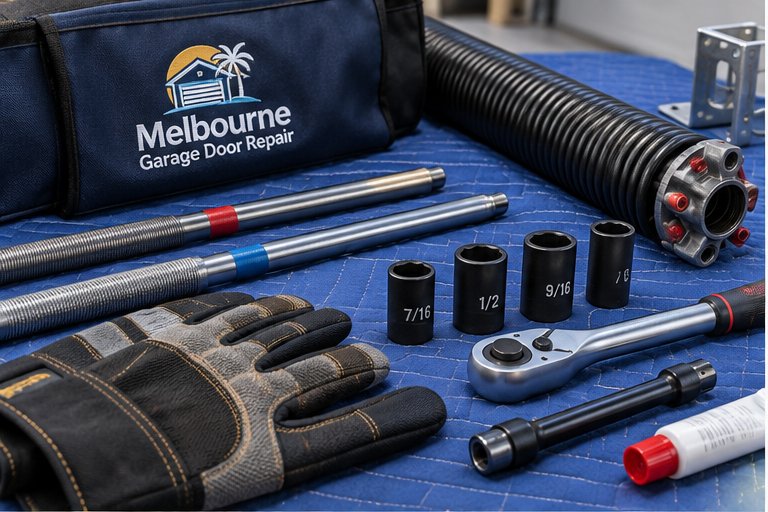
What this job is, and what it is not
Lubrication means putting a thin film of the right product on the small moving joints of the door so metal does not rub on metal. It is a cleaning and comfort job, not a repair. It will quiet a dry hinge and ease a roller stem, but it will not fix a bent track, a worn spring or a loose bracket.
That distinction matters for safety. People sometimes reach for the spray can when a door starts making a worrying sound, hoping to silence it. If the noise comes from a part that is under tension or damaged, a quiet door can simply hide a growing problem. We will point out those moments as we go.
Everything below can be done from the floor, with the door closed and the opener switched off. You will not need a ladder, and you will not touch the springs, the lift cables or the large brackets at the bottom corners of the door.
Gather the right supplies first
A short supply list makes the job tidy. Choose products that are made for garage doors. General household oils can thin out and run, and some products leave a sticky film that collects sand and dust, which is a real concern when a house sits near a beach or a dirt road.
- A spray lubricant labeled for garage doors, usually silicone based or a white lithium type.
- A small can with a thin straw or a fine nozzle, so the product goes where you aim it.
- Clean rags or paper towels, and a dry brush for loosening grit.
- A flashlight for seeing the hinges and roller stems clearly.
- Closed shoes, safety glasses and light gloves.
- A sheet of cardboard or an old towel to protect the floor and the car.
Step one: make the area safe
Park the vehicles outside, or well away from the door, and clear the floor under it. Close the door fully. Switch the opener off at the wall control if it has a lock button, or unplug the opener from its outlet so nobody can start it by accident while your hands are near the hinges.
Tell everyone in the home that you are working on the door, and keep children and pets out of the garage until you are finished. A garage door can look harmless when it is closed, but a bump on the wall control or a remote in a pocket can start it moving.
Stop here if the door is already off its track, if you see a visible gap in a spring, if a cable looks loose or frayed, or if anything is bent. Lubricating a damaged door does not make it safer. Call us instead.
Step two: clean before you lubricate
Lubricant over dirt is worse than no lubricant, because it turns dust into a grinding paste. Wipe each hinge, roller and the visible part of each track with a dry rag. Remove cobwebs, leaves and sand with the brush.
Take your time on the tracks. Run a clean rag along the inside face of each vertical track, then the curved section, then the horizontal part you can reach. The goal is a clean, dry surface where the rollers travel. Do not spray cleaner or lubricant into the track, because the rollers should roll, not slide, and a slick track can make them skid.
A word on solvents
Strong degreasers can damage nylon rollers, rubber seals and painted finishes. A damp cloth with a little mild soap is plenty for most cleaning. Dry everything afterward so no moisture sits in the hinge knuckles.
Step three: the hinges
Hinges are where most squeaks begin. Each one has a pivot where the two leaves meet, and often a small gap where the pin passes through. Aim the straw at that pivot and apply a short burst. A little goes a long way.
Work along the door, one hinge at a time, and wipe away any drips right away. Do not spray the hinge leaves that are bolted to the panel, and do not spray the screws or bolts. The goal is to wet the moving joint, not to coat the entire door.
If a hinge looks cracked, bent or pulled away from the panel, stop. Our page on hinge and track service explains what a technician does with damaged hinges, and why they should not be left to wear further.
Step four: the rollers
Rollers come in steel and nylon, and in sealed and open bearing types. Steel rollers with exposed bearings can take a small amount of lubricant at the point where the stem meets the roller body. Nylon rollers with sealed bearings usually need little or none.
Do not spray directly into the track, and avoid soaking the roller wheel. Aim for the joint at the stem, wipe off any excess, and let the product settle. If you are not sure which type you have, our overview of types of garage door rollers shows what each kind looks like.
While you are here, watch for rollers that wobble, have flat spots or sit loosely in the track. Those are signs of wear rather than dryness, and they belong on a technician's list, not under a spray can.
Step five: the opener rail or chain
If you have a chain or screw drive opener, the moving carrier or chain can take a light application of lubricant intended for that purpose. Belt drives usually need no lubrication at all, and spraying a belt can damage it.
Check your owner's manual or the opener label for what the manufacturer recommends. Apply only to the part named, with the opener unplugged and the trolley away from the area you are working on. Wipe up excess so it does not drip onto the car.
If the opener makes grinding or clunking sounds after lubrication, or the chain hangs low and jumps, stop. Our page on a chain that jumped or a belt that is slipping explains why those situations need attention beyond a spray.
What never gets lubricant
This is the heart of the safety message. A short list of parts should stay untouched, and the reasons are practical as well as protective.
- Torsion springs and extension springs. Lubricant does not make a spring safer, and putting your hands near one is dangerous.
- Lift cables and the drums they wind on. Oil can attract dirt that wears the strands.
- The bottom corner brackets that anchor the cables, which carry the full tension of the system.
- The inside surface of the tracks, where rollers need grip.
- Rubber and vinyl weather seals, which may swell or crack if exposed to petroleum products.
- Plastic or nylon parts not named by the manufacturer.
A note on the springs and why the rule is firm
You may find advice online suggesting a light spray on springs to reduce noise. We do not recommend it for a homeowner. The spring on a typical door holds a great deal of stored energy, and the area around it is exactly where an injury happens if something slips.
Spring squeak is also a diagnostic sign. A spring that complains may be rusting, may be rubbing the shaft or may be near the end of its working life. Silencing it with a spray can hide the signal. A technician can look at the spring, judge its condition and decide whether it can be left alone or should be replaced as a set.
If a spring is visibly gapped, stretched, rusted heavily or broken, do not use the door. Our guide on how long garage door springs last explains typical wear patterns without suggesting you do any work on them.
Step six: work the door through and wipe up
When you have finished, stand back and inspect for runs and drips. Wipe the hinge area and any parts where product has collected. Then reconnect or plug in the opener and run the door through one full open and close cycle while you stand clear and listen.
The lubricant needs a few cycles to spread, so do not judge the result after a single trip. After three or four cycles the sound should be smoother and the rollers quieter. Wipe off any new drips, and keep the first cycles under supervision.
If the door still shakes, judders or makes a sharp bang, do not keep running it. Lubrication cannot cure those problems, and our page on a very loud garage door sets out what the different sounds usually mean.
How often to lubricate on the Space Coast
Humidity, rain and salt air shorten the interval compared with a dry inland climate. A reasonable pattern for most Brevard and Indian River homes is to check the hinges and roller stems every few months, and to lubricate when they look dry or sound dry, not on a rigid date.
Homes close to the beach or the lagoon may find that metal dries out sooner, and that surface rust appears where bare steel is exposed. Wipe those spots when you see them, and keep an eye on chipped paint. Storm season is a good time to look again, since heavy rain can wash lubricant out of the joints.
| Part | Lubricate? | Notes |
|---|---|---|
| Hinge pivots | Yes, lightly | Wipe off excess, avoid the bolts and screws |
| Roller stems, steel rollers | Yes, lightly | Aim at the stem joint, not the track |
| Nylon rollers with sealed bearings | Usually no | Check the maker's advice |
| Chain or screw drive carrier | Per the opener maker | Opener unplugged first |
| Belt drive | No | Spray can damage the belt |
| Springs, cables, drums | Never | Technician only |
| Tracks (inside face) | No | Wipe clean and dry |
| Weather seals | No | Use only products made for rubber |
Choosing between silicone and lithium products
Silicone sprays are clean, dry soon after spraying and are gentle on rubber and plastic. They are a sensible choice for hinges and rollers on most homes, and they attract less dust than a heavy oil. Lithium based sprays are thicker, stay in place longer and suit exposed steel joints that carry more load, but they can collect grit if overapplied.
Avoid products that are mostly solvent, such as general loosening sprays, as a long term lubricant. They clean well but evaporate, leaving the joint dry. Avoid heavy grease on hinges, because it picks up sand and fibers. Whatever you choose, check that the label names garage door use or metal on metal joints.
If you are unsure what product suits your door, ask us during a visit. Our noisy garage door service includes looking at the cause of the sound, not just applying product.
Mistakes that make a door noisier
Most lubrication trouble comes from doing too much, not too little. A door that looks glossy and wet is usually a door that will be gritty in a month, because sand and pollen stick to every surface that stays damp.
The mistakes below are common, and every one of them is easy to avoid with a little patience.
- Soaking the hinges until product runs down the panel, which stains paint and draws dust.
- Spraying the whole door in one sweep instead of aiming at the moving joints.
- Lubricating the track so the rollers slide instead of turning.
- Using a thick grease on hinges that sit in a sandy, windy spot.
- Skipping the cleaning step and sealing dirt into the joint.
- Ignoring a new sound because the spray briefly covered it.
Doors with wood, windows or special finishes
Wood and composite doors need a gentler hand. Keep spray away from the painted or stained surface, since overspray can leave marks that are hard to remove. Use a rag to apply product to a small area, and test a hidden spot first if you are unsure about the finish.
Doors with glass or plastic window inserts should be kept clear of lubricant. Spray on glass leaves smears, and some plastics are damaged by solvents. Cover the window area with a towel while you work on the nearby hinges if the hinge sits close to the frame.
Insulated steel doors with a foam core behave like any other sectional door as far as the hinges and rollers go, but the finish can be scratched by a stiff brush. Use a soft rag around the panel faces and keep to the metal joints only.
Troubleshooting after you lubricate
Sometimes the noise remains. That is information, not failure. A squeal that disappears points to dryness. A rhythmic tick that stays may be a worn roller. A groan from the top of the door may be a spring or bearing at the end of the shaft, and a pop near the top may be a cable or drum issue.
In none of those cases should you try to correct the problem by spraying more. Excess product on the hinges can run onto panels and draw dirt, and extra spray on the tracks can make rollers slip. Record what you heard and when, because a good description helps a technician narrow things down before they arrive.
Rust on the parts you can see
Light rust on hinge leaves or track edges can be wiped and watched. Heavy flaking or rust at the brackets and springs is different. Our page on rust on a garage door and track explains the difference.
When to ask for a professional visit
A good maintenance habit includes knowing when to hand the job over. Call if the door is heavy to lift, if it drifts when you stop it halfway, if cables look worn or if a spring looks different from the day before. Those are signals that the system is unbalanced or worn, and lubricant will not help.
Our technicians come to the property, look at the door, explain what they find and fix or replace what is needed. You can contact us to ask about a tune-up that covers lubrication of the correct parts along with a safe look at the tension components.
Questions and answers
General loosening sprays clean well but evaporate, leaving the joint dry within a short time. For hinges and rollers it is better to use a product made for garage doors, such as silicone or white lithium. Whatever you use, keep it away from the springs, cables and seals.
The sound may be coming from a part that lubricant cannot help, such as a worn roller, a bent hinge, a dry bearing or a spring. If you have cleaned and lubricated the right points and the squeak continues, a technician can trace the actual source.
No. The rollers need to grip the track as they roll. A slick track can make rollers skid and collects dust and sand. Wipe the inside of each track clean and dry with a rag instead, and lubricate only the hinge pivots and roller stems.
We advise against it. Springs hold dangerous tension, and a noisy spring can be a sign of wear or rust. Spraying it may quiet it but hides the warning. Have a technician inspect it, and do not place your hands near it.
It varies with the product, the door and the weather. In humid, salty conditions near the coast, joints may dry sooner. Check the hinges and roller stems every few months and lubricate when they look or sound dry, rather than following a set date.
Usually not. Belt drives run quietly without it, and spraying the belt can harm it. Follow the manufacturer's instructions for your opener. Some chain and screw drives do take a light application on the named parts, with the opener unplugged first.
Wipe it up with a dry rag right away. Product left on rubber can soften or discolor it, and product on the concrete can make it slippery. A little mild soap on a damp cloth removes most residue, and the floor should be dry before anyone walks there.