
What a jackshaft opener is
Most garage door openers hang from the ceiling. A motor unit mounts in the middle of the garage, a rail runs toward the door, and a trolley pulls the door up and down by an arm. A jackshaft opener works on a different idea entirely.
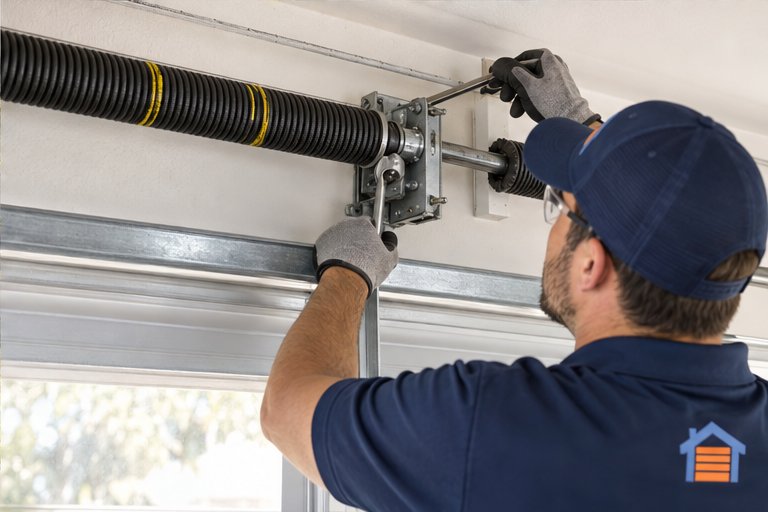
Instead of pulling the door along a rail, a jackshaft opener mounts on the wall, close to the end of the torsion spring shaft above the door. It turns that shaft directly. Since the shaft is what lifts the door through the cables, turning it raises and lowers the door.
The result is a compact motor unit on the side wall, a ceiling that is clear from front to back, and a door that is lifted from the point where the lifting actually happens. The approach has been used for years on commercial doors and is now common in homes too.
Where side-mount openers make sense
A wall-mount opener is not simply a nicer-looking version of the usual one. It solves particular problems, and it is worth choosing for those reasons. The situations below are where we see them used most often.
If none of them describes your garage, a conventional opener may serve you well. Our guide to opener drive types compares the ordinary choices.
- Garages with high ceilings, where a tall space is used for storage racks or a lift
- Garages with very little headroom above the door
- Doors with high-lift or vertical-lift track arrangements
- Garages that have a loft, a hoist or a hanging bike or kayak storage system
- Spaces where a ceiling-mounted rail would get in the way of a boat or a tall vehicle
- Garages with a finished or decorated ceiling that the owner prefers to keep clear
- Homeowners who want a quieter system, since the motor is not attached to the ceiling
What your door needs for a jackshaft opener
A jackshaft opener turns a shaft, so the door must have one. That means a torsion spring system, where a spring sits on a horizontal shaft above the door. Doors with extension springs on the sides, and no shaft, are generally not suited to this kind of opener without other changes.
The door also needs a suitable amount of open wall space beside the shaft, where the motor unit will mount. The wall must be solid enough to hold it, and the area around the shaft end must be clear. Some drum and bearing setups suit a particular model better than others.
Our team checks the shaft, the drums, the end bearing, the cable condition and the wall before recommending anything. If the door needs other attention first, we say so. Our guide on torsion and extension springs explains the difference.
Advantages worth knowing about
The biggest advantage is space. With no rail and trolley, the center of the garage ceiling is open. That matters when you want to hang storage, install a lift, store a boat on a rack or use a high-roof vehicle.
Other benefits depend on the model. Many wall-mount openers are quiet in use, since the motor is not attached to the ceiling joists that can carry vibration through the house. Many include a battery backup option, and many are designed to connect to a home network.
They also lift the door where the lifting force is applied, the shaft, and that can be gentler on a door's panels than a long arm pulling at the top. We do not promise any specific result, but the design has clear mechanical logic.
Limits and trade-offs
A jackshaft opener is not for everyone. It needs a torsion spring door, and it needs wall space beside the shaft. The range of models and accessories can be narrower than for ordinary ceiling units, so your choices may be fewer.
They also depend on the door being in good mechanical condition. Because the opener turns the shaft directly, it sees the full effect of any balance problem, a worn drum, a damaged cable or a bent shaft. A door that is out of balance should be put right before a new opener goes on.
The installation is also more particular than for a basic ceiling-mounted opener. We discuss all of this before you decide, and we will tell you if a conventional opener is the better route.
Ceiling-mount and wall-mount compared
The table sets the two approaches side by side. It shows general patterns that apply to many garages, not firm rules, and each model has its own details.
We use it to start a conversation about your garage, your door and how you use the space.
| Feature | Ceiling-mount opener | Wall-mount (jackshaft) opener |
|---|---|---|
| Where the motor sits | On the ceiling, with a rail to the door | On the wall beside the spring shaft |
| Ceiling space | Occupied by the rail and motor | Open from front to back |
| How it moves the door | Pulls with a trolley and arm | Turns the spring shaft |
| Suits high-lift or low-headroom doors | Sometimes, with limits | Often a good fit |
| Spring type needed | Works with torsion or extension | Needs a torsion shaft |
| Wall space needed | Little | Clear space beside the shaft |
| Noise carried through the ceiling | Can be noticeable | Usually less transmitted |
Why the door must be in good shape first
The shaft, drums, cables and springs are the heart of the door, and a jackshaft opener connects directly to them. A worn bearing, a frayed cable, a bent shaft or a tired spring will show up in how the new opener behaves, and in how long it lasts.
This is why we inspect the door before an installation. If a spring is worn, a cable is frayed or the balance is wrong, we explain what we see and what needs attention first. These parts hold dangerous tension and are never a homeowner job. Our pages on balance and adjustment and on drum and bearing service describe work we do for that purpose.
Fitting a new opener to a door that is not in good order is a false economy. The opener is asked to do the springs' job and will wear out sooner.
How an installation goes, in outline
We begin with the inspection and a conversation about how you use the garage. We then confirm the model that suits the door and the wall, and agree what the job includes. The steps below describe the general order of the work, and details vary with the model.
A technician handles each step, since several involve parts under tension or work at height. This overview is meant to help you understand the process, not to teach it as a do-it-yourself project.
Preparing the door and shaft
The technician makes the door safe to work on, checks the spring, drums and bearing, and confirms that the door is balanced. Any worn part is raised with you before going further. The area around the shaft end is cleared and the wall surface is checked for solid mounting.
Mounting and connecting the unit
The motor unit is fixed to the wall and coupled to the shaft following the maker's instructions. Power is run to the unit, and the wall control, sensors and any accessories are connected. Everything is positioned so the unit is accessible for service and clear of moving parts.
Setting limits and testing
The travel limits are set so the door stops where it should, open and closed. The technician tests the safety sensors and the reversal, confirms the force settings, programs remotes and keypads, and runs the door through several cycles. Finally, the unit and the manual release are explained to you.
Safety features you should expect
Any opener we fit should have safety sensors near the floor and a reversal that responds to resistance. A wall-mount opener should also have a means of operating the door by hand when the power is off, and we show you how it works on your particular model.
We test these features at the end of every installation, and we encourage you to repeat simple checks regularly. Our guide to garage door safety tests explains the checks that a homeowner can safely do.
If a door has no working sensors, or the reversal has failed, we do not leave it that way. Safety features are not optional extras, and an installation is not finished until they have been tested.
Power outages and battery backup
Storms and outages are part of life on the Space Coast. An opener that cannot run without mains power leaves the door dependent on the manual release, which is fine for occasional use but awkward for a household that comes and goes.
Many wall-mount openers offer a battery backup, either built in or as an add-on. A backup lets the opener keep working through an outage for a limited number of cycles. We will tell you what your chosen model offers and how long to expect the battery to last before it needs replacing.
Our page on battery backup for garage door openers explains how backups work and what to expect.
Smart features, remotes and keypads
Most wall-mount openers work with remotes and wireless keypads, and many connect to a home network for use with a phone. Which features come built in and which are optional differs between models.
We help you decide what you actually want. For some households that is simply a reliable remote and a keypad. For others it is alerts, scheduled closing and the ability to check the door from anywhere.
Security matters here, too. Modern openers use changing codes, and your keypad code should be treated like a house key. See our page on garage door keypad installation for more on that side of the system.
Questions to ask before you choose
A short list of questions will clarify whether a wall-mount opener suits you. Bring them to the discussion with any installer, including us.
None needs a technical answer from you. They simply help match the equipment to the garage.
- Does my door have torsion springs on a shaft above the opening?
- Is there clear wall space beside the shaft for the unit?
- Is my door in good mechanical condition, and balanced?
- Do I need the ceiling clear for storage, a lift or a tall vehicle?
- Do I want battery backup and phone connection?
- How will the manual release work during an outage?
- What does the installer test and explain before leaving?
Commercial and tall-door applications
Shops, workshops and storage buildings often have tall doors with high-lift track and limited headroom, which is where jackshaft operators began. Wall-mounted operators suit these doors because they can be sized for the door's weight and cycle count and do not need a long rail across the ceiling.
Commercial doors cycle many times a day, and the opener must be chosen for that duty. Our page on commercial garage door service covers how we approach heavier doors and busier use.
For boat garages, RV bays and workshops at home, the same reasoning applies on a smaller scale. A clear ceiling can matter more than anything else about the opener.
Examples of garages where the choice paid off
A few typical situations show how the decision plays out. These are general examples of the kinds of garages we see, not specific customers.
A home with a lift for a classic car needs the ceiling clear, because a rail and motor would collide with the lifted vehicle. A wall-mount opener keeps the full height available, so the lift and the door can coexist.
A garage with a boat on overhead racks has the same problem. The racks use the ceiling, and a conventional rail crosses the space where the boat hangs. Moving the opener to the wall avoids the conflict entirely.
A townhome garage with a very shallow gap above the door may not have room for a standard trolley and rail to clear the top of the door's travel. A wall-mount unit does not need that clearance, which can make the difference between a door that works and one that cannot be fitted with an opener at all.
When a conventional opener is simply fine
Many garages have an ordinary ceiling, an ordinary door and no special storage plans. A well-chosen conventional opener serves them perfectly well. We do not suggest a wall-mount unit for its own sake, and we will say so when it is not the sensible choice.
When the existing door is the real issue
Sometimes an owner asks about a new type of opener when the real trouble is a tired door. A door that is heavy, noisy or crooked will make any opener struggle. We look at the door first, since fitting new equipment to a worn door only moves the problem.
Replacing an existing opener with a wall-mount unit
Swapping a ceiling opener for a wall-mount one is more than removing one box and fitting another. The old rail, trolley, arm and ceiling brackets come out, the door's top section may need its attachment changed, and the wall beside the shaft needs to be prepared.
The existing wiring may need to move, and the wall control, sensors and any lights are reconnected to suit the new unit. The old opener's remotes and keypads may or may not work with the new one, so we check compatibility and set up the new ones as needed.
Our page on garage door opener replacement describes the general replacement process, which applies whichever type you choose.
Looking after a wall-mount opener
A wall-mount opener needs less routine care than a chain-driven ceiling unit, since there is no chain or rail to adjust. It still deserves attention. Keep the area around the unit clear, keep the sensor lenses clean, replace remote and keypad batteries, and watch for changes in how the door moves.
The door matters just as much as the opener. Rollers, hinges and the tracks should be kept clean and suitably lubricated, and the springs and cables inspected by a technician at sensible intervals. Never adjust the springs, cables or drum set screws yourself.
If you are considering a wall-mount opener, or want to know whether your garage suits one, you are welcome to contact us. We will look at the door and the space, explain what we find and go through the options.
Questions and answers
A regular opener hangs from the ceiling and pulls the door along a rail. A jackshaft opener mounts on the wall beside the torsion spring shaft and turns that shaft directly. This leaves the ceiling clear, which helps with high ceilings, low headroom, storage racks and lifts.
No. It needs a door with a torsion spring shaft above the opening, and clear wall space beside the shaft. Doors with extension springs and no shaft are generally not suited without other changes. We inspect the door first and tell you whether it can take one.
Often, yes. Because the motor is on the wall and not fixed to the ceiling, less vibration travels through the structure and into rooms above or beside the garage. Noise varies by model and by the condition of the door, so a worn or unbalanced door will still be noisy.
Yes. A jackshaft opener turns the shaft directly, so it feels any balance problem, worn drum, damaged cable or tired spring. Those parts hold dangerous tension and are never a homeowner job. If the door needs work, we explain it and recommend doing it before the opener goes on.
Like any opener, a wall-mount unit needs power, so it will not run during an outage unless it has a battery backup. Many models offer one. All doors also have a manual release. We show you how it works on your model, and explain when not to use it.
Many models connect to a home network and a phone app, while others work with remotes and keypads only. Which features are built in and which are optional depends on the model. We talk through what you want and match the equipment to it.
Yes. We test the safety sensors and the reversal, check the force and travel settings, and run the door through several cycles. We also show you how the manual release works and explain simple checks you can repeat yourself. The job is not finished until those tests are done.