
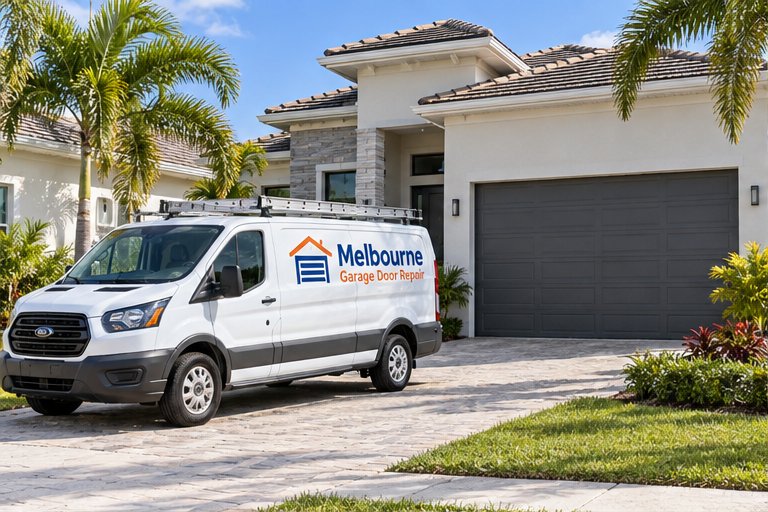
A growing community with young garages
Port St. John sits in north Brevard County, between the Indian River Lagoon side of the county and the wide marshes toward the St. Johns River. It is an unincorporated community, which means there is no town hall of its own, and over the years a good deal of it has been filled in with newer subdivisions.
That growth tells us something useful about the garage doors here. A large share of them are not old. They were hung by builders who needed to finish houses on a schedule, and they are working through the first stage of their lives.
Young does not mean trouble proof. It means the problems are different from the ones we meet in a seventy year old beach cottage. We spend more time on adjustment, settling and setup than on worn out parts, and we explain the difference so you know what you are paying attention to.
Another feature of newer neighborhoods is that the houses on a street were often finished in waves. One owner moves in during a dry spring, the next during a stormy summer, and each garage door has had a slightly different early life. Two identical doors on the same street can behave quite differently by their third year, which is why we look at each one rather than assuming.
What a new door does in its first year
A new garage door is a heavy assembly of steel or composite panels, hinges, rollers, tracks, springs, cables and an opener, all fitted to an opening that was framed by a different crew on a different day. In the first months the whole system beds in.
Fasteners relax a little, tracks find their true position and the opener learns its travel limits. Small drifts in alignment are normal, and a door that was perfect on the day of closing can develop a rub or a bounce by spring.
Limits and force settings drifting
The opener decides where the door stops by counting travel or by reading a limit switch. If it settles a little, the door may stop short of the floor or reverse on its way down. Resetting the limits is a simple adjustment when it is done carefully.
Fasteners that need a second look
Vibration slowly works on hinge screws and track bracket bolts. We check these on a young door because a small tightening now prevents a rattle, a wobble or a bent track later.
Builder grade equipment and what that means
Builders choose garage doors for price, appearance and delivery, and they do it for dozens of houses at a time. The result is usually a perfectly serviceable door with a modest opener, a standard spring and plain rollers.
Cost-conscious choices are normal when hundreds of houses are being built, and nobody should feel misled by them. None of that is a criticism. It simply means that the parts are sized for ordinary use, and ordinary use in a busy household can be heavier than the builder expected. A family that uses the garage as the main entrance may cycle the door many times a day.
- Standard torsion springs rated for a limited number of cycles
- Rollers with plastic or light steel construction
- Openers chosen for cost rather than for long service
- Weather seals that are thin and soon flatten
- Single wall panels on some models, double wall on others
Springs and cables in a busy household
The springs carry the weight of the door, which is why the opener can be a fairly small motor. A spring is a wear part with a finite number of cycles, and a household that opens the door often will use those cycles up sooner than a household that rarely does.
We never suggest that an owner adjust or replace a spring or a cable. They hold dangerous tension and the work belongs to a trained technician with the right bars and tools. If you see a gap in a spring, a frayed cable or a door that suddenly feels very heavy, leave it alone and contact us.
You can read more about what happens when one lets go in torsion spring repair and about how long a spring usually lasts in our guide to spring life.
Reading the HOA when you want a change
Many Port St. John subdivisions have a homeowners association, and most of them care about what the front of a house looks like. A garage door is a large part of that front. Before you change a style, color or window pattern, it is sensible to check what your association allows.
Rules vary a great deal. Some groups require approval for any exterior change, some only for color, and some are relaxed about like for like replacement. We can describe the door you have and the one you want in plain terms so your application is clear.
Our overview of HOA rules and garage doors explains the usual questions and what documents help your request along.
Moving in and checking the garage
People arrive in Port St. John from other states and from other parts of Florida, and the garage is rarely the first thing on the list. It tends to come up in the first week, when a remote is missing or a box blocks a sensor.
A short check at move in saves headaches. It also gives you a baseline, so that later you can tell the difference between a door that has always sounded this way and one that has changed.
- Count the remotes and keypad codes you were actually given
- Find the manual release and learn how it should be used
- Watch the door run through a full cycle and note any shudder
- Look at the sensors near the floor and confirm both lights are steady
- Look for gaps along the bottom edge when the door is closed
Resetting remotes after a change of owner
Remotes and keypad codes from the previous owner may still work. Most people do not like that thought, and it is a simple matter to clear the old ones and set up your own.
We can program new remotes and keypads and explain how the opener stores them. Our page on remote and keypad programming covers the process, and the opener model decides how simple or involved it is.
If a remote only works when you stand close to the door, try a fresh battery before anything else. A weak battery is the most common reason for a remote that seems to have lost range.
Car visor remotes are a separate case. Some vehicles carry a built in transmitter that has to be taught the opener's signal, and the steps differ from one vehicle to the next. If yours will not pair, tell us the opener label and we can explain what the opener expects, so you can follow the vehicle's own instructions with confidence.
Sensors, storage and busy garages
The safety sensors are two small eyes near the floor on either side of the opening. They send a beam across the door's path, and if anything breaks the beam while the door is closing, the opener reverses. In a house with children, bicycles and boxes, they take a lot of knocks.
A sensor that has been nudged out of line will usually show a blinking light and refuse to close the door. You can wipe the lenses with a soft cloth and look at how each unit is aimed, but if the lights stay blinking, leave the wiring alone and call us.
Our page on safety sensor repair explains what we look at, and the problem page for a door that reverses before closing covers the most common symptom.
Heat, humidity and summer storms
North Brevard has the same warm, humid climate as the rest of the Space Coast. Long summers mean heat in the garage, afternoon thunderstorms are routine, and the wet season brings moisture that finds its way into tracks, hinges and opener electronics.
Heat expands metal and softens lubricants. Humidity encourages surface rust where paint has chipped. Neither is dramatic on its own, but together they slowly stiffen a door that is not looked after.
Lightning is the other seasonal visitor. A nearby strike can send a surge through household wiring and leave an opener with a dead circuit board even though the door itself is fine. If your opener stops responding after a storm, check whether the garage outlet has tripped before assuming the motor is gone, and let us know what you noticed.
A light, regular service keeps rollers and hinges moving. We describe a sensible routine in garage door maintenance and tune-up.
Power cuts and the manual release
Thunderstorms and tropical weather can interrupt power across a neighborhood. When the electricity goes, the opener stops, and the door will not move on its own. Most openers have a red release cord that disconnects the door from the motor so you can lift it by hand.
Using that release is a skill worth learning before you need it. The door should be fully closed when you pull the cord, because if a spring is weak or broken, an open door can drop suddenly. Never pull the cord with the door raised unless you know it is balanced.
We walk through the steps in using the manual release in a power outage. A battery backup is also worth considering for households that depend on the garage as the main entrance.
Replacing a young door that does not suit you
Not every replacement is because of failure. Some owners in newer homes decide the plain builder door is not what they want. They may want insulation, a different window pattern or a style that suits the street.
A new installation is a larger job than a repair. We measure the opening, check the framing and header, talk through panel and finish choices, and confirm that the opener you have can handle the new weight.
Our pages on new garage door installation and garage doors for new construction give the background, and the contact form is the way to start the conversation.
Commuters and the daily rhythm of a door
Many households in this part of Brevard have someone driving to work in the early morning and returning in the evening. That is two trips a day for each vehicle, plus errands and school runs, and the garage door is the first and last thing they touch.
A door that makes an unfamiliar noise or hesitates is an annoyance at six in the morning, and a door that will not close is a worry when the household leaves. Because use is so regular, small changes are easy to notice, and we encourage owners to trust that instinct.
If you hear a new grinding, scraping or popping sound, our guide to diagnosing garage door noises can help you describe it, which makes the visit more focused.
Older homes and lots on the edges
Not every property here is a recent build. There are older houses and larger lots on the edges of the community, some with doors that have been in place for decades and some with garages that were added after the original construction.
Older doors are more likely to be wood or heavier steel, to use extension springs, and to have openers that are long out of production. Parts may be harder to match, and the decision to repair or replace becomes a real question.
We explain the options openly in repairing or replacing your garage door, and we are happy to say when a repair makes sense and when it does not.
Garages that do more than store a car
In many homes the garage has become a workshop, a gym, a play space or an overflow pantry. Doors that were designed for a car passing in and out are now opened for a delivery, a lawn mower or a hobby project.
This changes how a door is used and how it should be secured. We can look at locks, emergency release placement and keypad access with the real use of your garage in mind rather than the idealized one.
For households with children and pets, the guide to garage door safety for kids and pets sets out simple habits that make a big difference.
What a visit to a Port St. John home looks like
A technician comes to the property, looks at the door from inside and out, and listens to how it runs. Where it is safe, they test the balance, the sensors, the opener and the release. They explain what they find in plain language before anyone picks up a tool.
We will tell you what is wrong, what the options are, and which parts of the door are in good shape. Some issues are urgent and some can wait, and we try to be honest about which is which.
You are welcome to stand with the technician while they work through the door. Many owners find it useful to see a worn roller or a loose hinge for themselves, because it turns a vague complaint into something you can recognize the next time. Nothing is replaced until you understand why.
If you want to know what to expect in more detail, read what happens during a garage door service visit.
Getting in touch from Port St. John
If your door is stuck, loud, crooked or simply not behaving like it used to, we would like to hear about it. A few details help: what the door does, what you heard, whether anything changed recently, and what kind of opener you have.
Photographs of the door, the opener label and any damaged part are helpful. When you describe the problem we can often tell you what is likely to be involved before the visit, and what to avoid touching in the meantime.
Use the contact page to reach us, and tell us you are in Port St. John.
Questions and answers
Yes, though the needs differ from older homes. Young doors tend to need adjustment, tightening and limit resets rather than major parts. A light check in the early years also records how the door sounds when healthy, which makes later changes easier to spot and describe, and it catches small loose fasteners before they cause wear.
It is often a limit or force setting that has drifted as the door settled, or a sensor that has moved slightly out of line. Check that both sensor lights are steady and the lenses are clean, and look for anything resting in the door's path. If it keeps happening, we can reset the travel and force properly and test the reversing.
Usually you can apply, but check your association's rules first. Many require approval for style, color or window changes. We can describe the door you have and the one you want so your request is clear and complete when you submit it. Stay clear of the door while you test it, and keep children and pets away from the opening.
Close the door first, then pull the red release cord to disconnect it from the opener, and lift using the handle. Never release an open door unless you know it is balanced, because a weak spring can let it fall. Read our manual release guide before you try. If you are unsure whether the door is balanced, leave the release alone and ask us first.
No. Springs and cables hold dangerous tension and can cause serious injury. Leave all adjustment and replacement to a trained technician. Simple checks, such as looking for a gap in the spring or fraying on a cable, are safe, but stop there and contact us. Take a photograph if you can, because it helps us explain what we see before the visit.
They may. Many openers keep stored remotes and keypad codes until they are cleared, so an earlier owner could still have a working remote. We can erase the old ones and program new remotes or a keypad code so that only the devices you hold can open the door. A short note of any stored remotes also helps us set the opener up correctly.
Tell us what the door does, what noises you heard, whether anything changed recently and what the opener looks like. Photos of the door, the motor head and any label help a great deal, as does knowing whether the problem happens every time or only sometimes. We will explain what we find and what the options are.