
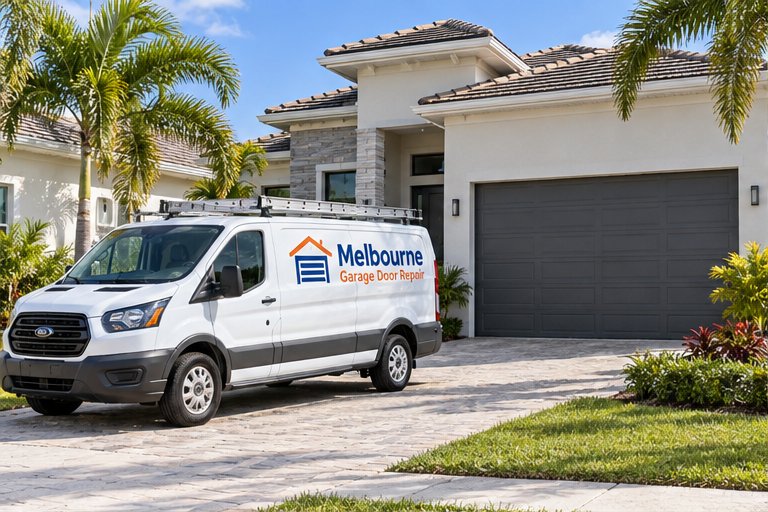
Newer neighborhoods south of the city
The area south of Vero Beach has grown through a series of newer subdivisions, with homes built in groups by developers over the last several decades. Streets curve around ponds, lots are modest and uniform, and the garages are attached, with two-car and three-car openings common.
A neighborhood of newer homes presents a different set of questions than one of older houses. The doors are younger, but they were built to a price and a schedule, and they are often at the point where the first springs, the first rollers and the first opener begin to show their age. We spend a lot of our time in this kind of community, and the pattern is quite consistent.
Uniform streets create a false sense of sameness. Two houses next to each other can have doors installed in different years, repaired by different people and used in very different ways. One household cycles its door twelve times a day while the next opens it twice. That difference decides how soon the springs wear out, so we judge each door on its own record rather than by the neighborhood.
When a young door starts to show its age
A builder-installed door usually comes with standard components chosen for economy. Springs are sized for an expected number of cycles, rollers are often nylon or plain steel, and the opener is a basic model. None of this is a defect; it is simply how most houses are built.
But it means that around the time a home is ten or fifteen years old, several parts reach the end of their useful life together. The spring may snap, the rollers get noisy and the opener may begin to labor. If one wears out, the others are usually not far behind, so it often makes sense to replace several parts in a single visit. See maintenance and tune-up for how we spot these early.
Sprinklers, wet doors and the landscaping edge
Irrigation is a fact of life in neighborhoods with manicured lawns. Sprinkler heads are often aimed near the garage, and a door that is sprayed daily by hard water collects white mineral stains, rust at the bottom edge and a damp, worn seal.
Check where your sprinklers point, and adjust the spray away from the door and the keypad. Water that sits at the bottom panel corrodes the steel from the inside and ruins the weatherstrip. If the bottom of your door is rusting, read about rust on a garage door and track. A new bottom seal is a modest repair, and it tends to be worth doing before the panel itself is damaged.
Living with an association
Many of these subdivisions have homeowner associations. Rules differ, but typically they govern the color, style and sometimes the condition of garage doors visible from the street. Some require that the door remain closed except when in use, and many ask for approval before a replacement.
For repairs that do not change the look of the door, such as springs, rollers, cables and openers, approval is rarely an issue. For replacement panels or a new door, check the rules first and send the association a clear description of what you intend. We can supply the details of the door you are considering, including its style, color and window layout, so your request is complete.
Seasonal residents and homes left alone
Along Florida's east coast, many people live in their homes only part of the year, leaving them closed for months at a time. A garage door that is not used for weeks is not at rest. Rubber seals dry, grease thickens, batteries in remotes and keypads run down, and the opener's circuit board can fail from a power surge while no one is home.
Before leaving, run the door through a few cycles and make sure whoever is checking the house has a working remote. On return, test the door slowly and listen. If something sounds different, address it before the household settles back into daily use. A long absence also makes it worth cleaning the sensor lenses, since spiders and dust build up in the empty garage.
Before you leave
Wipe the tracks, check the remote batteries, and make sure the safety reversal still works. Take a photo of the door in its closed position for reference.
When you return
Press the button once and watch the entire cycle. If the door shudders, pauses or shows a gap on one side, stop and have it examined rather than trying again and again.
Hurricane season in a house with no one home
A seasonal home faces a particular risk: a storm arrives while the owners are away. A garage door is a large opening, and a damaged door can let wind and rain into the house. Before leaving for the summer, check the condition of the panels, the tracks and the seal, and decide who will look after the house.
We do not claim that any door will survive a given storm. We do inspect and explain its condition, and note anything that looks weak. Our page on hurricane season garage door service describes the checks we make. If the opener may lose power for days, ask about a battery backup so that a caretaker can still open the door.
If you are away, ask a neighbor or caretaker to look at the door after any named storm. A short walk around the garage, checking for dents, light under the door and a closed, seated panel, tells them whether anything needs attention. They should not run the opener if anything looks wrong.
Golf carts, bikes and the busy garage
Many households around here keep a golf cart, e-bikes, kayaks or paddleboards in the garage, and in some of the two- and three-car garages the cart parks within a few feet of the door. Storage racks, wall hooks and ceiling shelves add to the crowding.
This matters to the door in several ways. Carts that are parked too close to the opening may be struck as the door closes. Ceiling racks can interfere with the opener rail. A heavy load hung from the garage ceiling can also flex it, changing the geometry that the opener expects. Keep a clear path along the track and the rail, and check from time to time that nothing has crept into the door's way.
A cart that is charged in the garage also adds an extension cord and a charger near the door. Route cords away from the track and sensor line, and never let a cord cross the door's path.
- Leave room at the floor line so the door closes cleanly
- Do not hang heavy items from the opener rail or its brackets
- Keep the sensor beam clear of boxes, coolers and cart parts
- Wipe the sensor lenses when you sweep
Understanding the three or four common failures
Newer doors tend to fail in a handful of ways. A torsion spring breaks, usually with a bang and a door that will not lift. A cable slips off its drum, leaving one side hanging. A roller wears out and begins to scrape. Or the opener loses a setting and refuses to close or reverses immediately.
Each has its own page on this site. If you heard a bang, see a spring that snapped with a loud bang. If the opener runs but nothing moves, see an opener that runs but the door does not move. Do not try to fix springs or cables yourself, since they are under great tension, and leave the door alone until it has been examined.
When more than one of these happens together, for example a noisy door and a slow opener, the cause is often shared. Worn rollers and a weakening spring both make the opener work harder, so the symptom shows in the motor even though the fault is in the door. That is why we look at the whole system rather than the part that complains first.
Pond-side streets, humidity and mildew
Many of the newer streets curve around retention ponds, and homes near water carry a little more humidity into the garage. Damp air settles on cold surfaces, feeds mildew on the weatherstrip and leaves a film on the sensor lenses. A door that is mostly closed and rarely opened holds that moisture longer.
A weekly wipe of the bottom seal and the lower panel is enough to keep mildew under control. If a black or green film returns again and again, check for a gap that lets rain in or a downspout that discharges next to the door. These small observations help us pinpoint the cause when we visit.
Noise in a house built close together
On a street of closely spaced houses, a loud door is noticed by neighbors as well as by the family. Rumbles, squeals and slams travel through shared walls and open windows, especially on early mornings and late evenings.
Most noise has an ordinary cause. Dry hinges squeal, worn rollers rumble, a loose bolt rattles and an opener belt that has stretched slaps against the rail. A door that is serviced and balanced runs far more quietly than one that has been left alone. If a loud door has become a source of tension on your street, see a door that is very loud for the usual causes.
Smart openers and the connected home
Newer homes often have openers that connect to a phone, report whether the door is open, and integrate with other devices. That is convenient, but it also adds a layer of electronics that can misbehave. A router change, a power cut or a firmware update can leave the opener disconnected.
Most connected problems are in the settings rather than the opener, and many can be resolved by reconnecting to the network. When the door itself is the problem, no app will fix it. We help with both: setting up the opener and checking the door. Our page on smart opener and Wi-Fi setup explains what we do.
Safety features still apply to the connected models. The sensors and the reversal must work whatever the app says. If your phone reports that the door is closed but you can see daylight under it, trust your eyes and have the door looked at.
Insulation, heat and a garage that is lived in
In a Florida summer, a garage can become a very hot room. Some owners use the space as a gym, a workshop or a place for a second refrigerator, and then wish for a cooler, quieter door. Insulated doors reduce heat transfer and noise and feel sturdier, though they are heavier and need springs matched to their weight.
If you are considering a change, think about how the garage is used and what you want it to do. Windows add light, but they also add the possibility of breakage. A door with insulation and no windows keeps heat out and the garage dim. We discuss these choices openly, without a sales push.
A heavier door changes how the springs must be set up, so a replacement is not a simple panel swap. The technician measures the door's weight and matches the springs to it. We explain this during an estimate so the process is clear before it starts.
Rentals and investment homes
A portion of homes in newer subdivisions are rented or held as investments. Owners who live elsewhere rely on tenants and property managers to report problems, and a garage door problem can go unreported for a long time. Remotes disappear between tenants; sensors get knocked out of alignment; seals tear.
A short look at the door between tenants is a good habit. It is less costly to replace a worn roller during a vacancy than to respond to an urgent call from a new tenant on the first night. We explain what we find so that owners and managers can plan sensibly.
Owners who manage several properties find it useful to keep a list of which doors have which openers and remotes. When a tenant calls, the information is at hand, and the visit is more focused.
A short owner's checklist
There is a lot you can do without tools. Once a month, press the button and watch the door. Listen for new noises. Wipe the sensor lenses. Test the reversal with a roll of paper towels. Inspect the bottom seal for cracks. Replace remote batteries every year or so.
Anything beyond that, such as springs, cables, drums, brackets and track alignment, belongs to a trained technician. If you ever see a frayed cable, a gap in a spring coil or a door hanging crooked, stay clear and contact us.
Keep a simple note of when you last had the door serviced, which remotes you hold and what you noticed. A few lines in your phone are enough, and the record helps the next technician see how the door has behaved over the years.
Replace remote batteries once a year, and keep a spare in the drawer. A weak battery produces the most common false alarm we hear about: a door that seems broken but only needs a new coin cell.
Commercial and light industrial doors nearby
Along the busier roads south of the city there are small businesses with roll-up or sectional doors: storage units, shops, contractors' yards and service bays. Commercial doors take far more cycles than residential ones, and downtime hurts. They often have heavier springs and different operators.
We handle commercial doors as well as residential ones, and the approach is the same: look at the door, explain what we find, and describe the options. Our page on commercial garage door service sets out what we cover.
What a visit looks like
We arrive at your home, look at the door and the opener, and ask what you have noticed. After inspecting the springs, cables, rollers, hinges and tracks, we explain what we found and what the options are. Repairs begin only when you understand and agree to them.
When we finish, we run the door through its full travel, test the safety reversal and show you how to use the release. If we spotted something that will need attention later, we tell you now so you can plan.
Questions and answers
Possibly, though not necessarily soon. Builder doors use standard parts that wear out with use, often around the ten to fifteen year mark depending on how often the door cycles. Regular care and a periodic inspection help us catch wear before something fails suddenly.
Usually not for like-for-like repairs such as springs, rollers, cables and openers. A replacement door or panel that changes the look often does. Check your association rules first. We can provide details of the style and color you are considering for your application.
Run the door through a few full cycles, clean the tracks and sensor lenses, replace remote batteries and test the safety reversal. Make sure whoever checks the house has a working remote and knows where the manual release is. Tell us if anything seems unusual.
Yes. Repeated spraying leaves mineral stains, speeds up rust at the bottom edge and wears the seal. Redirect the sprinkler heads away from the door and keypad. If the bottom of the door is already corroded, a technician can advise on seals and panel condition.
Often yes. Most connection problems come from changed router settings or an interrupted power supply and are solved by reconnecting. If the door itself is misbehaving, we examine it as well, since an app cannot repair a spring, roller or track fault.
Stay clear and do not try to lift or run the door. A bang often means a torsion spring has broken. The parts hold dangerous force, so leave the repair to a trained technician. Contact us and describe what you heard and saw.
Yes. We repair and service commercial garage doors, including those used for storage, shops and service bays. These doors cycle more often than residential ones, so wear shows sooner. We look at the door and operator and explain the options plainly.