
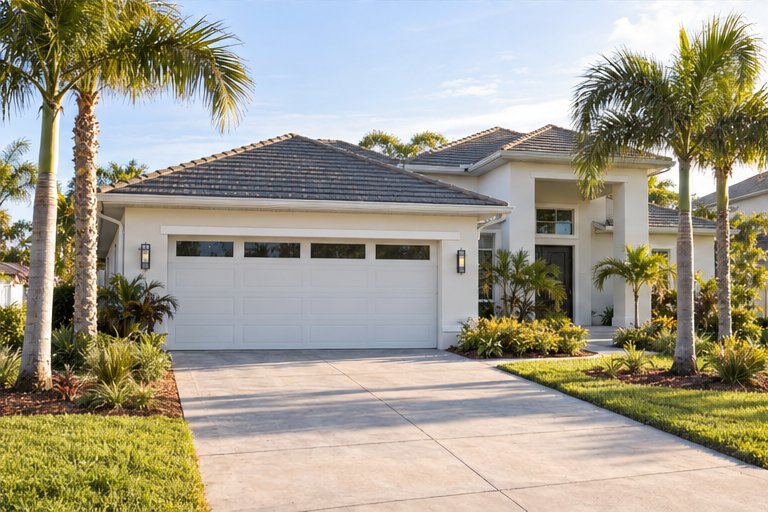
Two sides of one city
Vero Beach sits in Indian River County, with the Indian River Lagoon running between the barrier island and the mainland. That water is more than a scenic fact. It divides the city into two environments, and a garage door on one side lives a different life from a door on the other.
On the island side, doors face salt-laden breezes, sandy driveways and the occasional storm surge conversation. On the mainland side, doors deal more with heat, afternoon thunderstorms, tree debris and the ordinary wear of daily family use.
When we arrive at a Vero Beach property, one of the first things we consider is which side of the lagoon we are on. It shapes what we look for before we even touch the door.
Neighborhood character shifts a lot here. A few blocks can separate older cottages with original single-car garages from newer homes with wide double doors, and the right approach to repair, parts and opener choice changes with each.
What a coastal location asks of hardware
Steel is strong, but it is not immune to a salty atmosphere. On beachside streets the first parts to show trouble are usually the small ones: hinge pins, roller stems, bolts, bracket edges and the cable ends where moisture can sit unnoticed.
Surface rust on a hinge is often cosmetic and can be slowed with cleaning and the right lubricant. Rust that flakes, pits deeply or weeps brown stains down a bracket is a different matter, because it can weaken the part that is holding the door's weight.
- Look at the bottom bracket on each side of the door, where the lifting cable attaches. Rust here deserves a professional look and should not be touched.
- Check hinge knuckles for stiffness. A hinge that no longer swings freely makes the opener work harder.
- Notice whether the bottom edge of the door shows rust streaks, which suggests moisture is wicking up from the floor.
- Run a hand along the track edges for rough, flaking metal.
Mainland neighborhoods and the passage of time
Many Vero Beach homes on the mainland side were built across several decades, so a single street can contain a door from one era next to a door from another. That variety is a pleasant thing in a neighborhood and a puzzle for a technician, because parts, track sizes and opener generations are not uniform.
Older doors often use extension springs, which stretch along the sides of the track, while newer or upgraded doors use a torsion spring mounted above the opening. We explain the difference in our spring guide, and it matters here because the safe approach and the repair differ between the two.
Original openers on original doors
It is not unusual to find an opener that has been running since the house was built. These units can keep going for a long time, but they may lack the modern safety features that newer ones carry as standard, such as reliable reversing sensors and rolling-code remotes.
Replacing one is not an emergency. It is a decision worth making calmly, and we lay out the options in the opener buying guide.
Doors that have been painted many times
Repeated repainting can leave panels with thick edges that rub the track or stick to the weather seal. A door that binds only on humid days may be fighting its own paint rather than a mechanical fault.
Humidity, rain and a door that sticks
Florida summers bring warm, wet air nearly every day, and wood components swell in it. A door with a wooden bottom section, or with wooden trim around the opening, can drag in damp weather and loosen up again in the dry months.
If your door sticks only during the rainy season, tell us. That pattern points toward swelling, paint buildup or a weather seal gripping the jamb, not toward a failing spring, and it changes the repair we recommend.
Hurricane season and your garage door
The garage door is the largest moving opening in most homes, and in a strong wind it can be the weakest point of the building envelope. That is why storm preparation matters even if you never see a hurricane warning in a given year.
Before the season, we like to see the door operating smoothly, the tracks securely fastened, the bottom seal intact and the manual release working. We cover the broader checklist in garage door hurricane preparation, and our hurricane season service page explains what a pre-season visit involves.
After a storm, treat any door that moved, bowed or came off its track as unsafe to operate until someone has looked at it.
Power outages and the manual release
Storms bring outages, and outages leave a garage door stuck closed with a car inside. Every opener has a manual release cord, usually a red handle hanging from the trolley, that disconnects the door from the motor so it can be lifted by hand.
Use it only when the door is fully closed, and only after you have made sure nothing is wrong with the springs. If the door feels extremely heavy, or one side is lower than the other, stop and do not force it. A broken spring means the door's weight is no longer supported, and lifting it can cause injury.
A battery backup unit is one way to avoid the problem. We describe how it works in battery backup for garage door openers.
Seasonal residents and homes left alone
Vero Beach has many homes that sit unoccupied for part of the year. A door that is not used for months can develop its own problems: seals stiffen, lubricant dries out, remote batteries die and pests find shelter in corners and track ends.
If you are returning after a long absence, do a gentle check before you rely on the door. Open it by hand using the release if the opener seems unresponsive, watch for sticking, listen for scraping and look at the cables for any fraying or slack.
If you are about to leave, there is a short routine worth doing first, and our vacation checklist walks through it.
- Test the reversing sensors and the auto-reverse behavior before you leave.
- Replace remote and keypad batteries so they do not leak while you are away.
- Confirm the door locks or that the opener's vacation lock feature works.
- Ask a trusted neighbor or property manager to know where the manual release is.
Homeowner associations and community standards
Many Vero Beach neighborhoods, including golf and gated communities, have associations with rules about door style, color and window patterns. If your door needs replacing, the replacement usually has to satisfy those guidelines.
It helps to bring your approved style or the association's guidelines to the conversation. We can describe what is possible within a given look, and you can submit your choice for review before anything is ordered. Our page on HOA rules and garage doors explains what to expect from the process.
Repair or replace: a calm way to decide
Most garage door problems are repairs. A spring, a cable, a roller set or a sensor can be fixed without replacing the door. But there are situations where replacement is the more sensible path, and it helps to recognize them early.
Panels that are cracked in several places, a door that has lost its shape, extensive rust on structural parts, or a door that no longer matches the way you use the garage may tip the balance. Our guide on repairing or replacing your door sets out the questions we ask, and the comparison table below summarizes the usual signals.
| What you notice | Usually points toward |
|---|---|
| A single noisy roller or a stiff hinge | Repair or tune-up |
| A broken spring or frayed cable | Repair of that part |
| One damaged panel on an otherwise sound door | Panel repair or section replacement |
| Several cracked or bowed panels | Replacement worth considering |
| Door no longer matches the opening after remodeling | Replacement worth considering |
| Opener over its useful life but door in good shape | Opener replacement only |
Garages that do more than park a car
In a place where outdoor living is part of the lifestyle, the garage often doubles as a workshop, a storage space for beach gear, kayaks and bicycles, or even a small gym. That extra use means the door opens and closes more often, and sometimes with more weight on it than the original design expected.
A door that carries added insulation, windows or heavier panels can fall out of balance. If it feels harder to lift by hand than it used to, or drifts when you stop it partway, balance is worth checking. Our balance and adjustment service explains how we test it safely.
Sun, sand and the finish on your door
Strong sun does as much quiet damage to a garage door as salt does. Paint fades and chalks, vinyl trim can warp, and rubber seals harden and crack long before the panels themselves give up. A door that looks tired is often only a door whose outer layer has given up.
Sand is the other constant on the island side. It blows into the bottom seal, settles into track channels and works into roller bearings, where it acts like a fine abrasive. A short rinse of the lower track area and a wipe of the seal during regular cleaning keeps most of it out of the moving parts.
Refinishing a door that is structurally sound can be a better choice than replacing it. If the panels are straight, the hardware is healthy and the insulation, if any, is intact, a fresh finish may be all the door needs.
Choosing a door that suits the street
Streets in Vero Beach range from low, tidy cottage rows to larger homes with wide, multi-car openings. A door should suit the architecture as well as the use. Carriage-style panels look natural on some homes and out of place on others, and a clean flat-panel design can feel right on a modern facade.
Material matters in this climate. Steel is common and sturdy, aluminum resists rust, wood is handsome but needs steady care in humid air, and composite options sit somewhere in between. Our material comparison sets them side by side.
Wind rating, insulation, window inserts and the color of the finish are separate decisions, and we are glad to talk through them one at a time instead of all at once.
Remotes, keypads and keeping codes tidy
Remotes go missing in a place where people move between cars, boats, golf carts and beach bags. A lost remote is a small security question, because whoever finds it may know which house it belongs to.
Most modern openers use rolling codes, which means that clearing the memory and reprogramming the remotes you still have shuts out the lost one. If your opener is older and uses a fixed code, that option may not exist, which is one more reason to consider an upgrade.
Keypads need fresh batteries and a code that is not the street number or the year the house was built. Change the code when a contractor, house sitter or tenant no longer needs it.
- Count the working remotes in the household and note who has each one.
- Replace batteries once a year as a habit, not a reaction.
- Keep a spare remote inside the house, not in a vehicle that could be broken into.
- Change keypad codes after any change in who has access to the home.
What happens when we visit
We come to the property, look at the door and listen to what you have noticed. We test the balance, examine the springs and cables from a safe distance, check tracks, rollers and hinges, and test the opener and its safety reversing.
Then we explain what we found in plain language, show you the parts involved if you wish, and describe the options. If a repair is sensible, we explain it. If replacement makes more sense, we say so and why. Nothing is decided until you have understood the choices.
We do not ask you to climb a ladder or touch anything under tension. Our page on what happens during a service visit describes the process in more detail.
Small checks you can safely do yourself
There is a handful of things a homeowner can do without risk. They will not replace a professional visit, but they can often tell you what kind of problem you have.
Stop and call us if any of the following turns up: a gap in the cable, a visibly stretched or separated spring, a door that is crooked in the opening, or any sound that resembles a bang followed by silence.
- Wipe the sensor lenses near the floor with a soft cloth and check that their indicator lights are steady.
- Replace the battery in a remote that responds weakly.
- Watch the door travel and note any jerking, scraping or uneven movement.
- Test the auto-reverse by placing a rolled towel on the floor in the door's path. The door should reverse on contact.
- Look for objects in the tracks, such as sand, leaves or small debris.
Questions and answers
Often yes. Doors near the ocean and lagoon face more salt in the air, which accelerates rust on hinges, brackets and cable ends. Mainland doors deal more with heat, rain and tree debris. We adjust our inspection to the setting, and we may suggest more frequent cleaning and lubrication for doors closer to the water. We are happy to answer follow-up questions before any visit is arranged.
Pull the red manual release handle while the door is fully closed, then lift gently. If the door feels extremely heavy, uneven, or will not stay up, stop and do not force it, since a spring may be broken. Keep clear of the door's path and contact us so we can look at it. If you are unsure, describe what you see and hear, and we will help you sort it out.
Usually, yes, as long as the replacement follows the association's guidelines for style, color and windows. Find out what is approved before ordering, and submit your choice for review if required. We can explain what each style involves and help you describe it clearly in your request. Nothing is decided until you understand what we found and what the options are.
A yearly visit is a sensible rhythm for most homes, and doors close to salt water may benefit from more attention. A tune-up covers balance, hardware, lubrication, seals and the opener's safety reversing. Our maintenance page describes what is included so you know what to expect. Photographs of the door and any labels can help us prepare before we arrive.
It depends where it is. Light surface rust on a hinge or panel edge is common and can often be cleaned and protected. Heavy, flaking or pitted rust on brackets, cable ends or track mounts can weaken parts that carry the load. If you see that, do not touch the parts and ask us to look. Whatever the situation, we explain things in plain language and leave the choice with you.
Many older openers can be repaired, especially for sensor or remote problems. Replacement becomes more attractive when parts are hard to find, the unit lacks modern safety features, or repairs keep recurring. We explain what we find and let you weigh the options without pressure. We are happy to answer follow-up questions before any visit is arranged. If you are unsure, describe what you see and hear, and we will help you sort it out.
Yes. We work on homes and commercial properties, including doors used by tenants or staff. Tell us who has access, how often the door is used and whether there are loading needs, and we will plan the visit around that and explain what we find afterward. If you are unsure, describe what you see and hear, and we will help you sort it out.
Yes. Owners and managers can arrange a visit, and we explain our findings to whoever is present. It helps to tell us beforehand who has access, whether remotes or keypad codes need resetting, and whether the door is shared by several units so we can plan sensibly. Nothing is decided until you understand what we found and what the options are.