
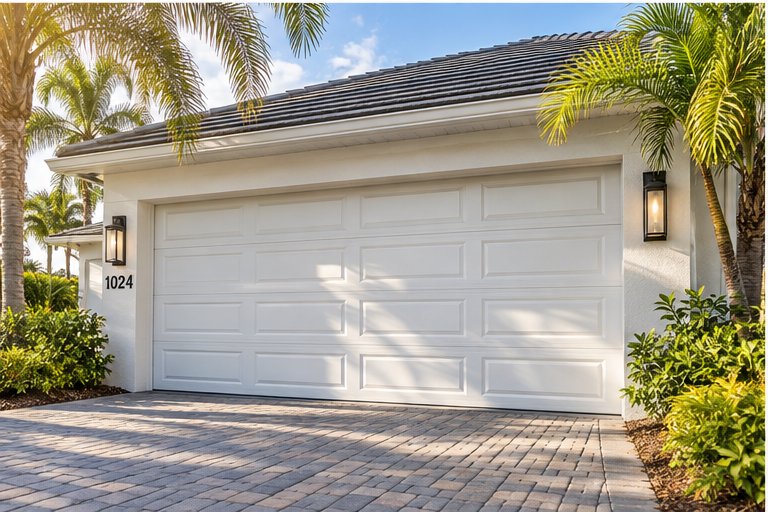
Color is a durability decision as well as a design one
A garage door color looks like a matter of taste, and partly it is. It is also a matter of physics. Every color absorbs some sunlight and reflects the rest. Darker shades absorb more, and the extra energy becomes heat in the panel, in the finish and in the air of the garage.
In Melbourne, the sun is strong for much of the year, with a rainy season that keeps surfaces damp for weeks at a time, and the door often faces a driveway that bounces more light back at it. Choosing a color without thinking about heat and fading is like choosing a roof without thinking about rain. It may still look good, but it may not stay that way.
What the sun does to a finish over the years
Ultraviolet light slowly breaks down the binders in paint and coatings. The first sign is usually a loss of gloss, followed by a chalky film you can wipe off with your finger. Later the color itself fades, and the fade is rarely even. The side that gets the most afternoon sun changes first.
Some pigments hold up much better than others. Reds, deep blues and some bright shades are known for fading faster under harsh sun. Whites, creams, grays and earth tones tend to age more gracefully. The quality of the coating counts as much as the color, so ask how a finish is made rather than only what it looks like on day one.
- Chalking is the first warning and can often be cleaned and recoated.
- Fading shows sooner on south and west faces.
- Hairline cracking in the paint means moisture can reach the panel.
- Peeling at the bottom edges usually points to trapped moisture.
Light versus dark: heat, expansion and the garage inside
A very dark door in full sun can become uncomfortably hot to touch. That heat passes into the garage, raises the load on any air conditioning next to it and can stress materials that expand with temperature. Vinyl, some composites and thin panels may bow slightly on a scorching day, and the finish can age sooner.
Lighter shades reflect more of the sun and run cooler. That does not mean you must choose white. Many medium tones are a good compromise, and a dark color on a door that sits in shade for most of the day is a different matter from the same color on a west-facing wall. Look at how much sun your own door receives before you decide. Watch it across a full day: a door that looks shaded at breakfast may take full sun from three o'clock until sunset, and that stretch is the hardest on any finish.
A simple observation test
On a clear afternoon, put your palm near the door surface, not directly on it, and notice how warm it feels. Do the same on a neighbor's wall in shade. The difference tells you what a darker finish might add.
When a dark color still makes sense
Doors in shade, on north-facing walls or under deep overhangs handle dark colors better. A manufacturer's finish designed to reflect heat can also help, though you should ask what claims can be shown.
Factory finishes compared with field painting
Most steel and aluminum doors leave the factory with a baked-on coating, applied in controlled conditions and cured with heat. This usually bonds better and lasts longer than paint brushed on at home. Many wood, composite and fiberglass doors are sold primed or stained and need finishing after installation.
Painting on site is a legitimate choice and sometimes the only one. The key is preparation. The surface must be clean, dry and lightly scuffed, and the paint must be made for the material and for exterior use. Painting over salt residue or damp metal gives poor results. Keep the paint can and the exact color name in a drawer, so touch-ups years later will match. Always check with the door maker before painting an insulated or coated door, since some finishes can cause trouble with heat or void the maker's terms.
- Factory finishes tend to resist chipping and fading better than field paint.
- Field paint is easy to change later but needs careful preparation.
- Primed-only doors must be finished soon after installation.
- Never use paint that was meant for interior use outdoors.
Wood-grain textures and stains
A wood-grain finish on steel or composite uses a molded texture and a stain or paint to imitate timber. Done well, it looks warm and natural from the street. Done poorly, it looks flat and repetitive up close. Ask to see a full section, not a small chip, and view it in daylight. The material underneath also shapes how a finish ages, which our guide to garage door materials compared covers, and the pattern of the panels is discussed in styles and curb appeal.
Real wood is stained or painted and must be resealed regularly. Salt, humidity and sun are all hard on it. A good rule is to look at the finish each season and recoat at the first sign of dullness. Waiting for peeling means moisture has already entered the grain.
Looks that work well
Medium walnut and cedar tones suit stucco and stone. Weathered gray and driftwood tones fit coastal homes. Deep espresso looks smart but runs hot.
Looks to approach carefully
Very glossy faux-wood can look artificial. Finishes with strong red or orange tints may clash with brick, pavers or roof tile.
Sheen: flat, satin and gloss
Sheen describes how much light bounces off the surface, and it changes the character of a color almost as much as the shade itself. A flat finish hides dents and uneven panels but can hold dirt. Satin reflects a little light and is the most common choice. Gloss gives a crisp, polished look but shows every dent, ripple and wave in the panel.
On large doors, gloss can make small imperfections look bigger, since the reflections stretch and bend over the surface. Satin gives a more forgiving result and cleans more easily than flat. If your door already has a few dents or a slightly wavy section, a satin or low-sheen finish will be kinder to it.
Matching the door to the rest of the house
Three relationships matter: the door against the wall color, the door against the trim and the door against fixed features such as the roof, pavers and brick. Each can be matched, contrasted or blended.
Blend with the wall
A door the same or close to the wall color makes the garage recede, which is helpful when the garage is prominent. White and cream homes often use a matching tone for a calm look.
Match the trim
Matching the door to the trim and fascia ties it into the architecture, and it gives crisp edges around the opening. This works well on traditional homes.
Contrast with the wall
A darker or bolder door gives a modern, intentional look. It also makes any dent, scuff or faded patch more visible, so plan to maintain it.
Coastal palettes that tend to age well
Without claiming any rule, some palettes consistently look settled on the Space Coast, and most of them are the kind of colors you would also choose for stucco or a coastal cottage. Warm whites and sand tones reflect the sun and suit stucco. Soft grays and greige sit comfortably next to concrete pavers and tile roofs. Muted blues and greens echo water and vegetation without clashing with it.
Strong colors can work when used with care. A deep green or navy door on a pale house looks classic. Bright accent colors are better kept for the entry door, where fading matters less and the surface is smaller.
| Color family | Heat | Fading tendency | Notes |
|---|---|---|---|
| White and cream | Cooler | Low | Show dirt and mildew streaks |
| Sand and beige | Cool to moderate | Low | Blend well with stucco |
| Light and medium gray | Moderate | Low to moderate | Hide dust well |
| Navy and deep green | Warmer | Moderate | Smart with light walls |
| Black and espresso | Hottest | Higher on exposed walls | Show every scratch and dent |
| Reds and bright shades | Warm | Higher | Work well as accents |
Rules about color in neighborhoods with associations
Many Space Coast communities have approved color lists, and some also control sheen and window style. Always look at the rules before you order, because a door that is returned or repainted costs time and money. Our guide to HOA rules and garage doors explains what to prepare when you submit a request.
Bring a physical sample or a paint chip, a photo of the house and a clear description. Approval can take a while, so build that into your plans, and keep the approval letter in case anyone asks later.
Testing a color before you commit
Colors change with light, and Florida light is stronger than the light most manufacturers use for their samples. A shade that looks soft in a showroom can look stark on a wall in full sun, and a shade that looks flat on a sample card can look rich on a large door. Testing costs a little effort and saves a lot of regret.
Put a large sample against the actual door, not just against the wall. Look at it in the morning, at noon and in the late afternoon. Check it on a cloudy day and at dusk with your exterior lights on. Walk to the street and see how it looks from the distance people will actually see it.
- Use a sample at least as large as a clipboard.
- Tape it to the door and leave it for a couple of days.
- Compare it with the trim, brick or roof, not only the wall.
- Take photos at different times so you can compare them later.
- Ask others for their honest opinion of the contrast.
Keeping the finish looking good
Cleaning is not glamorous, but it matters more than almost any other step. Regular cleaning is the most useful way to protect a finish. Salt, pollen, dust and mildew all hold moisture against the surface. Rinse the door with fresh water, wash with mild soap and a soft cloth or sponge, and rinse again. Avoid harsh solvents, abrasive pads and pressure washers held close to the surface.
Wax or a protective coating made for the material can help in some cases. Check that the product suits your finish before you use it. Our seasonal checklist includes a cleaning step that fits well into a regular routine.
Touching up chips, scratches and rust spots
Small damage is easy to deal with if caught early. Clean the area, remove any loose paint or rust gently, treat bare metal with a suitable primer and apply matching paint in thin coats. Large repaired areas rarely match perfectly, so it is better to blend the touch-up into the surrounding area than to leave a sharp edge.
If rust is spreading under the paint or a section is bubbling at the bottom, the metal underneath may be failing. Our page on rust on a garage door and track explains the signs. Never apply paint or touch-up near springs, cables or the brackets at the base of the door, since those parts hold tension and should only be handled by a technician.
Mildew, streaks and what they mean
Humidity feeds mildew, and mildew loves shaded, slightly rough surfaces. Gray or black freckles on the lower sections, around windows and along the seams between panels are common in the Space Coast summer. They look like dirt but they are living growth, and wiping them off with a dry cloth only spreads them.
A gentle wash with mild soap and water usually removes light mildew. Stubborn patches may need a cleaner made for exterior finishes, tested on a small hidden spot first. Avoid bleach on colored or wood-grain finishes, since it can lighten or stain them. If streaks keep returning, look for the cause: a sprinkler that hits the door, a gutter that overflows or shrubs that hold moisture against the bottom edge.
Orange or brown streaks
These usually come from rusting hardware or a scratch in the coating. Clean the area and find the source. Rust bleeding from a hinge or screw is a sign to replace that part, which a technician can do safely.
White or powdery film
That is chalking, the first stage of finish breakdown. It can often be cleaned off, and a protective coating suited to the material may slow it down.
Two-tone doors and accent bands
Some owners paint the upper window row or the lower panels in a second color. Done with restraint, it adds interest. A darker band on the bottom section can hide splash marks from rain, while a lighter top reflects more sun. The risk is that two colors double the number of edges that can peel and the lines that must be kept straight.
If you try it, keep the break on a natural joint between sections rather than in the middle of a panel. Choose two shades from the same family or a neutral with a single accent. Test the pairing with large samples, since two colors that look elegant next to each other in a small chip can seem busy across sixteen feet of door.
Hardware, trim and accent finishes
Hinges, handles and window frames come in black, bronze, white and brushed metal. Match them to other exterior metal, including light fixtures, house numbers and the entry door handle. Mixed finishes can look intentional if limited to two, but a collection of many looks scattered.
Trim and weather seals also come in colors. A bottom seal that matches the door looks neat, and it is one more reason to replace worn seals rather than leave them. See weather seal replacement for more about what is involved.
Repainting an existing door
A fresh coat can transform a sound door. First confirm that the door is worth the effort: straight sections, smooth operation and no deep rust. A door that is out of balance or damaged needs repair before cosmetics, and you can contact us to have it looked at.
Wash and rinse thoroughly, let the surface dry completely and sand or scuff glossy areas. Prime bare spots, then apply two thin coats of exterior paint suited to the material, working one section at a time with the door fully closed. Keep paint out of the rollers, hinges and track, and let everything dry before you operate the door. If you disconnect the opener to work on the door, reconnect it carefully afterward and test the balance and safety reversal.
Questions and answers
Lighter and neutral shades such as white, cream, sand and gray tend to fade less and run cooler. Reds and very bright colors usually fade faster. The quality of the finish matters as much as the color, so ask how the coating is made and whether it is suited to strong ultraviolet light. Large samples taped to the door for a few days show the truth.
Often yes, with the right preparation and exterior paint. Clean it, scuff glossy areas, prime bare spots and use thin coats. Very dark colors can add heat, so check with the door maker first. Keep paint off rollers, hinges and track, and do not touch spring parts. Prepare the surface carefully and use thin coats rather than one thick layer.
They absorb more sun, so the panel and the garage get warmer, and some materials expand or fade sooner. Dark colors also show dents and scratches. They can work well on a door that sits in shade. Check the manufacturer's guidance before choosing dark on a sun-facing wall. Check the heat in the afternoon before committing to a deep shade.
Satin is the usual choice because it reflects some light, cleans well and is forgiving of small waves in the panels. Gloss looks polished but shows every dent and ripple. Flat hides imperfections but can collect dirt. Pick the sheen that suits the condition of your door. Whatever the sheen, a gentle wash keeps it looking even.
A rinse after salt spray and storms, plus a gentle wash each season, suits most doors on the coast. Use mild soap, a soft cloth and plenty of fresh water. Avoid harsh solvents and close-range pressure washing. Regular cleaning protects the finish and spots problems early. Seasonal cleaning also gives you a chance to spot rust or peeling early.
In many neighborhoods with associations, yes. Rules may cover color, sheen, windows and panel pattern. Check the guidelines and submit a sample and photo before you order or paint. Keep the approval in writing so you have it if the question comes up again later. Ask your association what documents they want so approval goes smoothly.