
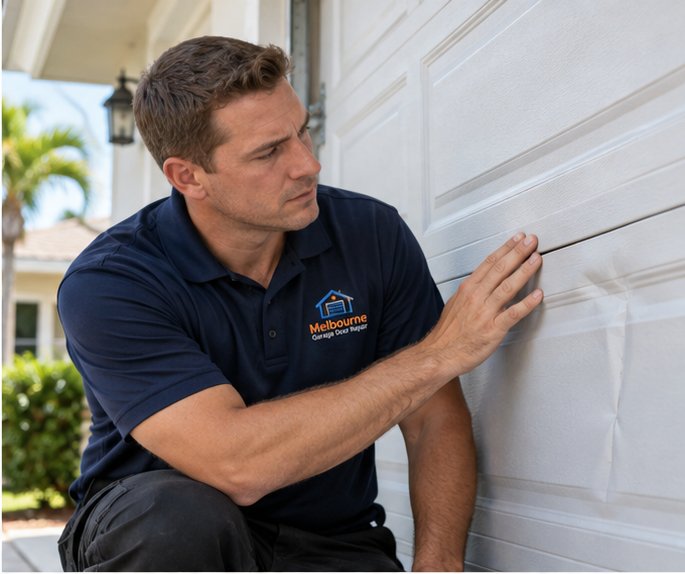
Why a crack deserves attention
A crack in a garage door panel is easy to dismiss, especially when it is short and the door still works. Yet the panel is part of a structure. Each section carries hinges, supports rollers, and helps hold the door rigid as it travels along the track. A crack interrupts that structure at the point where force passes through it.
Cracks also change over time. Every cycle of the door flexes the panel slightly. A hairline split that was barely visible last month can lengthen, branch or open wider, particularly near a hinge, a roller bracket or the place where the opener arm attaches. Moisture can then enter the opening, and in a coastal climate that speeds up rot in wood and corrosion in metal.
This page explains the usual causes, the stages of damage, and how a technician decides between a repair, a section replacement and a new door. It is educational only, because the right answer always depends on seeing the door.
Where cracks usually appear
Cracks are not random. They tend to form where stress concentrates, and learning those spots helps you describe the problem accurately when you call.
- Around the top bracket, where the opener arm pushes and pulls on the upper section
- At hinge locations, where screws or bolts bear the weight of neighboring panels
- Along the end stiles, the vertical edges that hold the roller shafts
- At the corners of window or decorative inserts
- Across the middle of a wide panel, especially on older fiberglass or thin composite skins
- Along a seam or joint on a wood door where moisture has softened the glue
- At the point of a previous impact, even if the repair looked fine at the time
Cracks that run with the grain
On wood, cracks often follow the grain and open as the wood dries and swells with the seasons. These can be shallow, but if they run through the thickness of the panel they are structural.
Cracks that radiate from a point
A star or spiderweb pattern usually means a single impact. The cracks spread outward from where something struck the door, and the middle can be soft or missing.
The main causes of cracked panels
Understanding why a panel cracked is as important as seeing the crack. If we only fix the symptom, the cause may crack the next panel. The common causes fall into a few groups.
Impact is the most obvious one. Vehicles, balls, tools and storm debris can crack a panel in a single moment. Impact from inside the garage matters too, such as a ladder tipping into the door or a load pinned against it as the door lowers.
Stress from operation is quieter. A door that is out of balance or binding makes the opener push harder, and the top section can fatigue and split around its bracket. Loose hinges and worn rollers add to this by allowing the panel to rack slightly with each cycle.
Age and environment matter as well. Sun exposure makes some plastics and fiberglass brittle. Heat and cold cause expansion and contraction. Moisture swells wood and breaks down glue lines. Salt in the air attacks fasteners and metal edges, which weakens the places where the panel is held.
Steel, wood, fiberglass, vinyl and composite
Different panel materials crack in different ways, so the first question is often what your door is made of. Many doors on the Space Coast are steel, with or without insulation, but wood, composite, fiberglass and aluminum with glass are all common.
Steel tends to dent and crease before it cracks, but it can split at a weld, a fold or a rusted edge. Wood can crack along the grain, around knots, or at the joints between boards. Fiberglass and composite panels can craze with fine surface lines, then develop through cracks at the stress points. Vinyl and some plastic faced panels can turn brittle with age. Aluminum frames can fatigue at the corners, and the glass or acrylic in them can crack separately.
Our overview of garage door materials compared discusses each material and how it holds up to heat, humidity and salt air. Knowing your material also guides what a replacement section would need to match.
Surface cracks, structural cracks and cracks that are really something else
Not every line on a panel is a true crack. Paint and finish can craze or peel while the panel beneath is intact. Caulk or sealant lines can split without the panel being damaged. A wood door can show surface checking from drying that does not pass through the board.
The sorting below is a general guide to what you may be seeing.
| What you see | What it often is | Level of concern |
|---|---|---|
| Fine lines in paint or coating only | Finish crazing from sun and heat | Low, but protect against moisture |
| Short hairline in wood along the grain | Surface checking from drying and swelling | Watch; may need sealing |
| Line that runs through the panel and opens at the edges | Structural crack | High; panel weakened |
| Star pattern with a soft center | Impact damage | High; panel may be compromised |
| Split at a hinge or bracket | Stress or fatigue crack | High; supports for hardware affected |
What a crack means for strength and safety
A cracked panel is weaker than a sound one, and the weakness shows up in specific ways. The panel may flex more than it should, so the door sags between hinge points. A cracked area near a hinge can let the hinge pull out, which drops a section of the door. A cracked end stile can let a roller shaft shift, and the roller may jump the track.
A door weighs a great deal, and it is held in balance by springs under high tension. When a structural part fails, the door can twist or drop suddenly. That is why we advise caution with any door that has a through crack. Keep people, pets and vehicles from standing under it, and avoid running it more than you must until it has been checked.
If the door sounds different, rubs, tilts, or the opener strains, treat those as signs the crack is affecting operation. A nearby page on bent or buckled garage door panels describes related damage that often comes with it.
Simple checks you can do from the floor
You can learn a lot without touching any of the parts that carry tension. Do these checks with the door closed and, ideally, with a second person present. Stay on the floor, and stop if anything looks unsafe.
- Walk the full width of the door inside and outside, looking for lines that run through the panel
- Shine a flashlight along the surface at a low angle to reveal hairline cracks
- Look from inside for daylight showing through a crack
- Compare the lines between sections for evenness from end to end
- Look at hinge locations for splits, pulled screws or loosened hardware
- Note whether the crack has grown by marking its ends lightly with painter's tape and checking again later
- Photograph everything with something for scale, such as a coin or a ruler
What not to do
Do not climb on a ladder to touch the top bracket, do not unscrew hinges, and do not adjust springs, cables or the brackets that hold them. Do not use glue, tape or filler on a structural crack and then rely on it. If someone has been hurt, call 911.
Temporary protection until the door is seen
Some owners wish to limit further damage while waiting for a visit. A few cautious steps are reasonable. If the crack lets rain in, a strip of waterproof tape on the outside can slow water entry, as long as it does not interfere with the door's travel. If the door is used daily, consider using it less until it has been looked at, and always open and close it with the wall control or remote, not by hand.
If the door is already stuck, uneven or no longer closing, do not force it. Leave it where it is, keep the area clear, and arrange a visit. If you need the garage secured, a technician can explain safe options once the door has been examined.
None of these steps is a repair. They only reduce risk until the door can be assessed, and they should never involve the springs, cables or lifting brackets.
Repairing a crack: when it is reasonable
There are cases where repair of a crack is reasonable. A shallow crack in a wood panel's surface can be sealed and refinished. A crack in a non-structural trim piece can be replaced separately. A split in a window insert can often be handled by replacing the insert alone, leaving the panel intact.
For structural cracks, repair is less likely. Epoxy and fillers can close a gap, but they do not restore the original strength where the panel carries hinge loads. A repaired area that flexes will crack again, usually in the same place, and may take the hardware with it.
Our page on garage door panel repair describes the work we do on sections, including what can be repaired and what is better replaced. The right call comes down to where the crack is and how much load that part carries.
Replacing a single section
For many sectional doors, replacing the cracked section is the sensible fix. The technician takes the door's load off the damaged panel in a controlled way, removes the section, installs a new one, and moves the hinges, rollers and any hardware that can be reused. The door is then checked for balance and smooth travel.
Panels vary in height, depth, profile and finish, so a replacement needs to match. If the door's make and model are known, the correct section may be straightforward to identify. If the door is older or the label is gone, it can take more effort to find a section that fits properly.
Color and texture can differ slightly from older panels that have been in the sun for years. Paint can be matched in many cases, though a perfect match is not always possible. We would rather say so at the start than leave you surprised later.
When a new door is the better path
Replacing a section makes less sense if several panels are cracked, if the door is old and brittle, or if parts are no longer available. In those cases, a new door may be a better use of money than a series of repairs. A new door also lets you choose better insulation, a stronger construction or a style that suits your home.
The decision also involves the rest of the system. If the springs, cables, rollers and opener have also reached the end of their life, replacing them along with the door can be more sensible than doing them one at a time. We lay out these trade-offs in the guide to repairing versus replacing a garage door.
If your door is in a community with architectural rules, a new door should fit those rules. Our notes on garage doors and HOA requirements can help you prepare before you order.
Cracks after storms and strong wind
After a severe storm, check the door for cracks even if you think it came through unharmed. Debris can crack panels without leaving an obvious dent, and wind pressure can flex a weak panel enough to split it. Cracks around window inserts and at the ends of panels are especially common after high winds.
Wind-rated doors are built with reinforcement for local conditions, and codes in Florida set requirements for new installations. Our notes on wind and building rules basics explain these ideas in general terms. We do not make claims about any specific door's rating without seeing its label.
If you suspect storm damage, you may also read about a garage door damaged after a storm. Take photographs before anything is moved or repaired, since they may be helpful if you speak to your insurance provider.
Preventing cracks and extending panel life
Preventing cracks is mostly a matter of keeping the door moving freely and the finish intact. A balanced door that runs smoothly puts far less stress on any one panel. Clean, lubricated moving parts and tight hardware help the load spread evenly.
Protect the surface as well. For wood, keep paint or stain in good condition, especially on the bottom edge and the top of each panel where water collects. For steel, repair chips before rust starts. For fiberglass and composite, watch for crazing and address it early. Keep the weather seal in good shape, since standing water at the bottom is a frequent cause of panel decay.
Teach everyone in the home not to lean items against the door or store things in the swing path of the door. A short monthly look at the door, from both sides, takes only a minute and catches many problems when they are still small.
What to expect when we look at it
When you contact us, we will ask what you have seen, the age and type of door if known, and whether it still operates. Photographs help. We will arrange a visit and, at the door, examine the cracked panel, the hardware around it, the track, the cables and springs by eye, and the balance of the door.
We then explain what we found in plain terms: whether the crack is surface or structural, whether it can be repaired, and what replacing the section or the door would involve. We do not claim any outcome before we have seen the door, and we will not recommend more than the situation needs.
If you would like to have the door looked at, contact us and describe the crack. A clear description and a few photographs make the first conversation more useful.
Questions and answers
It may be only cosmetic if it sits in the finish or follows the surface grain of wood. A line that runs through the panel, opens at the edges, or sits near a hinge or bracket is more serious. Watch whether it grows, photograph it, and have a technician look if it spreads or the door acts differently.
Fillers and adhesives can close a gap and improve appearance, but they rarely restore strength where the panel carries hinge or roller loads. A repaired structural crack often reopens at the same place. For minor surface cracks the approach can be reasonable, while structural cracks usually lead to replacing the section.
On many sectional doors, yes. The key questions are whether a matching section is available and whether the rest of the door is in sound condition. Color and texture may differ slightly from weathered panels. If the door is old or several panels are damaged, a new door may be the more practical option.
Use caution. A through crack can weaken hinge mounts and roller supports, and a failing part can make the door shift or drop. If the door moves normally and the crack is minor, limited use may be acceptable until it is examined. If it tilts, scrapes, or strains the opener, stop and keep the area clear.
Age, sun exposure and temperature swings make these materials brittle, and impacts or repeated flexing from a binding door can finish the job. Cracks often start near hinges, stiles and window corners. Early crazing in the surface is a sign to keep an eye on the panel and protect it from moisture.
A through crack can let rain and humid air into the garage, and moisture then speeds up rot in wood and corrosion in metal fasteners. Sealing the outside temporarily may slow the entry, but it is not a structural repair. Having the panel assessed lets you decide whether to repair or replace it.
Yes. Take photographs from several angles, with something for scale, before anything is moved or fixed. They help you describe the problem to a technician and give you a record of the original condition if you decide to speak with your insurance provider about storm or impact damage.