
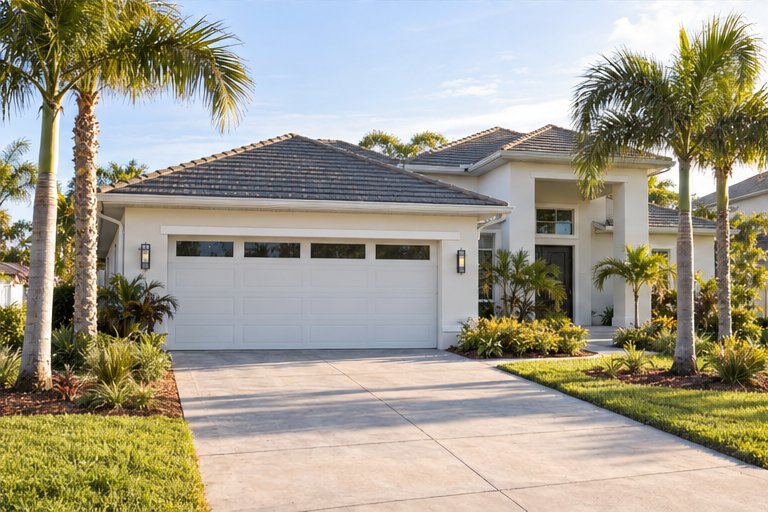
Living between two waters
Merritt Island is a long barrier-style island with the Indian River Lagoon on its west side and the Banana River on its east. The southern end, around Sykes Creek and the Courtenay area, is threaded with canals and waterways, and many homes sit on or near the water.
For a garage door, that setting matters more than almost anything else. Moisture is constant, the air carries salt, and storm surge and heavy rain are real concerns during hurricane season. A door that would last comfortably well inland is working harder here.
This page describes what we see on waterfront and near-water homes on south Merritt Island, and how we approach a door in that environment.
Moisture that never quite leaves
The air near the lagoon and the river is damp for much of the year. Morning dew settles on cold metal, and afternoon storms soak the face of the door. Moisture works its way into hinges, rollers and the inside of tracks, where it can sit for days.
Over time, that moisture speeds up rust on springs, cables, fasteners and any unprotected steel. Rust itself is not always an emergency, but it weakens metal and increases friction. A hinge that was smooth last year can bind this year.
Wiping down the visible hardware and applying a light lubricant on a regular schedule slows all of this. Our page on garage doors in a coastal climate explains the routine in more detail.
Condensation inside the garage
A closed garage in a humid climate can behave like a greenhouse in reverse. Cool surfaces, such as a concrete floor or a steel door, collect water droplets when warm, wet air meets them. You may see damp patches under the door or beads of water along the track.
Letting the garage breathe on dry days, keeping stored items off the floor and checking that the weather seals are not trapping moisture all help. Condensation alone is not a door fault, but it does feed rust.
Brackish air and the hardware that suffers first
The water here is a mix of fresh and salt, and the air carries a touch of both. The effect on metal is slower than directly on the oceanfront, but it is there. Fasteners, springs and the ends of cables are the first to show it.
Look at the bolts and brackets for orange-brown staining or flaking. Look at the spring coils for rust between the turns. Look at the cable where it meets the drum, since frayed strands there are a warning.
If you see rust that has eaten into a part, or a cable with broken strands, stop using the door and keep clear. Do not try to adjust or replace those parts yourself. They hold dangerous tension.
- Rust blooms on spring coils and brackets
- Orange streaks beneath hinges and fasteners
- Pitting on the bottom edge of the door
- Corroded wall-control and sensor connections
- Opener terminals with green or white powder
Canals, docks and the garage next to the water
Many homes here have a garage at street level and a dock, boat lift or seawall at the back. In some, the garage is the room closest to the water. That position means it takes the brunt of wind-driven rain and, in a major storm, higher water.
If your garage floor is low, ask yourself what happens when the water rises. Keep valuables, the opener's power supply and the remote controls off the floor if you can. After flooding, an opener should be checked before it is used again, since water in the motor or circuit board can cause shorts and shocks.
See our page on water leaking under a garage door for the usual causes of wet floors and what can be done about them.
Boat garages and tall openings
South Merritt Island is boating country. Garages here often shelter a boat on a trailer, a jet ski or a kayak rack, and some homes have tall or wide openings to fit them. A taller door has longer tracks and a heavier load on the springs.
If you are towing a boat in and out, the door gets more use than usual and the risk of a collision rises. A mirror or antenna clipping a panel or the opener rail is easily done. Check the clearance as you back in, and consider a marker on the wall.
Boat trailers also bring water, salt and mud into the garage. Rinse the floor now and then, and wipe the bottom of the door and the track so the residue does not sit against the metal.
Antennas, masts and roof racks
A boat on a trailer is taller than it looks. An antenna, a tower or a kayak rack can catch the top of the opening or strike the opener rail hanging from the ceiling. If you have ever heard a scrape or a bang when pulling in, check the rail, the header bracket and the top panel for damage.
A bent rail can cause the opener to jam or the door to travel unevenly. If you notice a bend, have it looked at before it fails.
Flood zones, raised homes and low thresholds
Some homes in the area are raised on pilings or stem walls, and the garage may be at ground level underneath. Others are on slab at an elevation only slightly above the street. In both cases, the bottom of the door is the part most exposed to water.
A bottom seal that has hardened, cracked or flattened lets water and debris pass. On a low threshold, a seal and a good fit to the floor can make a real difference during heavy rain. A garage door is not a flood barrier, though, and we would never describe it as one.
If your garage has taken water before, mention it. Reduced strength in the bottom panel, rust on the lower hinges and a damp opener are all things we look for. Our page on bottom seal and threshold service describes what we can do.
Hurricane season on the island
On a barrier island, preparation for storm season is part of life. A garage door is among the larger openings in a house, and wind pressure on it can be significant. In Florida, newer doors are usually built to meet wind-load requirements, and the label on the door typically shows what it is designed for.
Before the season starts, check the track, the hinges, the fasteners and the seals. If your door is old, or you are not sure of its rating, talk it over with us. A replacement built for high winds is a sizeable decision, so take the time to understand it.
After a storm, do not run a door that has taken a hit. Look for bent tracks, dents and displaced hardware. Our guide to garage door hurricane preparation sets out what to do beforehand and afterwards.
It is also worth thinking about what is stored near the door. Loose items such as paddleboards, ladders and fishing poles can be thrown against the door by wind, or can fall against the track. Secure them or move them to a safer place before a storm arrives, and keep the area around the door clear so you can reach the manual release if you need it.
Power loss, surge and the opener
Outages are a regular occurrence during summer storms. If the power goes out, the opener cannot lift the door, but the manual release can let you in or out. Pull the red cord with the door closed, and lift it by hand only if it moves freely.
Lightning near the water is common. A surge can burn out the opener's board or scramble the settings. A surge protector on the opener's outlet helps, as does unplugging it during a nearby strike if you can do so safely.
If the door has acted oddly since a storm, such as opening by itself or ignoring the remote, our page on a door that opens or closes by itself is a good place to start.
Older island homes and newer rebuilds
Areas around Sykes Creek and Courtenay include homes of different ages. Some were built decades ago and have been renovated since. Others are newer builds or rebuilt homes with large modern garages.
Older doors may have thinner panels, smaller springs and a lighter frame. They may have been patched or repainted multiple times. A newer insulated door is heavier, and the springs must match. That difference changes what we recommend and how we adjust.
We look at each door as it is, not as we expect it to be. If you are renovating, tell us what you plan to do to the garage and the door, so any work is done in the right order.
If your home has changed hands recently, it is a good moment for a look at the garage door. A buyer's inspection may only run the door once. A closer check of springs, cables, rollers and sensors can reveal wear that has not yet caused a problem. See buying a home: garage door inspection for what is worth checking.
Canal-side corrosion on electronics
It is not just the metal parts that suffer. The electronics of an opener, the wall control, the sensors and the remote receiver are all exposed to humidity. Connections can corrode, and condensation inside a sensor housing can cause intermittent faults.
If a sensor works one day and not the next, or the wall control flickers, look for moisture or corrosion at the wire connections. Do not open the opener housing. Our page on safety sensor repair explains what we check.
Replacing a corroded wire or sensor is usually simple compared with chasing a fault that comes and goes. Intermittent problems tend to get worse, not better.
Paint, finish and the sun
Strong sun and humidity attack door finishes. A door that is repainted without proper preparation can peel in a season. Salt-laden air makes it worse, since moisture trapped beneath the paint spreads rust.
If you are repainting, clean the door, treat any rust, use a primer suited to the material and finish with a quality exterior paint. If the door is steel, pay particular attention to the bottom edge and the seams, where rust usually begins.
If you are choosing a new door, ask how the finish is applied and what protection is on the cut edges and the fasteners. See garage door colors and finishes for ideas that suit a bright, humid location.
Fasteners deserve attention as well. Stainless or coated hardware stands up to damp air better than plain steel, and replacing a rusted bolt before it fails is a small job. When you find a fastener that is badly corroded, do not try to remove one that holds a spring or cable bracket. Those are for a trained technician.
Seasonal residents and homes left empty
South Merritt Island has a mix of full-time and seasonal residents. A home may be closed up for weeks or months, and a garage door that sits unused for long periods can develop problems. Seals stick, lubricant dries, and humidity builds up inside the closed space.
Before you leave, test the door, check the remote batteries and make sure someone you trust knows how to use the manual release. When you return, watch the door run through a full cycle before you rely on it.
Our garage door vacation checklist is a useful reference if you are away for any length of time.
Waterfront rentals and short stays
Vacation and seasonal rentals add another layer. Guests are not familiar with the door, the remote or the keypad, and they use them in ways an owner might not. A door that is slammed shut, forced when it sticks or left half open can suffer.
A simple instruction card on the wall, explaining the keypad and the manual release, can prevent many calls. Replace remote batteries between stays, and keep the sensors clear of luggage and boat gear.
If you manage a rental, our page on garage doors for rental properties covers the practical points in more depth.
What a visit to a waterfront home involves
We come to the property, look at the door and ask what you have noticed. We check the springs, cables, rollers, hinges, tracks, seals, balance, opener and safety reversal, and we look closely for corrosion.
We then explain what we found. If parts need replacing, we say which and why. If a door can safely keep working while you plan ahead, we say that as well. If it should not be used, we explain why.
Nothing is done until you understand the options and agree to go ahead.
A maintenance rhythm for damp, salty air
A simple routine goes a long way here. Once a month, rinse salt and grime from the door with fresh water, wipe it dry, and look over the hardware. Every few months, lubricate the rollers and hinges with a suitable product and wipe away the excess.
Twice a year, test the safety reversal and sensors, and check the weather seals. Once a year, have the door looked over by a technician who can check the springs and cables, which are not for homeowners to adjust.
The monthly garage door checklist sets out the safe checks. If something looks wrong, such as frayed cable, a gap in a spring coil or a door that sits crooked, stop using the door and call us.
Wind, rain and the exposed front of the house
Houses on open water get weather from all directions. A garage door facing the water or an open lot catches wind-driven rain, and the rain finds any gap at the sides, top or bottom. Water running down the track can stain walls and rust fasteners.
Weather stripping around the frame, a good top seal and a bottom seal that sits cleanly against the floor reduce what gets in. If water collects at one end of the door, the floor slope or a slightly out-of-level door may be the cause.
We can check the door's fit and the condition of every seal. If the cause is something beyond the door, such as drainage or the slab, we tell you what we see so you can speak to the right person.
A good fit is also quieter. A door that rattles in the wind is often one whose track or seals have worked loose, and tightening or replacing those parts helps the door as well as the garage.
Questions and answers
It can. Moisture and salt in the air speed up rust on springs, cables, hinges and fasteners, and they can corrode electrical connections. Regular rinsing, drying, lubrication and a yearly inspection make a real difference. We look closely at corrosion on every waterfront door and tell you what we find before deciding on any work. We are glad to answer any further questions when you get in touch.
A garage door is not a flood barrier. A good bottom seal and a well-fitted door can limit rain driven under it, but rising water is a different matter. We can check the seal and threshold and explain what is realistic. Keep valuables and electrical items off the floor, and have the opener checked after any flood. We are glad to answer any further questions when you get in touch.
With the door closed, pull the red release cord hanging from the trolley, then lift the door by hand if it moves smoothly. If it feels very heavy, crooked or stuck, stop, because a spring or cable may be damaged. Contact us rather than forcing it. Re-engage the opener carefully once power returns. We are glad to answer any further questions when you get in touch.
Light surface rust is common near water and is not always urgent, but rust that has pitted the metal or built up between coils can weaken a spring. Do not try to treat or adjust springs yourself, because they hold dangerous tension. Tell us what you see and we will inspect them and explain the options. We are glad to answer any further questions when you get in touch.
Yes. After a storm, avoid running a door that has been hit or pushed by wind. Photograph any damage from a safe distance and get in touch. We inspect the track, panels, hinges, springs and opener, explain what is damaged and describe the options for repair or replacement. We are glad to answer any further questions when you get in touch.
Test the door through a full cycle, replace remote batteries, check the seals and make sure someone trustworthy knows how to use the manual release. Clear the floor near the door. On return, watch the door run through a full cycle before relying on it. Call us if anything sounds or looks different. We are glad to answer any further questions when you get in touch.
Yes. Taller and wider doors carry more weight, so the springs, cables and opener must be matched to the door. We inspect the whole assembly, check for impact damage from trailers and masts, and explain what is needed. If you are planning a taller opening, talk to us before ordering a door. We are glad to answer any further questions when you get in touch.