
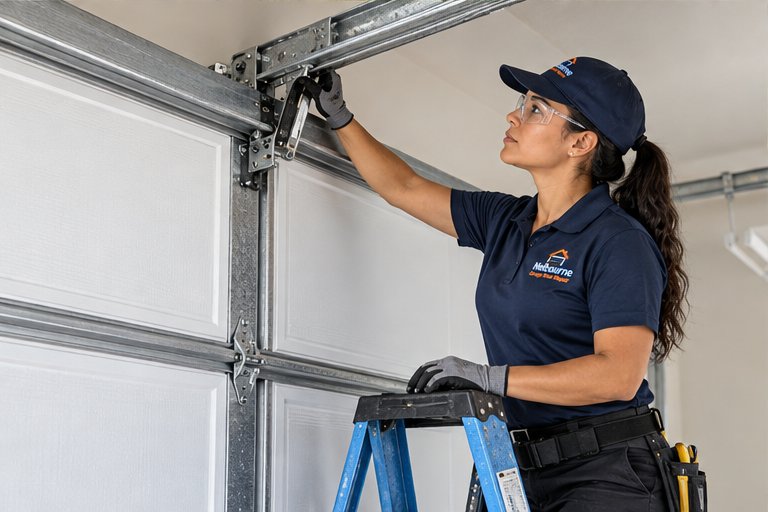
Where the line sits and why
Homeowners are good at maintaining their houses, and a garage door looks like just another piece of equipment. It is not. The door is balanced by springs under heavy tension, and the cables and brackets that connect them carry loads that can cause serious injury if they fail or are handled wrongly. People are hurt every year by trying to adjust parts that were never meant for amateur hands.
The good news is that the safe jobs and the dangerous jobs divide cleanly. Anything that involves looking, listening, cleaning, testing a remote or sensor, and carefully using the manual release is reasonable for an owner. Anything that involves springs, cables, bottom brackets, drums, track mounting or the door sections themselves belongs to a trained technician.
We are not trying to scare you. We want you to do the things that help, skip the things that hurt, and call us when a job crosses the line. If you read only one idea from this page, make it this: never adjust, loosen or replace springs, cables or brackets yourself.
The table of checks and jobs
The left column lists common tasks. The middle column says who should do them. The right column gives a short note on why.
| Task | Who should do it | Note |
|---|---|---|
| Look over the door, tracks and hardware for damage | Owner | Look only, keep hands away from moving parts |
| Listen for scraping, popping or grinding when the door runs | Owner | Write down when each sound happens |
| Replace remote or keypad batteries | Owner | Follow the maker's instructions for the unit |
| Clean sensor lenses with a soft cloth | Owner | Wipe gently and check the indicator lights |
| Test the safety reversal with a small obstruction | Owner | Use a board or roll of paper towels, not a hand or foot |
| Use the manual release with the door fully closed | Owner with care | Only when closed, never on a broken or crooked door |
| Wipe the track surface and clear debris | Owner | Wipe only, do not grease the inside of the track |
| Lubricate rollers, hinges and the opener rail as advised | Owner | Use the right product on the right parts |
| Program a remote or keypad | Owner | Follow the opener's instructions |
| Adjust or replace springs | Technician only | High tension, serious injury risk |
| Replace or adjust cables, drums or bottom brackets | Technician only | Loaded parts that can release suddenly |
| Realign or reset a door that is off its track | Technician only | The door can fall or twist |
| Replace panels or hinges on a loaded door | Technician only | Changes balance and can unload the door |
| Move or remount track and spring hardware | Technician only | Structural and balance critical |
| Replace or wire an opener | Technician recommended | Wiring and alignment matter for safe operation |
Checks that are safe for owners
The first safe job is simply looking. Stand back and view the door from inside the garage, with the door closed. Does it sit level? Do the panels line up? Are there any gaps, dents, rust spots or loose fasteners? Look at the tracks, the rollers and the hinges, and note anything that seems bent, worn or out of place. Do not touch the springs or cables.
The second safe job is listening. Run the door with the opener and pay attention. A smooth hum is normal. Scraping, popping, grinding or slapping are not. Note whether the sound happens on the way up, on the way down or both, and where in the travel. A description like that is useful to a technician, as our guide to diagnosing garage door noises explains.
The third safe job is checking the accessories. Remotes, keypads and wall controls can all be tested from where you stand. If a remote is weak, replace its battery. If the door ignores the wall control, check for the lock feature that some wall panels have. Our page on a remote that is not working lists simple steps.
A safe visual routine
Do it monthly. Look at the door closed, then open, from a position where you are not under it. Compare the left and right sides. Look for frayed strands, gaps and hardware that appears to have moved. Report what you see; do not fix it.
A safe listening routine
Run the door twice with the garage quiet. Close any other source of noise. Describe the sounds in plain words, such as scrape, pop or squeal.
Sensors and the safety reversal test
Every modern opener has photo eye sensors near the floor on each side of the door. They send a beam across the opening, and if something breaks the beam while the door is closing, the door reverses. Dust, spider webs, sunlight and slight misalignment are the usual reasons for trouble, and an owner can deal with the simple ones.
Wipe each lens with a soft, clean cloth. Make sure each sensor is firmly in its bracket and that the indicator lights are steady, not blinking. Our page on sensor lights that blink describes the common patterns. If the lights stay wrong after cleaning, stop and call for a visit.
The reversal test checks the opener's second protection. With the door open, lay a flat board or a roll of paper towels on the floor in the door's path. Press the button to close. The door should touch the object, stop and reverse. Never use a hand, foot or any part of a person or pet for this test. If the door does not reverse, stop using the opener and have it checked. Our garage door safety tests guide covers the steps.
- Keep the test object low and flat.
- Do not stand in the door's path.
- If the door crushes or fails to reverse, stop and call for service.
- Repeat the test every few months, and after any opener adjustment.
Cleaning and lubrication done properly
Lubrication is a useful owner job when done correctly and with the right product. Moving metal parts such as roller stems, hinge pivots and bearings benefit from a light coating of a suitable garage door lubricant. The opener's chain or screw may need a different product than a belt, which usually needs none.
Keep lubricant off the inside of the track, where the rollers run. A greasy track collects dirt and can make rollers slip rather than roll. Wipe the track with a clean, dry cloth instead. Also, keep lubricant away from weather seals and the sensors.
Do not spray the springs, cables or brackets. Lubricating springs is sometimes mentioned in older advice, but it involves getting close to loaded parts, and a technician should decide what the springs need. Our lubrication guide describes what to treat and what to leave alone.
The manual release: useful, but handle with care
The red cord with a handle that hangs from the opener rail is the manual release. It disconnects the door from the opener so that the door can be moved by hand, for example during a power failure. Used correctly, it is a safe and important feature. Our guide to the manual release during a power outage covers the details.
The rule is simple. Use it only when the door is fully closed. If the door is open or partly open and you release it, the door can fall suddenly if the springs are weak or broken. Pull the handle straight down and back, lift the door slowly by hand, and stop at once if it feels very heavy or moves unevenly.
If the cord is stuck, or the door feels extremely heavy, do not pull harder. A heavy door with the release pulled may mean a broken spring. In that case, leave the door closed and call for service.
When not to use it at all
Do not use the release on a door that is crooked, off its track, partly open or that has just made a loud bang. The door may be unbalanced and could fall.
Reconnecting the opener
Follow the manufacturer's steps for reconnecting. If the carriage will not engage, or the door feels wrong afterward, stop and ask for help.
Jobs that belong only to a technician
Springs top the list. A torsion spring sits above the door on a shaft and is wound under heavy tension. An extension spring runs along the side and stretches when the door is closed. Either type can release its energy suddenly and with great force. Cables are also loaded, and so are the bottom brackets that hold them. A bracket that is released with the door closed can send hardware flying.
Track mounting, drums, bearings and the center bracket also affect balance and safety. So does the replacement of panels on a loaded door, since a missing section changes the weight distribution. Putting a door back on its track after it has come off is not a tidy job either, because the door can twist or drop.
A technician has the tools, the knowledge of tension, and the training to handle those parts safely. Our page about broken torsion spring repair explains what that work involves, and why we tell owners to leave it alone.
- Springs: never adjust, wind, loosen or replace.
- Cables and drums: never remove, tighten or re route.
- Bottom brackets: never unbolt, especially with the door closed.
- Track mounting and door sections: never move or remove.
- Door off its track: never try to lift or force it back.
Why online videos can mislead
Plenty of videos show people replacing springs and cables, and they make it look routine. What they rarely show is the tools matched to the exact spring size, the care taken with the winding direction, the number of turns, the safety clamps, or the injuries from mistakes that are not recorded.
Spring sizes, door weights and mounting differ from one door to the next. A step that works on one door can be dangerous on another. The wrong spring, the wrong tension or a missed fastener can lead to a door that is out of balance, or one that fails suddenly later.
We are not suggesting that homeowners are careless. The point is that this is a trade with a particular risk, and the safest approach is to treat it as such. If a video tempts you, picture the spring unwinding on its own, and then pick up the phone.
Openers: where the line is less sharp
Openers are electrical and mechanical devices, and some jobs on them are friendlier than others. Changing a light bulb, replacing a remote battery, adjusting a travel limit following the instructions and programming a keypad are typical owner tasks. Mounting a new opener on the ceiling, wiring it and setting the force and travel properly is more involved.
If an opener is not responding, check that it has power, that the wall control is not locked out and that nothing blocks the sensors. If those checks do not help, the problem may be in the logic board, the motor or the gears. Our overview of garage door opener repair describes what a technician checks.
Installing a new opener involves mounting a rail, connecting it to the door and wiring the sensors. If the door is out of balance, the new opener will be asked to do the springs' job and will wear out sooner. That is why we check balance before fitting any opener.
Weather seals, trim and cosmetic jobs
Some jobs sit in between. Replacing a bottom seal, adding a weather strip to the sides or cleaning and touching up paint are low risk tasks that many owners handle. The bottom seal slides into a retainer on the lowest panel, and with the door closed and the opener disconnected, it can usually be replaced without touching any loaded part.
There are still points to watch. Make sure the door is fully closed and stays that way. Do not remove the bottom bracket or the panel itself. If the seal retainer is bent or the bottom panel is damaged, stop and ask a technician to look. For more on seals, read about weather seal replacement.
Painting or cleaning the outside is also fine. Keep paint off the rollers, tracks and seals, and let it dry before closing the door fully.
Florida conditions that affect the decision
On the Space Coast, humidity, salt air and heat make garage door hardware age faster. Rust creeps into hinges, bolts and track fasteners. Seals dry out and crack. Wood doors swell. These problems tempt owners to tighten bolts and spray everything, but over tightening or spraying the wrong parts causes more trouble.
Our advice is to clean, look and report, and let a technician decide what to tighten or replace. A door in a coastal setting benefits from periodic professional attention, even if no problem is obvious. The recommendations in our coastal climate guide explain what the local conditions do to a door.
Before storm season, check that the manual release works, that the tracks look clear, and that the door closes fully. Leave bracing, bolting or reinforcement decisions to a professional.
A sensible plan for owners
A good routine is simple. Once a month, look and listen. Every few months, clean the sensors and test the reversal. Twice a year, apply lubricant to the right moving parts. Before storm season, test the manual release and the opener. Throughout, write down anything unusual.
Between those checks, keep the area under the door clear, keep remotes away from children, and make sure everyone in the household knows not to touch the springs and cables. A short family talk can prevent a lot of problems.
If something looks wrong, stop. It is perfectly fine to call us with a question, even if it turns out to be minor. Our monthly checklist gives you a set of safe steps to follow.
When to call us
Call when a door is heavy, uneven, noisy in a new way, off its track, or banging. Call when a cable or spring looks damaged. Call when the opener hums but the door does not move, or when the reversal test fails. Call also when you are unsure, because that uncertainty is a good reason to ask.
We come to the property, look at the door and hardware, and explain what we find in plain language. We will tell you what the options are, and which parts of the job you can do yourself, if any. If the door can safely wait, we will say so.
You can reach us through the contact page, and we will follow up about getting the door looked at.
Questions and answers
No. Springs hold stored energy and can cause serious injury if handled wrongly, and the correct size and tension depend on the door. Spring replacement and adjustment should be done only by a trained technician. If you suspect a broken spring, keep clear of the door, do not run the opener and call for service.
You can look over the door, listen for unusual sounds, replace remote batteries, clean sensor lenses, test the safety reversal with a flat object, lubricate the right moving parts and use the manual release when the door is closed. Stop if anything seems wrong, and do not touch springs, cables or brackets. Keep the checks gentle and stop at any resistance.
It is safe when the door is fully closed and moves normally. Do not use it when the door is open, partly open, crooked, off its track or after a loud bang. A very heavy door may have a broken spring. If the door feels wrong, leave it closed and call for service. Practice the steps once with the door closed, so the motion is familiar if the power fails.
No. Wipe the track clean with a dry cloth instead. Grease inside the track collects dirt and can make rollers slip. Lubricant belongs on moving metal parts such as hinges, roller stems and bearings, as the maker advises. Keep it off the seals and sensors, and never spray springs or cables. A dry cloth is all the track needs.
No. A door that has come off its track can twist or fall, and the springs and cables are probably loaded in an unusual way. Keep people and vehicles clear, do not run the opener and call for service. A technician will check the track, rollers and hardware before the door moves again. Even a gentle attempt can injure you.
Some owners do, but it involves ceiling mounting, wiring and setting force and travel properly. The door also needs to be balanced first, or the opener takes the springs' load and wears out sooner. A technician can fit the opener and test the safety reversal and sensors for you. That balance step is routine for us.
Treat it as not safe and ask. If it involves springs, cables, brackets, tracks, sections or a door that will not move normally, leave it to a technician. If it is looking, listening, cleaning or testing a remote, it is probably fine. We are happy to answer questions. There is no embarrassment in asking before you start, and it can save an injury.