
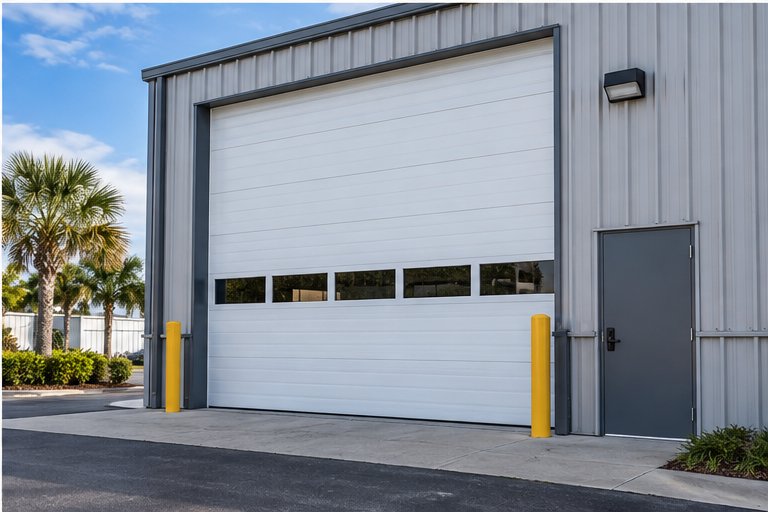
Two doors that solve the same problem differently
Both door types close an opening and open it again, but the way they move could hardly be more different. A sectional door is made of horizontal panels joined by hinges. As it rises, it bends around a curve in the track and then lies flat against the ceiling of the garage. A rolling door is made of a long curtain of narrow slats that wind up around a drum, called a barrel, mounted above the opening.
That one difference drives nearly everything else: how much headroom you need, where the springs sit, how the door is powered, how loud it is, how well it seals, and what usually goes wrong. Understanding the mechanism makes it much easier to decide which type fits a given building.
How a sectional door moves
A sectional door rides on rollers inside two vertical tracks that curve into horizontal tracks overhead. Torsion springs on a shaft above the door, or extension springs along the sides, balance the weight so the door feels light and an opener can lift it with a modest motor. Cables run from the bottom corners to the spring system and carry much of the load.
Because the panels fold at the hinges, the door takes up space in the garage ceiling when open. You need enough headroom for the track to curve and for the door to rest overhead. The panels can be insulated, windowed, painted and styled to match a house, which is a large part of why sectional doors dominate residential building. Our guide to how a garage door works explains the pieces in more detail.
Moving parts that wear
Rollers, hinges, cables, springs and the opener all move every time the door runs. Each of those parts has a service life, and the daily use of a family garage means the cycles add up steadily.
Why the springs matter so much
The springs are the heart of a sectional door. They hold stored energy and must be left to trained hands. The same warning applies to cables and bottom brackets.
How a rolling door moves
A rolling door, sometimes called a roll up or coiling door, is made from interlocking slats that curl onto a barrel as the door rises. The barrel is mounted in a hood above the opening, with guides on each side that keep the curtain in line. A spring system inside the barrel, or a motor and gear operator, controls the movement.
Since the curtain coils up instead of lying flat, it needs very little headroom compared with a sectional door. It also leaves the ceiling clear. This is a big advantage in buildings with low ceilings, overhead pipes, ducts or lifts. Many rolling doors are powered by a motor mounted at the side and operated by a wall switch or a control panel, and larger ones are intended for commercial use.
Slats and curtains
The curtain can be made of steel, aluminum or other materials. Solid slats give privacy, while perforated or open grille styles allow air and sight lines through.
Hoods and guides
The hood protects the coil from weather and dirt, and the side guides hold the curtain edges. Damage to either can make the door bind or wander.
Side by side comparison
Use this table as a handy reference. The sections that follow explain the rows in more depth.
| Factor | Sectional door | Rolling door |
|---|---|---|
| How it opens | Panels fold at hinges and travel along curved tracks to rest overhead | Slats coil around a barrel in a hood above the opening |
| Headroom needed | Moderate to large, depending on track type | Small, mostly the hood itself |
| Typical setting | Homes, townhouses, many small businesses | Shops, storage units, warehouses, service bays |
| Appearance options | Wide range of panel styles, windows, colors and finishes | Plainer and more utilitarian, with fewer style choices |
| Insulation | Insulated panels are widely available | Insulated curtains exist but are less common, and slat gaps limit sealing |
| Sealing against weather | Seals along the bottom, sides and top give a tight fit | Slat edges and guides allow more air and moisture past |
| Noise when running | Can be quiet with good rollers and a belt drive | Usually louder because of the metal curtain and gear operator |
| Common repair items | Springs, cables, rollers, hinges, panels, opener | Curtain slats, guides, barrel springs, operator, limit settings |
| Security feel | Solid panels and locks, depends on opener and latch | Heavy curtain and lock bars suit commercial security |
| Right fit when | Style, insulation and quiet matter | Headroom is tight or heavy daily use is expected |
Headroom, ceilings and the shape of the building
Space is often the deciding factor. A sectional door needs the track to run back along the ceiling, and it needs enough height above the opening for the curve. In a typical house garage that room exists, and the area above the door often becomes useful storage for ladders or seasonal items.
In a commercial building, the ceiling may be filled with ducts, pipes or racking. A rolling door takes its space in the hood at the top of the opening and leaves the ceiling clear, which is the reason it appears so often in storage rooms and service bays around Melbourne, Palm Bay and Titusville.
If you are not sure what fits, a technician can measure the headroom, side room and back room of your opening. Our guide to measuring for a new garage door explains the figures that matter, and our notes on residential and commercial garage doors give a broader view.
Appearance and curb appeal
A house garage faces the street, so its appearance matters. Sectional doors come in many panel designs, from flat panels to raised panels, carriage house styles, full view glass and wood look finishes. They can be painted to coordinate with trim, shutters and the front door, and many neighborhoods with architectural review boards expect one of those looks.
Rolling doors are about function. They are usually plain slatted surfaces in a limited range of colors. That works well on a workshop or a storage building, but it is rarely what a homeowner wants on the front of a house, which is why rolling doors are uncommon on residential garages.
The exceptions are special situations such as a detached shop, a boat storage building or a utility room on a larger lot, where the owner values the compact headroom and the strong feel of the curtain over style.
Insulation, heat and moisture
Florida summers put real demands on a garage door. A sectional door can be ordered with insulated panels that reduce heat gain into the garage, soften noise from the street and make the door feel more solid. Our overview of garage door insulation shows what the layers do and do not accomplish.
A rolling door has slats that overlap but do not form a continuous insulated surface. Some are filled with insulation, and brush seals along the guides help, but the door will not seal as tightly as a sectional panel set. In a conditioned space or a room where temperature matters, that can be a disadvantage.
Moisture is a second concern. Sectional doors with proper bottom seals keep wind driven rain and pests out of the garage. Rolling doors can let in more air and moisture around the guides and at the bottom edge, so a coastal owner should ask about the seal details before choosing.
- Sectional: continuous panels, good sealing, many insulation options.
- Rolling: compact and strong, but more gaps for air and moisture.
- Either type benefits from fresh seals checked at least once a year.
Springs, balance and power
A sectional door is counterbalanced by a spring system, and its balance is what lets an opener work without strain. If the balance drifts, the door becomes heavy, the opener struggles and parts wear sooner. Our page on balance and adjustment explains how a technician restores it.
A rolling door has its own spring tension, located inside the barrel, and a gear operator that drives the barrel. The tension is just as dangerous as on a sectional door and is also work for trained technicians. Adjusting the limit settings for the top and bottom travel is another professional task, because wrong limits can crush the curtain or leave a gap.
In both types, a power failure means the door should be operated by the manual release or chain hoist, as designed. Practice with the release before you need it, with the door fully closed and no one standing nearby.
Repair patterns for each type
Sectional doors tend to need attention to the parts that flex and roll. Rollers wear out, hinges loosen, cables fray, springs lose strength, panels dent, and openers wear. A homeowner can see and hear most of these developing, and early attention usually keeps a small problem small. If the door has jumped out of its track, see a door that is off track for what to do and what to avoid.
Rolling doors fail in a different way. The curtain can bend or dent where it is struck by a forklift or a vehicle, a slat can catch in the guide, the operator can lose its limit setting, or the barrel spring can lose tension. A bent slat is usually a section repair, but a badly damaged curtain may need new slats or a new curtain altogether.
Both types need regular lubrication and cleaning of the moving parts, suited to the type. The sectional door's rollers, hinges and bearings are the main places for lubricant, and our lubrication guide describes what to apply and what to leave dry.
Warning signs on a sectional door
Loud banging, scraping, a door that sits crooked, a door that drifts down when halfway up, and an opener that groans are all reasons to stop using the door and have it looked at.
Warning signs on a rolling door
A curtain that rubs the side guides, an operator that stops short, new gaps at the bottom, or a coil that looks uneven in the hood all call for an inspection.
Commercial use and daily wear
A business door works harder than a home door. A delivery bay may open dozens of times a day, and the door is exposed to impacts, dust, weather and different people operating it. Rolling doors are built for that kind of duty, with heavy slats and robust operators, and many repair shops, storage facilities and warehouses use them for good reason.
Sectional doors are also used in businesses, including heavy duty versions with thicker panels and stronger hardware. They suit retail fronts, offices and fleet bays where appearance and insulation count. Our page on commercial garage door service describes what we look at on these doors.
Whichever type you run, a regular maintenance routine pays off in a commercial setting, where a stuck door can stop work. Read the notes on maintenance for business owners for a practical schedule.
Wind, storms and security
Wind affects both types, but in different ways. A large sectional door can flex under pressure, so wind rated doors use reinforcement, heavier tracks and stronger fastening. A rolling door is held at both edges by the guides and relies on the strength of the slats and the guide attachments to resist pressure.
For storm preparation on the Space Coast, both types need sound hardware, tight fasteners and a working manual release before the season begins. Look at the condition of the guides on a rolling door and the track and bracket condition on a sectional door, but let a technician handle any adjustment.
On security, a closed rolling door is a hard barrier, and many have lock bars at the sides. A sectional door depends on a secure opener, a good latch and a well maintained track. Neither type is secure if the manual release is left exposed to a coat hanger or a pry tool.
Choosing between them
Choose by the building and its use. If the opening belongs to a home, the answer is almost always a sectional door, because it can be insulated, styled and sealed, and because the garage space above it is useful. If the opening belongs to a shop, a storage space or a heavy use bay with limited headroom, a rolling door may be the sensible choice.
Think also about who will be maintaining it. A sectional door has more parts but is familiar to nearly every garage door technician. A rolling door has fewer visible parts but may call for particular knowledge of the operator and the barrel.
Whichever you choose, the same principles hold. Match the door to the opening and the use. Ask about wind rating, sealing and warranty details in writing from the supplier. Have the installation done properly and balance tested on the day.
Pick sectional when
You want style, insulation, quiet running, and a garage that feels part of the house.
Pick rolling when
You need compact headroom, heavy duty cycles, or a utilitarian door for a commercial opening.
Can I switch from one type to the other
Sometimes. Converting a rolling door to a sectional door requires enough headroom and side room for tracks, space on the ceiling for the horizontal run and a way to mount springs and an opener. Converting a sectional door to a rolling door requires a hood space above the opening and a way to power the operator.
Either change can involve structural work, electrical work and local permit questions. The opening may need to be reframed. The right first step is an inspection that measures what room you actually have. Our new garage door installation page explains what the process looks like for a home door.
Talk to us about your door
If you are choosing a door for a new space, or you have a door that is not behaving, we can come to the property, look at the opening and the hardware, and explain what we find in plain language. We serve Melbourne and the surrounding Space Coast communities.
To describe your door and what it is doing, use the contact page. We will walk through your options with you before anything is done.
Questions and answers
Occasionally, usually for detached shops, boat storage buildings or rooms with very low headroom. Most homes use sectional doors because they can be insulated, styled and sealed well, and they suit the look of a house. A rolling door is more common on commercial and storage buildings. If you are curious about a special case, describe the building and we can talk it through.
A rolling door needs less, because the curtain coils into a hood above the opening instead of running back along the ceiling. A sectional door needs headroom for the track curve and overhead run. A technician can measure your opening and tell you which types will fit. Do not guess on a tight space; measure first, and let us check the hardware too.
A closed rolling door is a heavy barrier with lock bars at the sides, so it suits many commercial uses. A sectional door can be very secure too, if the opener, latch and manual release are well kept. Security depends on the hardware and how it is maintained, not only on the door type. If you are unsure, ask what lock and latch options each door offers before deciding.
No. Both types use spring tension that can cause serious injury if it is released wrongly. Springs, cables and brackets should be adjusted or replaced only by a trained technician. Owners can look, listen and test the door, but should stop if anything seems wrong and call for help. Instead, describe what you see and hear, and let the technician decide what the door needs.
Both can work when built from suitable materials and maintained. Sectional doors with good bottom and side seals keep out more wind driven rain. Rolling doors can let in more air around the guides. In either case, finishes, fasteners and hardware near the coast need regular checks and cleaning. Ask your supplier about finishes and fasteners suited to coastal air before you order.
Usually yes, because a metal curtain winding onto a barrel and a gear operator make more sound than a well tuned sectional door with quality rollers and a belt drive. Noise levels vary with the model, the condition and how well it is maintained. A quieter door usually means a well tuned, well lubricated one.
Yes. We look at sectional doors on homes and businesses, and we can discuss rolling door needs when you contact us. We will come to the property, check the door and hardware, explain what we find and talk through the options with you. Just describe the door and what it is doing, and we will take it from there.