
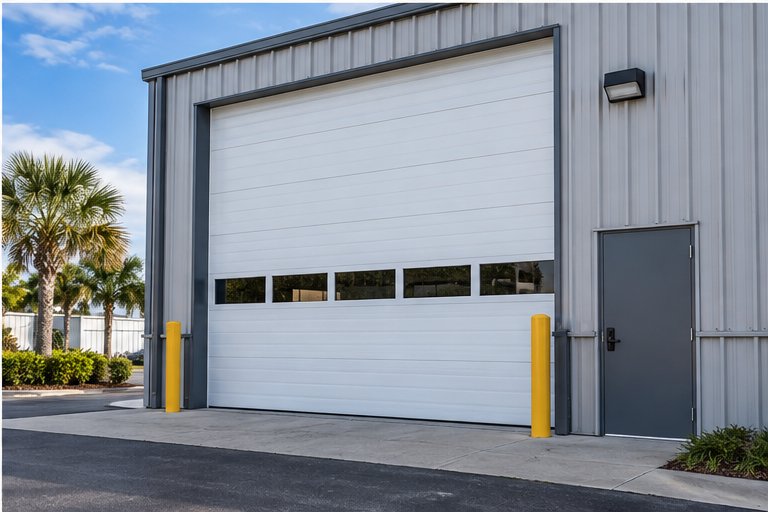
One idea, two very different jobs
At a glance, a door in a residential neighborhood and a door on a commercial building can look alike. Both close an opening, both move on tracks, and both use springs to offset weight. Underneath, they are built for different lives.
A home door might cycle a few times a day, in a dry and sheltered space, with one driver pressing a button. A commercial door might cycle dozens of times, be struck by equipment, face wide openings and be run by several staff members who are in a hurry.
Understanding this difference helps when you are choosing a door for a new space, deciding whether a home door can handle a heavier workload, or planning maintenance. The right door for the job is the one made for the job.
Noise and neighbors can matter as well. A home door sits beside bedrooms and next to a property line, so a quiet operator is a real benefit. A commercial door in an industrial setting often trades quiet for toughness. Those priorities shape which parts get chosen.
Size and weight
Residential doors are generally sized for cars, with single and double widths being the most common. They are built to be light enough for a home opener and a standard spring set to handle comfortably. See single versus double garage doors for how those two sizes differ.
Commercial doors range far more widely. Openings may be tall enough for a delivery van or wide enough for several vehicles. A bigger door is heavier, and heavier means stronger springs, thicker tracks and more robust hardware.
Height matters as well. Taller openings need longer tracks and more headroom, and they catch more wind. A wide span puts more load on each section, so panels in a wide commercial door are often reinforced with horizontal struts that a standard home door does not need.
Weight changes everything downstream. It affects the springs, the opener, the track mounting, the wall or ceiling structure, and the safety margin when something goes wrong.
Construction and materials
Home doors often use insulated or non-insulated steel panels, and also wood, composite or aluminum with glass for style. The emphasis is on appearance, insulation and noise. Panels are typically thinner, because the door is looked at every day and the weight must stay within reach of a home opener.
Commercial doors lean toward strength. Thicker gauge steel, reinforced sections, heavier struts and wider hinges are common. Some commercial doors are built for impact, weather or security rather than curb appeal.
Our overview of steel, aluminum, wood and composite doors covers how materials generally compare, which applies to both settings.
| Feature | Residential | Commercial |
|---|---|---|
| Typical use | A few cycles a day | Many cycles through a working day |
| Panel build | Lighter, focus on looks and insulation | Heavier, focus on strength and durability |
| Springs | Standard torsion or extension sets | Heavier springs, often with larger drums |
| Opener | Trolley-type chain, belt or screw drive | Often jackshaft, hoist or industrial operators |
| Hardware | Light to medium track and hinges | Heavy track, reinforced brackets |
| Service rhythm | Yearly or as needed | Regular, often scheduled by the business |
Springs and counterbalance
Every sectional door, large or small, depends on springs to counterbalance its weight. Without them, an opener would be lifting hundreds of pounds on every cycle. The principle is the same in homes and businesses, but the scale is not.
Commercial doors often use larger or multiple torsion springs, bigger drums and heavier cables. These parts hold very high tension, and the consequences of a failure are greater. For that reason, commercial spring work is strictly a job for a trained technician.
Our guide to torsion and extension springs explains the main types. Whichever type is in use, springs and cables are never an owner or employee repair.
Cycle life
Springs are rated for a number of cycles. A door used often will reach the end of that rating sooner than one used rarely, which is why high-use commercial doors may need spring attention more often than a home door.
Balance
A well balanced door is easy on the opener. When a commercial door goes out of balance, the operator strains, and the repairs get larger.
Openers and operators
A residential opener is usually a ceiling-mounted unit with a chain, belt or screw that pulls a trolley along a rail. It is designed for infrequent use and a particular door weight. Our guide to chain, belt and screw drive openers describes those types.
Commercial operators are designed to run harder. Some mount on the side of the door or at the drum, called jackshaft or wall-mounted operators, which frees headroom. Others are hoist operators that drive a chain on the shaft. Many have heavy duty motors, stronger gearing and thermal protection for repeated use.
Putting a light home opener on a heavy door does not work well. It will strain, overheat and wear out. The reverse, an industrial operator on a light home door, can be an unnecessary mismatch. Matching the opener to the door is a job for a technician.
Power supply is another difference. Home openers run on ordinary household current, while some commercial operators need a different supply and a dedicated circuit. Controls vary too: a home door might have a wall button and a keypad, whereas a business may use key switches, pull cords, radio controls for several users, or timers. Each choice affects who can open the door and when, so it is worth deciding on access rules before the operator is selected.
Duty cycle and wear
Duty cycle means how often and how hard a door is used. A home garage that opens twice in the morning and twice at night has a low duty cycle. A loading dock that opens many times an hour has a high one.
High duty cycles accelerate wear on everything that moves. Rollers, hinges, bearings, cables and springs all see more cycles. The door may be built for it, but the maintenance rhythm needs to keep up.
A business owner often benefits from treating the door as equipment with a service schedule, in the same way as a vehicle or a refrigeration unit. Our guide on garage door maintenance for business owners describes that approach.
- Count roughly how many times the door cycles on a typical day.
- Note whether the door is used by one person or many.
- Watch for slow starts, strained motors and noises that grow over weeks.
- Schedule inspections at a rhythm that matches the use.
Safety systems
Both residential and commercial doors use safety systems, including photo-eye sensors, edge sensors and the opener's own force sensing. In homes, the standard setup is a pair of sensors near the floor. In commercial settings, there may be additional features such as sensing edges, warning lights, audible alerts and interlocks.
Where forklifts, carts and delivery staff pass through, visibility matters. A door that closes while someone is crossing the opening can injure a person or damage cargo, so the safety design is tuned to the environment.
Whatever the setting, safety features should never be bypassed. Our guide to garage door safety tests describes simple checks for home doors, and the same principle applies in a business: test the safety system on a schedule.
Security, insulation and weather
Homes and businesses have different security concerns. A home owner worries about the door that opens into the living space. A business may worry about stock, tools or vehicles, and about after-hours entry. Commercial doors may have heavier locks, slide bolts, or hardware that resists forced entry.
Insulation also differs. Home owners often choose insulated doors to keep the garage temperature moderate. Some commercial spaces need it for comfort or climate control, and others value ventilation, daylight panels or open mesh. Our guide to garage door insulation explains the general idea.
Weather matters for both. In coastal Florida, wind, rain, humidity and salt affect hardware and finishes alike, and large commercial openings face a larger wind load.
Rolling doors and other commercial types
Sectional doors are common in both worlds, but commercial properties also use other types. Rolling steel doors coil up into a barrel above the opening. They suit wide openings, tight headroom and strong security needs. Our overview of sectional and rolling doors outlines the trade-offs.
Other commercial options include high-speed doors for busy traffic, fire-rated doors in some buildings, and insulated doors for temperature-controlled areas. Each has its own hardware and service needs. We are not able to say which types satisfy particular building rules; that is a question for your building department and your designer.
Sectional doors
Sectional doors fold on tracks and are the most familiar type. They suit homes, shops and many service bays.
Rolling doors
Rolling doors suit wide spans and tight spaces. Their service needs focus on the barrel, springs and guides.
Service differences
Servicing a home door and servicing a commercial door follow the same logic, but the details are not the same. Commercial work often means heavier parts, bigger equipment and sometimes working around business hours.
A technician needs to assess the door, the springs, the operator, the safety devices and the way the door is used. For a business, scheduling matters, since a door out of service can stop deliveries or leave a building open. Our commercial garage door service page explains what we look at.
- Inspection of springs, cables, drums and bearings.
- Review of tracks, rollers, hinges and mounting.
- Operator checks, including limits, force and safety devices.
- Notes on any wear that suggests upcoming repairs.
Can a home door handle commercial use?
Sometimes a home garage becomes a small workshop, a home business or a studio. The door starts to be used far more than it was designed for. Owners ask whether a residential door can cope.
The honest answer is that it depends on use. A home door that opens a few more times a day than planned may be fine with attentive maintenance. A door that is cycled constantly, or struck by equipment, will wear faster and may need heavier hardware. If you are moving into that territory, a technician can look at the door and explain whether it is suited to the work or whether a heavier door would serve better.
Do not rely on an owner's guess about weight or spring size; those need to be matched correctly.
Choosing between the two for a mixed-use property
Some properties blur the line, such as a home with an attached shop, a farmhouse with a barn, or a small commercial unit in a residential area. In those cases, think about what the door will actually do: how often it cycles, what size vehicles use it, and who operates it.
A door that will carry heavy use or large vehicles belongs in the commercial class. A door that serves ordinary cars and occasional equipment can stay residential. If you are building new, our guide to garage doors for new construction describes the planning questions.
Codes, wind loads and approvals
Florida has building rules that address wind, and these can apply to garage doors on homes and businesses alike. Larger openings are more affected by wind loads, which is why door construction and bracing matter.
We cannot say which rules apply to your property or whether a specific door meets them. Your city or county building department, your designer or your contractor can answer that. We recommend confirming requirements before ordering a replacement, especially for commercial openings.
Repair, replace or upgrade
The question of repair or replacement is similar in both settings: look at safety, the condition of the door and the availability of parts. In commercial settings, the cost of downtime can weigh heavily, so planning matters.
A business may choose to replace parts on a schedule rather than waiting for failure, or to upgrade an operator while the door is otherwise sound. Our guide on when to repair and when to replace outlines the thinking, which applies broadly.
Planned replacement
Replacing springs or rollers on a schedule can keep a busy door running without surprise outages.
Upgrading components
A better operator, stronger hardware or a different seal can extend the life of a sound door.
Working with a technician on either type
Whether you manage a home or a business, a technician visit starts the same way. We come to the property, look at the door, explain what we find, and describe the options. For businesses, we also talk about how the door is used, since that shapes the recommendation.
To arrange a visit or to describe your door, use our contact page.
What to tell a technician about your door
Whether the door is at a house or a shop, the more a technician knows about how it is used, the better the advice. A few details change the recommendation, and you can gather them in advance without any tools.
Start with the door itself: its approximate width and height, whether it is single or double, and what it is made of. Then describe the opener, if you know its type, and whether the door has windows or insulation. Photographs of the labels on the door and the operator are especially helpful.
Then describe the use. How many times does the door cycle on a normal day? Does one person use it, or many? Do forklifts, carts, trailers or tall vehicles pass through? Has anything struck it? Does it face the weather or sit inside a building? These answers tell the technician whether the door is working within its limits or beyond them.
Finally, describe the symptoms. Note any noise, shaking, slow travel, uneven closing or failure to reverse, and when each began. A short written timeline is often more useful than a long phone description.
- Approximate size and type of door, and its material.
- Opener or operator type, with a photo of its label.
- Daily cycle count and who operates the door.
- What passes through the opening, and anything that has struck it.
- A timeline of symptoms, including when they began.
Questions and answers
Commercial doors are built for heavier, more frequent use. They tend to be larger, with thicker panels, stronger hardware, bigger springs and more robust operators. Home doors are lighter and designed for a few cycles a day, with more attention to appearance and insulation.
Generally no. A home opener is designed for a lighter door and a lower duty cycle. On a heavy door it will strain and wear out early. A technician can match the operator to the weight, size and use of the door, so it works safely and lasts.
They use the same principle, but usually heavier torsion springs, larger drums and heavier cables because the doors weigh more. These parts hold very high tension, so adjustment and replacement should always be done by a trained technician.
That depends on how often it is used and how heavy the door is. High-use doors benefit from regular scheduled visits, while lightly used doors can follow a yearly rhythm. A technician can look at the door and suggest an interval that fits your operation.
Neither is better in every case. Rolling doors suit wide openings, tight headroom and strong security needs. Sectional doors suit many homes, shops and bays and offer a broad range of looks and insulation. The right choice depends on the opening and how the door will be used.
Possibly, if the door is cycled often or struck by equipment. Light extra use may be fine with careful maintenance. Heavy daily use may call for stronger hardware or a different door. A technician can look at your setup and explain what would suit it.
They can, and wind loads, fire ratings and other requirements may apply. We cannot say what applies to your property. Ask your city or county building department or your designer, and confirm the requirements before you order a replacement.